.png)
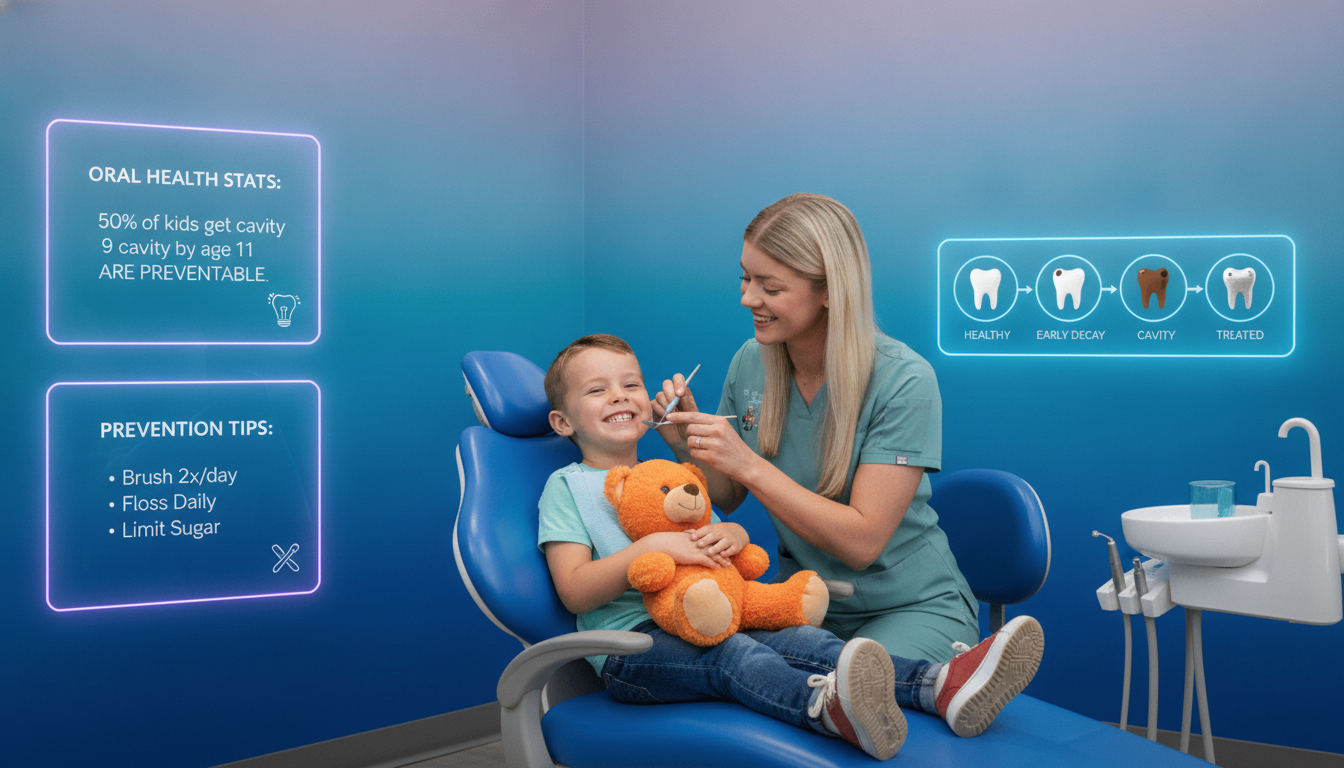
Cavities in kids are areas of permanent damage on the tooth surface caused by acid-producing bacteria, sugar, and poor oral hygiene. They affect baby teeth and permanent teeth alike. According to the CDC, tooth decay is the most common chronic childhood disease in the United States, affecting roughly 20% of children ages 5 to 11.
Key Takeaways
- Baby teeth are not disposable. Cavities in primary teeth cause pain, infection, and can affect how permanent teeth grow in.
- Decay can begin before age 1. Early childhood caries (ECC) starts the moment bacteria colonize your baby's mouth.
- Sugar isn't the only culprit. Starchy snacks, fruit juice, and even breast milk can fuel the bacteria that cause tooth decay.
- White spots are the first warning sign. Most parents miss early cavities because they don't look like holes yet.
- Untreated cavities affect sleep, eating, and school performance. Pain from tooth decay has real consequences beyond the mouth.
Has your child ever complained about a toothache, or have you spotted a dark spot on their tooth and wondered what it means? You are not alone. Millions of parents face this exact concern every year, often unsure whether what they're seeing is serious.
Tooth decay in children doesn't happen overnight. It builds quietly, often without obvious symptoms at first. By the time a child says their tooth hurts, the decay may already be well past the early stage where treatment is simplest and least invasive.
In this article, you will learn exactly what causes cavities in kids, how to recognize the warning signs early, what happens if a cavity goes untreated, and when to bring your child to a pediatric dentist. Whether your child has never had a cavity or seems to get them constantly, this guide gives you the answers you need.
What Are Cavities in Kids?
A cavity is a permanently damaged area in a tooth's hard surface, also called tooth enamel. Dentists refer to cavities as dental caries. They form when bacteria in the mouth produce acids that slowly eat through the enamel layer.
How Does Tooth Decay Develop?
Tooth decay follows a predictable process:
- Bacteria in your child's mouth feed on sugars and starches from food.
- Those bacteria produce acids as a byproduct.
- The acids attack the tooth enamel, softening it over time.
- If the damage is not reversed, the enamel breaks down and a cavity forms.
- Without treatment, decay spreads deeper into the tooth.
This process can begin within minutes of eating a sugary snack. Saliva helps wash away some of that acid, but it cannot do the job alone.
Why Are Baby Teeth More Vulnerable?
Baby teeth, or primary teeth, have thinner enamel than adult teeth. That thinner layer means acid can break through faster. Decay that might take months to progress in a permanent tooth can advance much more quickly in a baby tooth.
This is one reason pediatric dentists take cavities in young children seriously, even when parents assume baby teeth "don't matter" because they'll fall out anyway.
What Are Early Childhood Caries (ECC)?
Early childhood caries (ECC): a pattern of severe tooth decay affecting infants and toddlers, often linked to prolonged bottle feeding, breastfeeding at night, or frequent exposure to sugary drinks. ECC can affect children as young as 12 months and can destroy multiple teeth rapidly if left untreated. The American Academy of Pediatric Dentistry (AAPD) recommends a child's first dental visit by their first birthday specifically to catch ECC early.
How Common Are Cavities in Children?
What Do Childhood Cavity Statistics Show?
Tooth decay is the most common chronic disease in American children, more common than asthma. According to the Centers for Disease Control and Prevention (CDC):
- About 20% of children ages 5 to 11 have at least one untreated decayed tooth.
- Nearly 13% of adolescents ages 12 to 19 have untreated tooth decay.
- Children from lower-income families are twice as likely to have untreated cavities.
These numbers matter because untreated cavities don't heal on their own.
Which Children Face Higher Risk?
Some children are more likely to develop cavities than others. Higher-risk groups include:
- Children who consume sugary drinks or snacks frequently
- Children who don't brush twice daily with fluoride toothpaste
- Children with a history of early childhood caries
- Children whose parents have high levels of cavity-causing bacteria
- Children with reduced saliva flow or dry mouth
- Children from families with limited access to dental care
Knowing your child's risk level helps you take the right preventive steps before a cavity develops.
What Causes Cavities in Kids?
What Role Do Oral Bacteria and Dental Biofilm Play?
Your child's mouth is home to hundreds of types of bacteria. Most are harmless. However, a specific group, primarily Streptococcus mutans, feeds on sugar and produces lactic acid. This acid erodes tooth enamel.
Dental biofilm, commonly called plaque, is a sticky layer of bacteria that clings to teeth. When plaque is not removed by brushing and flossing, it hardens into tartar and creates the perfect environment for cavities to form.
How Do Sugars and Starches Cause Acid Production?
Every time your child eats a sugary or starchy food, the bacteria in their mouth begin producing acid within about 20 seconds. This acid attack lasts approximately 20 minutes after eating.
Frequent snacking means the teeth are under near-constant acid attack. It's not just candy. Crackers, chips, white bread, and even dried fruit feed those same bacteria.
What Happens With Poor Oral Hygiene Habits?
Brushing twice a day removes plaque before it hardens. Flossing clears food and bacteria from between teeth where brushes can't reach. When either step is skipped or done carelessly, bacteria accumulate and acid damage builds up steadily.
Many parents don't realize that how children brush matters as much as whether they brush. Rushing through a 15-second brush leaves large areas of enamel unprotected.
How Does Saliva Affect Cavity Risk?
Saliva is a natural defense against tooth decay. It neutralizes acids, washes away food particles, and delivers minerals that help repair early enamel damage. Children with reduced saliva production, whether from certain medications, mouth breathing, or a medical condition, face a higher risk of cavities.
Do Genetics and Enamel Quality Affect Cavities?
Yes. Some children inherit thinner or softer enamel, which is more vulnerable to acid erosion. Others may carry higher concentrations of S. mutans bacteria, passed from a caregiver through shared utensils or kissing. Genetics does not seal your child's fate, but it does make prevention even more important for some families.
What Risk Factors Increase Cavity Risk?
Does Frequent Snacking Increase Cavity Risk?
Yes, significantly. Every snack resets the 20-minute acid attack clock. A child who snacks six times a day has their teeth under acid attack for two hours or more. Consolidating meals and limiting between-meal snacks is one of the most effective cavity-reduction strategies available.
Are Sugary Drinks and Fruit Juice a Problem?
Absolutely. Juice, sports drinks, flavored milk, and sweetened water coat every tooth surface with sugar. Even 100% fruit juice contains as much sugar as soda in many cases. Sippy cups given throughout the day are especially problematic because they create prolonged sugar exposure. The AAPD recommends limiting juice to 4 oz per day for children ages 1 to 3.
What Is the Role of Fluoride in Cavity Prevention?
Fluoride is a mineral that strengthens tooth enamel and helps reverse very early-stage decay. Children who drink fluoridated tap water, use fluoride toothpaste, and receive fluoride varnish treatments at dental visits have significantly lower cavity rates. Limited fluoride exposure is one of the most modifiable risk factors in childhood tooth decay.
How Does Dry Mouth and Mouth Breathing Affect Teeth?
Children who breathe primarily through their mouths have drier oral environments. Less saliva means less acid neutralization and less natural tooth remineralization. Mouth breathing is often linked to allergies, enlarged tonsils, or structural airway issues, and can be addressed with appropriate medical care.
Can Orthodontic Appliances Increase Cavity Risk?
Braces, retainers, and other orthodontic appliances create additional surfaces where plaque collects. Children with braces need extra brushing time and may benefit from floss threaders or water flossers to clean around brackets. Without this extra effort, cavities can form rapidly beneath or around orthodontic hardware.
Why Does My Child Keep Getting Cavities?
This is one of the most common questions pediatric dentists hear. When a child gets repeated cavities despite regular brushing, one or more underlying factors is usually at work.
Are Hidden Sugar Sources the Problem?
Many "healthy" foods contain substantial hidden sugar. Granola bars, flavored yogurt, applesauce pouches, and even some crackers contain enough sugar to fuel bacterial acid production. Checking nutrition labels for total sugar content is worth the effort.
Could Incomplete Brushing and Flossing Be the Cause?
Children under age 8 generally lack the fine motor skills to brush effectively on their own. Pediatric dentists recommend that parents brush and floss for their children until around age 8, then supervise until age 10 to 12. Letting a young child brush independently often means large areas of plaque remain on the teeth.
What About High-Risk Oral Bacteria?
Some children carry higher concentrations of cavity-causing bacteria, sometimes acquired from a parent or caregiver. If bacteria levels are elevated, even good oral hygiene may not be enough on its own. A pediatric dentist can assess bacterial load and recommend targeted preventive treatments.
Can Enamel Defects and Genetics Explain Repeated Cavities?
Yes. Children born with enamel hypoplasia, a condition where enamel doesn't form completely, have weaker spots on their teeth that decay faster. These defects are sometimes visible as white or yellow patches on the tooth surface. If your child keeps getting cavities in the same areas, ask your dentist to evaluate enamel quality.
What Are the Stages of Tooth Decay in Children?
Stage 1: White Spot Lesions (Early Stage)
The first sign of tooth decay is not a hole. It's a chalky white spot on the enamel surface, sometimes visible on front teeth near the gumline. This stage represents mineral loss and is actually reversible with fluoride treatment and improved oral hygiene. Most parents and many children never notice these spots.
Stage 2: Decay Reaching the Dentin
Once acid erosion breaks through enamel, it enters the dentin layer beneath. Dentin is softer and has tiny tubes that connect to the tooth's nerve. Decay moves much faster in dentin than enamel. At this stage, your child may begin feeling sensitivity to sweet or cold foods.
Stage 3: Decay Affecting the Nerve
When decay reaches the pulp, the soft tissue at the center of the tooth containing nerves and blood vessels, it causes significant pain and inflammation. Bacteria can infect the pulp, which requires pulp therapy (similar to a root canal) or extraction.
Stage 4: Abscess and Serious Infection
A dental abscess is a pocket of pus caused by a bacterial infection at the root of the tooth. Symptoms include severe pain, swelling of the gum or face, fever, and difficulty swallowing. A dental abscess in a child is a medical emergency requiring immediate care.
How Quickly Does Decay Progress?
In baby teeth, decay can progress from a white spot to an abscess in as little as six months without treatment. In permanent teeth, the process is slower but no less serious. This speed is precisely why six-month dental checkups are essential for children.
What Are the Signs and Symptoms of Cavities in Kids?
Early cavities in kids often produce no symptoms at all. By the time symptoms appear, decay has usually progressed past the early reversible stage.
White, Brown, or Dark Spots
A white, chalky spot is in early decay. A brown or dark spot generally indicates decay that has progressed deeper. Either warrants a dental evaluation.
Sensitivity to Hot, Cold, or Sweet
When decay reaches the dentin, the tooth becomes sensitive to temperature changes and sweet foods. Your child may flinch, pull away from food, or complain that eating hurts on one side.
Toothaches and Pain
Spontaneous or persistent tooth pain, especially pain that wakes a child at night, suggests decay has reached or is approaching the nerve. This level of discomfort requires prompt dental attention.
Visible Holes or Pits
Once enamel breaks down enough, a visible hole or pit appears in the tooth surface. At this point, a filling is the minimum treatment required.
Bad Breath
Persistent bad breath in a child, even after brushing, can indicate active decay or infection. The bacteria in a cavity produce odorous compounds as they break down food and tooth structure.
Signs of Advanced Infection
Swelling of the gum, cheek, or jaw near a tooth is a serious warning sign. Fever combined with tooth pain may indicate a spreading infection. Take your child to a pediatric dentist or emergency care immediately if these signs appear.
Why Do Healthy Baby Teeth Matter?
Many parents assume cavities in baby teeth are less serious because those teeth will fall out. This is one of the most common misunderstandings in pediatric dental health.
How Do Baby Teeth Affect Speech Development?
Front baby teeth play a direct role in forming certain sounds, particularly "th," "f," and "v" sounds. Children who lose front teeth prematurely due to decay may develop speech patterns that require correction later.
How Do Primary Teeth Affect Eating and Chewing?
Baby teeth allow children to chew food properly and get adequate nutrition during critical developmental years. Pain from cavities can cause children to avoid certain foods, potentially affecting growth.
Do Baby Teeth Hold Space for Permanent Teeth?
Yes. Each baby tooth holds space in the jaw for the permanent tooth developing beneath it. When a baby tooth is lost too early, neighboring teeth drift into the gap. This can crowd or block the emerging permanent tooth, leading to orthodontic problems that require braces.
What Is the Long-Term Oral Health Connection?
Children with a history of cavities in baby teeth are significantly more likely to develop cavities in their permanent teeth. Establishing healthy habits early, and treating problems when they're small, protects your child's oral health for life. Research from the AAPD supports early preventive care as the most effective strategy for lifelong dental health.
What Happens If a Cavity Is Left Untreated?
Does Pain and Sensitivity Get Worse?
Yes. Without treatment, decay progresses from mild sensitivity to moderate pain to severe, constant toothache. Children often stop mentioning tooth pain because they adapt to it, but the underlying problem continues to worsen.
Can an Untreated Cavity Lead to Infection?
An untreated cavity can absolutely develop into a dental abscess. Oral infections in children can spread to surrounding teeth, the jawbone, and in rare cases, to the throat or brain. A 2007 case study published in medical literature documented a child's death from an untreated dental abscess. While rare, this outcome illustrates why dental infections in children are never minor.
How Can Cavities in Baby Teeth Affect Permanent Teeth?
Active infection around a baby tooth root can damage the developing permanent tooth beneath it, causing discoloration, structural defects, or eruption problems. Treating baby tooth cavities protects the permanent teeth that follow.
How Do Untreated Cavities Affect Sleep, Eating, and School?
A 2012 study published in BMC Oral Health found that children with untreated tooth pain were significantly more likely to miss school, have difficulty sleeping, and report problems eating. Tooth pain is not a minor inconvenience for a child. It affects their daily functioning in measurable ways.
How Do Dentists Diagnose Cavities in Children?
What Happens During a Pediatric Dental Exam?
A pediatric dentist visually examines every tooth surface using a dental mirror and explorer tool. They look for soft spots, discoloration, visible holes, and signs of early decay along the gumline. They also examine the gums, jaw, and bite.
What Are Digital X-Rays Used For?
Digital X-rays allow dentists to see decay between teeth and beneath existing fillings, areas impossible to detect by eye alone. Pediatric dental X-rays use very low radiation doses and are considered safe for children. The AAPD recommends X-rays every 6 to 12 months for children at high cavity risk.
How Are Early Signs of Decay Detected?
Some dental practices use additional tools such as laser cavity detection devices (like DIAGNOdent), which can identify early-stage decay before it becomes visible. These tools allow minimally invasive treatment while decay is still in its earliest stages.
How Is Cavity Severity Determined?
After examination and X-rays, the dentist classifies the cavity by how deeply it has progressed. Severity determines which treatment is appropriate, from a simple fluoride application to a crown or pulp therapy.
What Are the Treatment Options for Cavities in Kids?
Treatment depends on how far decay has progressed and which type of tooth is affected.
Fluoride Varnish
Fluoride varnish is a concentrated fluoride gel painted directly onto teeth. It is used for very early-stage decay (white spot lesions) and for preventive treatment in high-risk children. It's quick, painless, and applied at regular dental checkups.
Silver Diamine Fluoride (SDF)
Silver diamine fluoride (SDF): a liquid antibiotic compound applied to a cavity to stop decay from progressing. SDF is especially useful for young children who cannot tolerate traditional drilling, for cavities in baby teeth near natural exfoliation, or when multiple teeth need treatment simultaneously. It turns the treated area dark brown or black, which is a cosmetic consideration parents should discuss with their dentist.
Tooth-Colored Fillings
For cavities that have progressed through enamel into dentin, a composite resin filling (tooth-colored filling) is the standard treatment. The decayed material is removed, and the tooth is restored with a durable resin material that matches the tooth's natural color.
Pediatric Crowns
When decay is extensive or a tooth has been weakened significantly, a crown covers and protects the entire tooth. Stainless steel crowns are common for back teeth. Tooth-colored zirconia crowns are available for front teeth and in practices offering cosmetically focused pediatric care. You can learn more about these options at Make Your Kids Smile's restorative dentistry page.
Pulp Therapy
When decay reaches the nerve of a baby tooth, a pediatric dentist may perform pulp therapy, which involves removing the infected nerve tissue and sealing the tooth to prevent further infection. This preserves the tooth until it naturally falls out, maintaining the space for the permanent tooth.
Extraction When Necessary
If a tooth is too severely damaged to restore, extraction may be necessary. In these cases, a space maintainer is often placed to hold the gap open for the incoming permanent tooth.
When Should Parents Contact a Pediatric Dentist?
What Signs Suggest a Cavity Is Worsening?
Contact your pediatric dentist when you notice:
- A new white, brown, or dark spot on any tooth
- Your child avoiding food on one side of their mouth
- Complaints of tooth sensitivity or pain when eating
- Visible holes, pits, or rough edges on a tooth
- Persistent bad breath that doesn't resolve with brushing
Which Symptoms Need Prompt Care?
Call your dentist the same day if your child experiences:
- Spontaneous or constant toothache
- Pain that wakes them at night
- Swelling near a tooth or along the gumline
- A bump or pimple on the gum near a tooth
What Counts as a Dental Emergency?
Seek immediate care if your child has:
- Swelling of the cheek, jaw, or eye area related to a tooth
- Fever combined with tooth pain
- Difficulty breathing or swallowing
- Significant facial swelling
These symptoms can indicate a spreading infection requiring urgent medical and dental treatment.
Pediatric Cavity Care in Lafayette, LA
What Preventive Care Is Available for Lafayette Families?
Families in Lafayette have access to a full range of preventive and restorative pediatric dental services at Make Your Kids Smile. Preventive care includes professional cleanings, fluoride varnish treatments, dental sealants for back teeth, and dietary counseling tailored to your child's specific risk profile.
How Does Early Detection Lead to Minimally Invasive Treatment?
Catching cavities in kids at the white spot stage means treatment may require no drilling at all, only fluoride application and habit changes. Each stage of progression requires more invasive and more expensive treatment. The gap between a fluoride treatment and a crown is significant in terms of time, cost, and your child's comfort.
Early detection is the single most effective strategy for keeping treatment simple.
When Should You Schedule a Visit?
If your child is under 1 and hasn't had their first dental visit, schedule one now. For children already in care, don't skip the six-month checkup even when everything looks fine. And if you've noticed any of the symptoms described in this article, don't wait for the next routine visit. Call to schedule a same-week appointment.
Conclusion
Cavities in kids are common, preventable, and treatable, but only when caught early. Understanding what causes tooth decay, recognizing the warning signs, and knowing when to act makes a real difference in your child's health and comfort. The best time to address a cavity is before it causes pain.
Baby teeth are not temporary problems. They shape speech, nutrition, jaw development, and the foundation for healthy permanent teeth. A cavity in a 2-year-old deserves the same attention as one in a 10-year-old. Treating decay early protects your child from pain, infection, and complex treatment down the road.
At Make Your Kids Smile, we work with Lafayette families to catch cavities early, treat them gently, and give your child the preventive tools to keep their smile healthy for life. If you've noticed any signs of tooth decay or simply want peace of mind, we encourage you to schedule your child's next pediatric dental exam with us today.
Frequently Asked Questions
Can cavities in baby teeth heal on their own?
Early-stage decay, specifically white spot lesions, can be reversed with fluoride treatment and better oral hygiene before a cavity fully forms. However, once decay breaks through the enamel layer, it cannot heal on its own and requires professional dental treatment to stop its progression.
At what age do kids usually get their first cavity?
Cavities can begin as early as 12 months once teeth emerge and bacteria colonize the mouth. The most common peak period for early childhood cavities is between ages 2 and 5. However, children of any age can develop decay. Annual dental visits starting at age 1 help catch early problems.
Is it safe to leave a cavity in a baby tooth if it's going to fall out soon?
Not always. Even in a tooth close to natural loss, untreated decay can progress to infection, cause significant pain, or damage the developing permanent tooth beneath it. A pediatric dentist can assess whether treatment or monitoring is appropriate for your child's specific situation.
How can I tell if my child has a cavity without a dental X-ray?
You may notice white, brown, or dark spots on the tooth surface, visible holes or pitting, sensitivity to sweet or cold foods, or persistent bad breath. However, many cavities between teeth or beneath the gumline are invisible without X-rays. Regular dental exams are the only reliable way to detect all cavities.
Does sugar-free juice still cause cavities?
Sugar-free juice is less problematic for cavity bacteria but can still contribute to enamel erosion due to its acidity. Any acidic liquid consumed frequently weakens enamel over time. Water remains the best drink for children's teeth between meals.
How often should my child visit the dentist for cavity prevention?
Most children benefit from dental checkups every six months. Children with higher cavity risk may need visits every three to four months. Your pediatric dentist will recommend a schedule based on your child's specific risk factors, dental history, and oral hygiene habits.
.jpg)