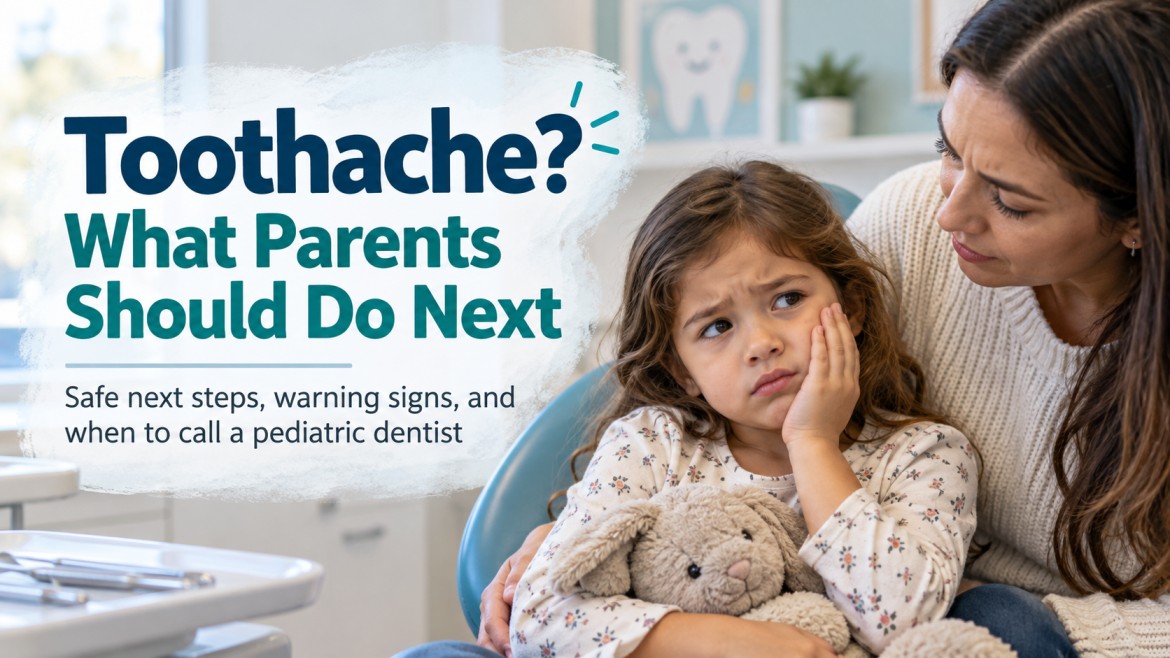
A child toothache almost always needs a dentist, even when the pain fades on its own. Call the office today if there is swelling, a fever, or pain that wakes your child at night. Go to the emergency room if swelling is spreading toward the eye or neck, or your child has trouble breathing or swallowing.
Key takeaways
- Spreading swelling or trouble breathing is an ER visit, not a dental visit.
- Night pain, or pain that medicine barely touches, needs a same-day call.
- Pain that stops suddenly still needs an exam.
- Never give a child aspirin, and never restart leftover antibiotics.
Is Your Child's Toothache an Emergency?
Most toothaches are not emergencies. A few are. Find the line below that matches what you are seeing.
Not sure how urgent it is? Call Dr. Leslie Jacobs Pediatric Dentistry at (337) 500-1500. The office is available 24/7 for dental emergencies.
When to Go to the ER
A dental infection can spread past the tooth into the tissue around it, and in a child, that can happen quickly. Go to the nearest emergency room for swelling that is spreading across the face or down the neck, swelling closing an eye, trouble breathing or swallowing, new drooling, a child who cannot open their mouth, or a high fever with unusual drowsiness. This is not common. But these signs need a hospital, not a wait-and-see night.
When to Call a Dentist Today
Call the same day for a fever with tooth pain, any swelling of the face or gum, a bump or pimple on the gum, pain that wakes your child from sleep, pain that medicine barely touches, or tooth pain after a knock to the mouth.
Call about a gum bump even if your child says it does not hurt. A bump often means an infection has found a way to drain. The pressure eases, but the cause is still there. Our guide to a swollen face from a tooth infection covers that situation in more detail.
When Mild Pain Can Wait
Pain that comes only with something cold, sweet, or chewy, and settles within a minute, can usually wait a few days. Your child should still be eating, sleeping, and acting like themselves. It does still need an appointment. That kind of sensitivity often means decay has reached the softer layer under the enamel, and it will not reverse on its own.
How to Relieve Your Child's Toothache at Home
Nothing you do at home fixes the cause. The goal tonight is comfort, so your child can eat, settle, and sleep.
Rinse and Check for Food
Have your child rinse with warm water. Then floss gently on both sides of the sore tooth. Food wedged between two teeth causes a surprising number of sudden toothaches in children. Floss straight down and straight out, and do not saw at the gum.
If the pain goes away and stays gone, trapped food was probably the whole story. Look with a flashlight anyway. A hole, a dark spot, a chipped edge, or a puffy gum is worth describing when you call.
Cold Compress
Hold a cold pack wrapped in a thin towel against the outside of the cheek, ten to fifteen minutes at a time. Never put ice straight on the skin or inside the mouth. Skip heat. A warm compress on a swollen face can help an infection spread.
Safe Pain Relief
Children's acetaminophen (Tylenol) or ibuprofen (Motrin, Advil) is the usual choice for child tooth pain relief. Ibuprofen also calms inflammation, which often helps. It is not given to babies under six months without a doctor's advice.
Dose by your child's current weight. Use the label on the bottle in your hand, and the syringe or cup that came with it. Do not dose from memory, by age alone, or with a kitchen spoon. Strengths differ between products, and that is where most home dosing mistakes start. Call us, your pediatrician, or your pharmacist if you are unsure.
Never give a child or teenager aspirin, and never hold a tablet against the sore tooth.
Foods to Eat and Avoid
Soft, room-temperature foods ask the least of a sore tooth. Try yogurt, scrambled eggs, mashed potato, or a smoothie from a spoon rather than a straw. Have your child chew on the other side.
Avoid anything very cold or hot, sweet, fizzy, citrus, hard, crunchy, or sticky. Keep fluids going even if eating has stopped.
Toothache at Night
A child's toothache at night really is worse. Lying flat raises pressure in the head, and an inflamed nerve feels it. There is also nothing left to distract your child from the ache.
For a child over one, an extra pillow under the head can help. For a baby under one, the crib stays flat. No pillows, no wedges, and nothing propped under the mattress — AAP safe-sleep guidance calls for a firm, flat surface, and inclined sleep products are not safe. Comfort your baby upright in your arms while they are awake, then lay them down flat on their back.
Time a dose of pain relief so it is working as your child settles, within what the label allows. Keep the room quiet and dim.
If pain still wakes your child, stop managing it at home. That usually means the problem has reached the nerve. Call (337) 500-1500 and ask for a same-day appointment.
What Not to Do for a Child's Toothache
Some of the remedies passed between parents are unsafe for children. These are the ones to skip.
- No aspirin. Aspirin and other salicylates are not given to children or teens because of their link to Reye syndrome, a rare but serious illness. Check ingredient lists, since some combination products contain salicylates.
- Nothing held against the gum. A tablet pressed on the tooth burns the soft tissue and leaves an ulcer. Pain medicine only works when it is swallowed.
- No benzocaine gels for young children. The FDA says over-the-counter benzocaine products, such as Orajel and Anbesol, should not be used in children under two. They are linked to methemoglobinemia, a rare condition that cuts the oxygen carried in the blood. For age two and up, the FDA advises using them sparingly.
- No clove oil, whiskey, or salt packs. Clove oil can burn a child's gum and tongue. Alcohol has no place in a child's mouth. None of these reach the pain, which sits inside the tooth.
- No leftover antibiotics. The wrong drug or a partial dose can quiet symptoms while the problem carries on. Antibiotics also do not treat the cause, and a dentist decides whether one has any role.
- Don't wait out pain that stopped. Severe pain that fades on its own can mean the nerve inside the tooth is no longer healthy. Keep the appointment and let an exam settle it.
What Causes Toothaches in Children?
How the pain behaves is the most useful thing you can tell us, and often more telling than anything you can see. None of this is a diagnosis. Only an exam can give you that.
Most childhood toothaches come down to a few causes. Decay is the common one, and it causes no pain until it is deep. When decay or an injury reaches the nerve inside a tooth, pain often turns constant and throbbing, and infection can follow. A knock to the mouth can injure a nerve even when the tooth looks fine, sometimes weeks later. Gum causes are simpler: food packed between teeth, or a sore gum where a molar is pushing through.
Children often point to the wrong tooth. Pain travels along shared nerve pathways, so an upper molar can be felt in the lower jaw or near the ear. Tell us the side and the rough area, and let the exam narrow it down.
Not all tooth pain is dental, either. Sinus congestion presses on the roots of the upper back teeth and gives a dull ache across several at once, usually alongside a cold. Ear infections and mouth ulcers get reported as toothache too. If several upper teeth ache together and your child has cold symptoms, start with your pediatrician.
Toothache in Babies and Toddlers
Signs of Dental Pain
Very young children show pain through behavior. Watch for refusing to chew on one side, turning down cold drinks or favorite foods, pulling at one cheek or ear, waking repeatedly after sleeping well, new drooling, or a mood change with no other explanation. One sign alone may mean little. Several together, on the same side, over a day or two is worth a call.
Teething vs. Toothache
Teething is mild, spread across the gums, and tied to a tooth you can see or feel arriving. It does not cause severe pain in one spot, facial swelling, or a high fever. It also does not explain pain in a toddler whose teeth came through months ago. Decay happens in baby teeth, and their enamel is thinner, so it can reach the nerve faster than in an adult tooth.
Call the same day for facial swelling, a fever with mouth pain, a child refusing to eat or drink, a gum bump, a dark tooth, or pain that keeps waking them. Age is not a reason to wait. Infants and toddlers are seen regularly in pediatric dental offices.
What Happens at a Pediatric Toothache Appointment?
What to Tell the Dentist
Have this ready when you call: when the pain started, and whether it is constant or comes and goes; which side, and whether your child can point to a tooth; what sets it off; whether there is swelling, fever, or a gum bump; what pain relief you gave and when; and any recent knock to the mouth. Mention medical conditions, allergies, and regular medication.
How Dentists Find and Treat Tooth Pain
The visit starts with your account and a look at the teeth, gums, and soft tissue. Gentle checks show how specific teeth react to pressure, cold, or tapping. An X-ray is often needed, because decay between teeth and infection at a root do not show from the surface. Whether images are taken depends on your child's symptoms, age, and what the exam finds.
Treatment depends on what is found, and on whether the tooth is a baby tooth or a permanent one. Trapped food may need nothing more than cleaning the area. Decay that has not reached the nerve is usually handled with a filling or a crown, both part of restorative dentistry. When the nerve is involved, treating the pulp inside the tooth or removing it may be the options, and our guide to pulp therapy versus extraction compares them. An antibiotic is sometimes part of managing a spreading infection, but it is not a treatment on its own.
Emergency care often handles the pain first, with the rest of the plan at a follow-up visit. Don't skip that visit. It is where the question of why this tooth gets answered.
How to Prevent Future Toothaches
Most toothaches are decay that was found late, and decay stays quiet until it is deep. That is why regular checkups matter more than any home routine.
A few habits help most. Floss between the back teeth, where decay usually starts and a brush cannot reach. Brush with a fluoride toothpaste in an amount suited to your child's age, with an adult finishing the job until around school age. Limit how often sugar reaches the teeth, which matters more than the total amount. Ask whether fluoride treatments or sealants are a fit for your child.
Cavities are not a verdict on anyone's parenting. Diet, saliva, the shape of a tooth, past decay, and genetics all play a part.
Child Toothache FAQs
My child's toothache stopped. Do we still need to come in?
Yes. If it was brief and clearly trapped food that you flossed out, a regular appointment is fine. If real pain faded on its own, be seen promptly. An exam is the only way to know whether the tooth is still healthy inside.
Should my child go to school with a toothache?
If pain relief holds them comfortably and they are eating and drinking, school is usually fine while you wait for the appointment. Keep them home and call us if there is a fever or swelling, if pain breaks through the medicine, or if they are not eating. Tell the school office what you gave and when.
Can teething really cause this much pain?
Teething is usually mild and comes with a tooth you can see or feel arriving. It does not cause severe pain in one spot, facial swelling, or a high fever. If your baby's distress goes beyond that, have them looked at rather than assuming.
Can I give ibuprofen and acetaminophen together?
Sometimes a dentist or pediatrician advises combining or alternating them for short-term pain. Major pediatric guidelines do not agree on the practice, largely because two medicines on two schedules is where dosing mistakes happen. Don't improvise it at home. Call and ask what suits your child, then write down each dose and the time you gave it.
My child says it hurts but I can't see anything. Is that possible?
Very. Decay often starts between the back teeth, where nothing shows from the outside. A crack or an injured nerve can be invisible too, and pain refers across the jaw. Believe your child, and let an exam and an image find what a flashlight cannot.
Get Help for Your Child's Toothache in Lafayette, LA
If your child is in pain, call Dr. Leslie Jacobs Pediatric Dentistry at (337) 500-1500. Dr. Jacobs is a board-certified pediatric dentist, and the office is available 24/7 for dental emergencies.
You will find us at 113 Rue Fontaine, Lafayette, LA 70508, open Monday through Friday, 8 a.m. to 5 p.m. We care for families across Lafayette Parish and Acadiana, including Youngsville and Broussard. You can also request an appointment online.
When you call, tell us what you are seeing and when it started. Swelling, a fever, or pain keeping your child awake moves the appointment up.
If swelling is spreading toward the eye or neck, or your child has trouble breathing or swallowing, go to the nearest emergency room first.