.png)
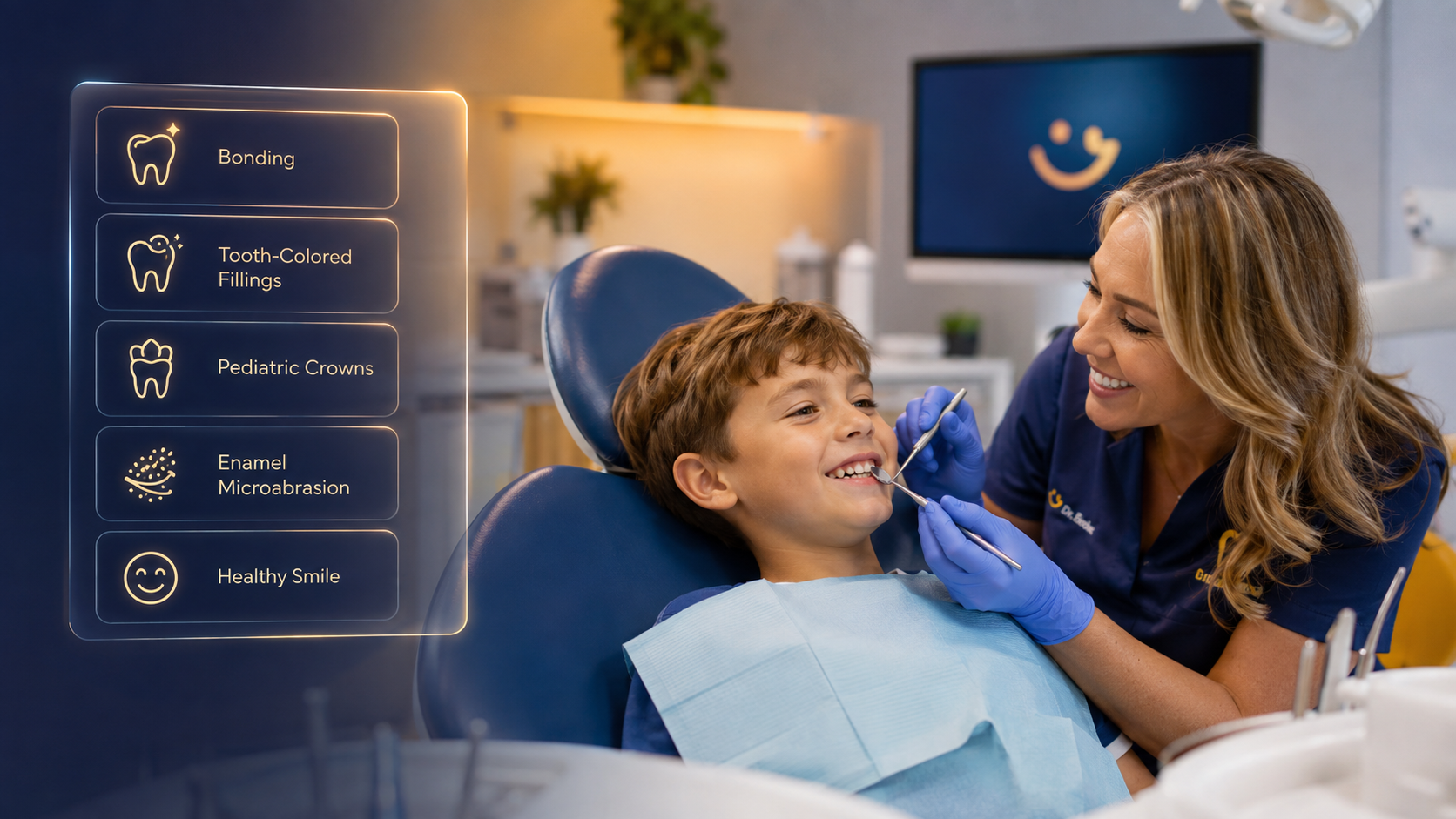
Cosmetic dentistry for kids covers treatments that improve how a child's teeth look, and most of that work repairs or protects the tooth at the same time. Common options include tooth-colored fillings, dental bonding, pediatric crowns, and enamel microabrasion. The right choice depends on your child's age, stage of dental development, and what caused the problem. Whitening is generally not recommended for young children, and any color change or damage should be examined before it is treated.
Key Takeaways
- Most pediatric cosmetic treatment is restorative first. A chipped, spotted, or dark tooth needs a diagnosis before anyone picks an esthetic fix.
- Age and dental development drive the plan. What suits a teenager with permanent teeth is often wrong for a five-year-old with baby teeth.
- The American Academy of Pediatric Dentistry discourages full-arch cosmetic whitening for children who still have baby teeth or a mix of baby and adult teeth.
- A tooth that turns gray after an injury needs an exam, not just a cosmetic touch-up. Color change can mean the nerve inside was damaged.
- Bonding and tooth-colored fillings on growing teeth are repairable and replaceable, so plan on touch-ups as your child grows.
A front tooth chips on the playground. A brown patch shows up on a brand-new adult molar. A baby tooth slowly turns gray weeks after a fall in the living room. Any of these can send a parent searching, and the questions are usually the same. Is this fixable, is it safe, and does it even need fixing right now?
This guide walks through what pediatric cosmetic dentistry actually involves, which treatments fit which problems, how age changes the answer, and what it may cost. It also flags the situations where an appearance concern is really a health concern in disguise.
What Is Cosmetic Dentistry for Kids?
Pediatric cosmetic dentistry improves the color, shape, size, or spacing of a child's teeth. In children, it rarely stands on its own. A chipped tooth needs the exposed surface sealed as well as reshaped, and a decayed front tooth needs the decay removed before anything can look better. That is why cosmetic dentistry for children usually gets planned alongside preventive and restorative care rather than separately from it.
Cosmetic vs. Restorative Dentistry for Children
Restorative dentistry repairs damage and disease so the tooth works properly again. Cosmetic dentistry focuses on appearance. In kids, the two overlap constantly. A tooth-colored filling in a front baby tooth repairs a cavity and restores the look of the tooth in the same appointment.
Purely cosmetic work, meaning treatment done only for looks, is a small slice of pediatric care. Most of what parents call cosmetic dentistry is restorative treatment done with materials that happen to match natural tooth color.
How Pediatric Cosmetic Dentistry Differs From Adult Treatment
Three things change the approach with children. First, the teeth themselves are different. Baby teeth have thinner enamel and relatively large nerve chambers, and newly erupted adult teeth are still maturing.
Second, the mouth keeps changing. Baby teeth fall out, jaws grow, and gum levels shift, so a result that looks ideal at age eight may not hold at fourteen. Third, treatment has to fit the child in the chair. Keeping a tooth dry long enough to bond material to it is harder with a wiggly four-year-old, and the American Academy of Pediatric Dentistry notes that material choice may change when moisture control is difficult.
When a Cosmetic Concern Signals an Underlying Problem
Some appearance changes are early warnings. Ask for an exam rather than a cosmetic quote when you notice any of these:
- Chalky white patches along the gumline, which can be early decay rather than a harmless mark.
- A tooth turning gray, brown, or black after an injury, which can mean the nerve inside is struggling.
- Yellow or brown patches with rough or crumbly edges on new adult molars, which can point to an enamel defect that raises cavity and sensitivity risk.
- A pimple-like bump on the gum near a discolored tooth, which needs prompt attention.
So the first step is a diagnosis, not a treatment menu. Once the cause is clear, the cosmetic options usually narrow to one or two sensible choices.
Is Cosmetic Dentistry Safe for Children?
The cosmetic procedures used most often in children are considered safe when the material, the technique, and the timing match the child's age and the tooth involved. Safety problems tend to come from treating the wrong tooth at the wrong stage, not from the procedures themselves. That is also why no responsible practice can promise a specific result before an exam.
Age-Appropriate Materials and Techniques
Pediatric dentists work with a defined set of materials. Composite resin is the tooth-colored material used for fillings and bonding. Glass ionomer and resin-modified glass ionomer release fluoride and tolerate moisture better, which helps with young or anxious patients. For teeth that need full coverage, options include composite strip crowns, pre-veneered stainless steel crowns, zirconia crowns, and plain stainless steel crowns on back teeth. The AAPD summarizes the evidence behind each of these materials for primary and young permanent teeth.
How Pediatric Dentists Protect Developing Teeth
The guiding idea is to remove as little tooth structure as possible and to keep the nerve healthy. Bonding adds material to a tooth instead of cutting it down. Microabrasion works on a very thin outer layer of enamel. Treatments that require permanent enamel removal, such as veneers, are usually postponed until growth and eruption settle down.
Risks and Limitations Parents Should Know
Every option has trade-offs, and knowing them up front prevents disappointment later.
- Bonding and composite can chip, stain at the edges, or wear over time.
- Crowns can loosen, and veneered facings on crowns can fracture or come off.
- Microabrasion removes a thin layer of enamel and cannot correct deep defects.
- Whitening can cause tooth sensitivity and gum irritation, and it does not change the color of existing fillings or crowns.
- Numbing can work less predictably on molars affected by enamel hypomineralization, which is worth discussing before treatment.
Is Your Child a Good Candidate?
Candidacy comes down to three questions. Where is your child in dental development, is the tooth healthy enough to treat, and can your child manage the appointment comfortably? A pediatric dentist weighs all three together.
Stage of Dental Development
Children move through three broad stages: all baby teeth, a mix of baby and adult teeth, and a full set of adult teeth. Timing varies widely from child to child, so the stage matters more than the birthday. During the mixed stage, baby teeth and adult teeth naturally differ in shade because their enamel differs in thickness. Treating one tooth to match the rest can be tricky while the mouth is still in transition.
Your Child's Comfort and Readiness
Some five-year-olds sit calmly through a bonding appointment. Some ten-year-olds need a slower introduction. Pediatric dentists use age-appropriate explanations, showing instruments before using them, and steady encouragement to build cooperation. When more support is needed, Dr. Leslie Jacobs Pediatric Dentistry offers nitrous oxide and oral sedation, and suitability for either depends on your child's health history, age, treatment needs, and the dentist's assessment.
When Treatment Should Be Delayed
Waiting is sometimes the better clinical choice. Cosmetic work is commonly postponed when:
- Active decay or inflamed gums need attention first.
- A recently injured tooth is still being monitored for changes.
- An adult tooth is only partly erupted and the gum line will keep shifting.
- A baby tooth is close to falling out on its own.
- The child is not on board with the treatment.
Common Cosmetic Dental Treatments for Kids
Here are the treatments parents ask about most, what each one solves, and where it fits by age.
Tooth-Colored Fillings
Tooth-colored fillings repair cavities using composite resin or glass ionomer instead of metal. They work in baby and adult teeth, and they are the usual choice for front teeth where appearance matters. The tooth is cleaned of decay, the material is placed in layers, and a curing light hardens it. Most single fillings finish in one visit.
Dental Bonding
Bonding is the most common cosmetic fix for a chipped front tooth in children. The dentist shapes composite resin onto the tooth, sculpts it to match the neighboring teeth, then hardens and polishes it. Nothing healthy is drilled away in a simple repair, and small chips are sometimes bonded without numbing. Bonding also closes small gaps and reshapes teeth that came in slightly irregular.
Pediatric Crowns
Crowns cover the whole tooth when too much structure is damaged for a filling to hold. For front baby teeth, options include composite strip crowns, pre-veneered stainless steel crowns, and zirconia crowns, all of which are tooth-colored. For back teeth, stainless steel crowns are frequently used because they hold up well under chewing, though they are silver in color. Crowns are also standard after nerve treatment, since a treated tooth becomes more fragile.
Enamel Microabrasion
Microabrasion gently polishes away a very thin layer of stained enamel using a mild acid and a fine abrasive paste. It suits surface-level white or brown marks, including some cases of fluorosis. A related technique, resin infiltration, seeps a thin resin into porous enamel so the spot blends with the surrounding tooth. Both are conservative options that avoid drilling, and neither one works on every spot.
Interceptive Orthodontics
Interceptive orthodontics uses appliances during growth to guide teeth and jaws, often before all adult teeth arrive. It can address crowding, crossbites, or space problems that would be harder to correct later. Many dentists suggest an orthodontic assessment around age seven, when enough adult teeth are in to see the pattern developing. Dr. Leslie Jacobs Pediatric Dentistry provides interceptive orthodontic appliances as part of its pediatric services.
Veneers: When They Are Appropriate
Veneers are thin shells bonded over the front of a tooth. They are rarely used in growing children because the gum line and bite are still changing, and because most veneer designs involve permanent enamel reduction. Bonding usually achieves a similar look on a young tooth while keeping options open. For older teens with a stable bite, a veneer may be reasonable after a full discussion of the trade-offs.
Teeth Whitening: Why It Is Usually Not Recommended for Kids
The American Academy of Pediatric Dentistry discourages full-arch cosmetic bleaching for children with baby teeth or a mix of baby and adult teeth. Its policy points out that shade differences are normal during the mixed stage, so whitening everything at that point can leave a mismatched result once the remaining adult teeth come in. Research on whitening in children is also limited compared with adults, and sensitivity and gum irritation are the side effects reported most often.
For adolescents with a full set of adult teeth, whitening can be considered as part of a planned treatment sequence under a dentist's guidance. Whitening also does not lighten fillings, bonding, or crowns, which is worth knowing before starting. Dr. Leslie Jacobs Pediatric Dentistry does list teeth whitening among its services, and whether it fits your child depends on an exam.
Which Treatment Fits Which Concern
This table shows what pediatric dentists commonly consider for each concern. It is a starting point for your conversation, not a diagnosis. The actual recommendation depends on the tooth, the cause, and your child's stage of development.
Tooth Discoloration in Children
Discoloration is the number one reason parents look into cosmetic care for a child. The treatment depends completely on the cause, so identifying the source comes first.
White Spots, Enamel Defects, and Fluorosis
White spots have several possible causes. Early decay shows as chalky patches, often near the gumline where plaque sits. Fluorosis, which follows higher fluoride intake while adult teeth are forming, tends to appear as faint symmetrical lines or cloudy areas without sharp borders. Enamel hypomineralization, including the pattern known as molar-incisor hypomineralization, produces well-defined creamy, yellow, or brown patches, and the AAPD notes those teeth can break down after eruption and may be sensitive.
These look similar to a worried parent and different to a trained eye. Only an exam distinguishes them reliably, and the difference changes both the urgency and the treatment.
Discoloration After Dental Trauma
A tooth that darkens after a bump or fall is reacting to the injury, and it needs a dental evaluation. Color change often appears days to weeks later and ranges from yellow to dark gray. Sometimes the tooth recovers and lightens. Sometimes the nerve tissue dies, and the color stays. The American Academy of Pediatrics advises seeing a dentist within a few days if discoloration or a gum boil develops after a dental injury.
Many gray baby teeth are simply monitored at checkups. Others need treatment if there are signs of infection. That call requires an exam and usually an X-ray, so it cannot be made from a photo.
Discoloration Caused by Decay
Decay can look white, brown, or black, and the shade says little about how deep it goes. A small brown pit in a groove can be shallow, while a dull white line near the gum can be an active problem. Cosmetic treatment over untreated decay does not solve anything, since the decay continues underneath.
When Discoloration Needs a Dental Evaluation
Book an exam promptly when the discoloration is new, is limited to one tooth, follows an injury, or comes with pain, swelling, or a bump on the gum. Swelling of the face or gum, or a fever alongside dental pain, should be treated as urgent. Dr. Leslie Jacobs Pediatric Dentistry lists 24/7 availability for dental emergencies for situations like these.
Cosmetic Treatment for Baby Teeth
Baby teeth are worth treating even though they eventually fall out. They handle chewing, hold space for the adult teeth forming underneath, and support speech. A damaged baby tooth is judged on whether it can still do those jobs, not only on how it looks.
When a Damaged Baby Tooth Should Be Treated
Treatment is generally recommended when a baby tooth has decay, a fracture that exposes inner layers, sharp edges that irritate the tongue or lip, pain or sensitivity, or damage extensive enough to threaten the tooth. A small chip on a tooth that is already loose may simply be smoothed and watched. The timing of the natural loss of that tooth is a real factor in the decision.
How It Protects Function and Spacing
Baby molars keep the gap open for the adult teeth beneath them. Losing one early can allow neighboring teeth to drift, which sometimes leads to crowding and a space maintainer later. Restoring a damaged tooth is often the simpler path. Front baby teeth matter less for spacing, so decisions there weigh comfort, chewing, and your child's own feelings about the tooth.
Effect on Developing Permanent Teeth
Adult teeth develop directly above the roots of the baby teeth, so untreated infection in a baby tooth can affect the tooth forming underneath. Significant injuries to baby front teeth are also linked with enamel changes in the adult tooth that follows. This is why dentists monitor an injured baby tooth until its replacement arrives, and it is a strong reason not to ignore a dark or abscessed baby tooth.
What to Expect at a Pediatric Cosmetic Dentistry Appointment
The first visit is about answering the question, not starting treatment. Expect a conversation, an exam, and a plan you can think over.
Exam and Diagnosis
The dentist reviews your child's dental and medical history, then examines the tooth and the surrounding gum. X-rays may be taken if they would change the diagnosis, for example, to check the nerve area of a tooth after an injury. Imaging decisions depend on symptoms, history, and clinical findings rather than a fixed schedule. Photos are sometimes taken so changes can be tracked at later visits.
Treatment Options and Planning
You should leave with a clear picture of what is going on, which options are reasonable, what each involves, and what monitoring instead of treating would look like. Ask how long each option is expected to last and what happens if it fails. Bring up any behavior or anxiety concerns here, since comfort planning is part of the treatment plan.
Procedure and Follow-Up Care
Many cosmetic procedures for kids are finished in a single visit. Bonding and tooth-colored fillings are usually straightforward, and numbing may or may not be needed depending on the tooth and the work involved. Crowns take a bit longer. Afterward, expect ordinary care instructions, a few days of caution with hard foods, and a checkup to confirm everything is holding well.
How Long Does Cosmetic Dental Work Last in Children?
Restorations in children have a finite lifespan, and that is expected rather than a sign something went wrong. Growth, chewing forces, cavity risk, and habits all affect how long the work holds. No dentist can promise a specific number of years for an individual child.
Bonding and Tooth-Colored Fillings
These generally last several years when they are cared for well, and they can be repaired or refreshed without starting over. Edges can stain, and small chips can appear, especially on front teeth used for biting into hard food. Grinding, nail biting, and chewing on ice shorten the lifespan noticeably.
Crowns and Other Restorations
Full-coverage crowns are the most durable option for a badly damaged tooth, which is why they are chosen when a filling is unlikely to hold. On baby teeth, a crown is usually expected to last until the tooth falls out naturally. Tooth-colored facings on crowns can chip, and the underlying crown often keeps working even when a facing is damaged.
Why Treatment May Need Replacing as Kids Grow
Adult teeth continue to change position for years after they erupt, and gum levels shift as the jaw grows. A bonded edge that matched perfectly at nine can look slightly off at fourteen. Replacing or adjusting work at that point is normal, and it is one reason conservative treatment is preferred while a child is still growing.
How Much Does Cosmetic Dentistry for Kids Cost?
Cost varies too much for a website figure to be useful. What helps is knowing which factors move the price and how coverage tends to work, so you can ask precise questions when you call.
Factors That Affect Cost
- Which procedure is needed, since bonding a small chip and placing a crown are very different jobs.
- How many teeth are involved.
- Which material is chosen, for example, a zirconia crown versus a stainless steel crown.
- Whether X-rays or additional diagnostics are needed.
- Whether nitrous oxide or sedation is part of the plan.
- How many visits the treatment takes.
Ask for a written treatment estimate before you commit. A good estimate lists each procedure separately so you can see what is driving the total.
Cosmetic vs. Medically Necessary Treatment
This distinction matters more than most parents expect. Treatment that repairs decay, protects a damaged tooth, or restores function is usually classed as necessary care. Treatment done only to improve appearance on an otherwise healthy tooth is usually classed as elective. The same procedure can fall on either side depending on why it is being done, so ask the office how your child's specific treatment will be coded.
Dental Insurance Coverage
Coverage depends entirely on your plan, so no practice can tell you what your benefits will pay before checking. In general terms, plans are more likely to contribute toward restorative treatment than toward purely elective cosmetic work, and details like annual maximums and waiting periods vary. Bring your plan information to the appointment and ask the front desk to verify benefits for the exact procedures proposed.
Caring for Your Child's Cosmetic Dental Work
Cosmetic dental work needs the same care as natural teeth, plus a little extra attention at the edges where the material meets the tooth. Decay can still start next to a filling or under a crown.
Brushing and Flossing
Brush twice a day with fluoride toothpaste, using an amount appropriate for your child's age, and floss where teeth touch. Younger children need an adult to brush for them or to go over the job afterward. Pay attention to the gumline around bonded areas and crowns, since plaque there is what undermines the restoration.
Foods and Habits to Avoid
Ice, hard candy, popcorn kernels, and pen chewing are the usual culprits behind broken bonding. Sticky candy can pull at crown facings. Using front teeth to open packaging is worth breaking as a habit for any child with bonded front teeth. Frequent sipping of sweet or acidic drinks raises cavity risk around restorations too.
Mouthguards for Sports and Bruxism
A mouthguard is the single most useful protection for a child with bonded or crowned front teeth who plays contact sports. A custom-fitted guard from the dental office fits better than a boil-and-bite version, which usually means kids actually wear it. If your child grinds at night, mention it at the next visit so the wear pattern can be checked and a night guard considered if appropriate.
Regular Dental Visits
Routine checkups catch a chipped edge or a leaking margin while the repair is still small. They also let the dentist monitor teeth that were injured or that show enamel defects. For children with cosmetic work in place, these visits are the difference between a quick polish and a full replacement later.
Choosing a Pediatric Cosmetic Dentist in Lafayette, LA
Cosmetic work on a growing child is a judgment call as much as a technical one. The dentist has to weigh what the tooth needs now against what the mouth will look like in five years.
Qualifications and Experience With Developing Teeth
Pediatric dentistry is a recognized dental specialty with additional training after dental school, focused on children, adolescents, and patients with special health care needs. That training covers growth and development, behavior guidance, and treatment of both baby and adult teeth. Dr. Leslie Jacobs is a board-certified pediatric dentist practicing in Lafayette, and the practice treats children from infancy through the teen years.
Child-Friendly, Comfortable Care
Look for a practice that explains procedures to your child in words they understand and gives them a chance to get comfortable before treatment starts. Ask what comfort options are available, including nitrous oxide and oral sedation, and how the team decides when either is appropriate. A practice built around children handles a nervous first-timer differently from a general office.
When to Schedule an Evaluation
Schedule an evaluation when you notice a chip, a color change, an unusual mark on a tooth, or damage after a fall. Sooner is better when an injury is involved, because early findings shape the options. The office at 113 Rue Fontaine, Lafayette, LA 70508 sees patients Monday through Friday from 8 am to 5 pm, and the practice lists 24/7 availability for dental emergencies. Families across Lafayette, Youngsville, Broussard, and the wider Acadiana area are welcome.
Questions to Ask Before Treatment
- What is causing this, and how do you know?
- What happens if we monitor it instead of treating it now?
- Which options fit my child's age and stage of development?
- How long is this expected to last, and what does a repair involve?
- Will my child need numbing, nitrous oxide, or sedation?
- How many visits will this take, and what is the estimated cost of each?
Frequently Asked Questions
At what age can a child have cosmetic dental treatment?
There is no fixed starting age. Treatments like tooth-colored fillings, bonding, and crowns are used on baby teeth in preschool-age children when the tooth needs repair. Elective treatments that change healthy teeth are usually delayed until adult teeth are fully in. The deciding factors are the tooth, the reason for treatment, and your child's readiness.
Does dental bonding hurt?
Simple bonding on a chipped tooth is usually comfortable, and small repairs are sometimes done without numbing because no drilling is required. If decay has to be removed or the chip is deep, local anesthetic is typically used. Tell the dentist beforehand if your child is anxious, since the plan can be adjusted.
Will my child need sedation or numbing?
Many cosmetic procedures need neither, and some need local anesthetic only. Nitrous oxide or oral sedation may be offered when a child cannot manage treatment comfortably or when the work is more involved. Suitability depends on your child's medical history, age, and treatment needs, and it is decided after an assessment, not in advance.
Can cosmetic treatment be done in one visit?
Often yes. Bonding, tooth-colored fillings, and microabrasion are commonly completed in a single appointment. Crowns and treatment involving several teeth can take longer. If the tooth was injured recently, the dentist may deliberately monitor it first before doing anything permanent.
Do white spots on teeth go away on their own?
It depends on the cause. Early decay spots can sometimes remineralize and fade with fluoride and better plaque control. Spots from fluorosis or enamel defects do not disappear on their own, though they can often be improved with microabrasion, resin infiltration, or bonding. An exam is what tells you which type you are dealing with.
Can a chipped baby tooth be left alone?
Sometimes. A small chip with smooth edges and no pain may just be smoothed and watched, especially if the tooth is close to falling out. A chip that exposes the inner layers, causes pain or sensitivity, or leaves a sharp edge should be treated. Have it examined rather than guessing which situation you have.
Is teeth whitening safe for children?
The AAPD discourages full-arch cosmetic whitening while a child still has baby teeth or a mix of baby and adult teeth, partly because shade differences are normal at that stage and the result would be uneven. Research in children is limited, and sensitivity and gum irritation are the most commonly reported side effects. For adolescents with all adult teeth in, whitening can be considered under a dentist's guidance.
Does insurance cover cosmetic dentistry for kids?
It depends on the plan and on why the treatment is being done. Restorative work that repairs decay or damage is more likely to receive some coverage than treatment done purely for appearance. Ask the dental office to verify your specific benefits and to provide an estimate before treatment begins.
Conclusion
Cosmetic dentistry for kids works best when it starts with a diagnosis rather than a wish list. Most of what looks like an appearance problem, whether that is a chipped edge, a dark tooth, or a white patch, carries information about the health of the tooth underneath. Once the cause is clear, the options are usually simple, conservative, and repairable as your child grows.
Keep three things in mind. Age and dental development shape what is appropriate. Whitening is a poor fit for younger children and a reasonable conversation for older teens. And any tooth that changes color after an injury deserves an exam rather than a wait-and-see approach at home.
If something about your child's smile is bothering you or bothering them, an evaluation is the practical next step. Call Dr. Leslie Jacobs Pediatric Dentistry at (337) 500-1500 or request an appointment online to have the tooth examined and your options explained. For a tooth that has just been broken or knocked out, treat it as a dental emergency and call right away.

.jpg)
.jpg)


