.png)
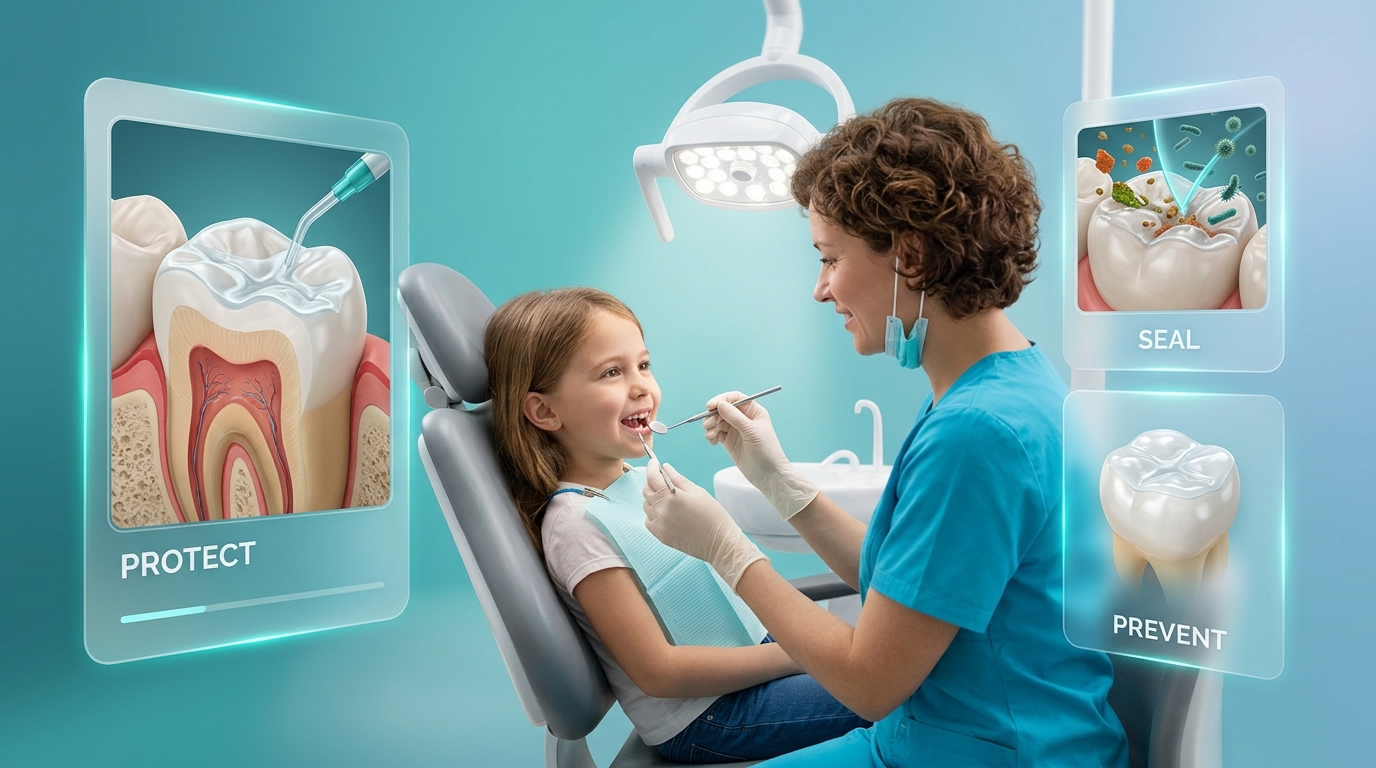
Dental sealants are thin protective coatings placed over the grooved chewing surfaces of back teeth, where most childhood cavities start. The American Dental Association and the American Academy of Pediatric Dentistry recommend them for primary and permanent molars in children and teens. Research shows a substantial drop in new chewing-surface cavities, though an exam is what determines which teeth would benefit and when.
Key Takeaways
- Sealants work mechanically, not chemically. They block food and bacteria from grooves a toothbrush bristle cannot physically enter, which is why they cover a gap that brushing and fluoride leave open.
- Timing matters more than age alone. The strongest protection comes from sealing a molar soon after it fully erupts, because that's when the tooth is most vulnerable and hasn't had time to start decaying.
- A sealant can be placed over very early decay that hasn't broken through the enamel, but not over a cavity that has already opened the tooth surface. Only an exam can tell which one your child has.
- Sealants are not permanent. Retention drops over time, so each one needs checking at routine visits, and some will need repair or replacement.
- The BPA question has a real answer: BPA isn't a formula ingredient in sealants, and any measurable exposure is small and brief. Simple steps at placement reduce it further.
If your child's dentist has recommended sealants, you probably have two questions running at once: does my child actually need this, and is putting a plastic-based material on my child's teeth a good idea? Both are fair. Sealants are one of the most studied preventive treatments in children's dentistry, and the research is specific enough to answer both questions honestly, including where sealants fall short.
This guide walks through what sealants do, how much they lower cavity risk, when they're worth placing, what the BPA evidence actually says, and what to expect after they're on.
What Dental Sealants Do for Your Child's Teeth
A sealant is a thin coating applied to the chewing surface of a back tooth. Placement takes only a few minutes per tooth, doesn't involve numbing in most cases, and doesn't remove healthy tooth structure. What it does is close off the one area of a molar that daily brushing can't reliably clean.
How a Thin Coating Physically Blocks Decay
Cavities begin when bacteria in dental plaque break down fermentable carbohydrates and produce acid. That acid pulls minerals out of enamel. If the process repeats often enough without enough recovery time, the enamel surface eventually breaks down.
The chewing surface of a molar isn't flat. It has narrow pits and grooves that dentists call pits and fissures that trap food debris and shelter plaque. Sealant material starts as a liquid resin that flows down into those grooves. It's then hardened, usually with a curing light, forming a barrier over the groove. Bacteria lose both the shelter and the steady food supply. The material sets immediately, so a child can eat and chew normally right after the visit.
One distinction is worth holding onto: a sealant doesn't make enamel stronger. Fluoride does that chemically. A sealant simply gets in the way, and that difference explains a lot about what it can and cannot protect.
Why a Toothbrush Can't Reach Into the Grooves of Back Teeth
Some molar grooves are narrower than a single toothbrush bristle. No amount of effort or technique changes that geometry. This is a tooth-anatomy issue, not a brushing-effort issue, and it explains why careful families still see cavities appear on chewing surfaces.
Two things make the problem sharper in children. Newly erupted molars sit far back in a small mouth, at the edge of what a child can comfortably reach. And a six-year-old's brushing coordination is still developing at exactly the moment the first permanent molars arrive. The CDC notes that about nine out of ten cavities occur in the back teeth, which is where those grooves are.
What Sealants Protect and What They Don't Cover
A sealant covers the chewing surface it's painted onto. Nothing else. That leaves several surfaces still relying on daily care:
- Between the teeth. Contact areas between molars are a common cavity site and are reached by floss, not by sealants.
- The smooth outer and inner sides of the tooth, along the cheek and tongue.
- Along the gumline, where plaque collects if brushing is rushed.
- Other teeth entirely. Sealants are placed on molars and sometimes premolars, not routinely on front teeth.
Because of that, sealing molars is one layer of protection rather than the whole plan. It's a reasonable point to raise when you schedule sealant appointments in Lafayette, so you leave knowing which surfaces still need attention at home.
How Well Do Sealants Actually Work?
The evidence base here is unusually solid for a preventive dental treatment, which makes it possible to give you real numbers instead of reassurance.
How Much They Lower a Child's Cavity Risk
The 2016 ADA/AAPD clinical practice guideline, built on a systematic review of randomized trials, found that sealants reduced the incidence of chewing-surface cavities in permanent molars by about 76% over two to three years compared with leaving those surfaces unsealed. Translated into absolute terms by the guideline panel: in a group of children with roughly 30% baseline cavity prevalence, about 207 cavities would be prevented per 1,000 sealants placed. The panel graded this a strong recommendation supported by moderate-quality evidence.
Public health data points in the same direction. The CDC reports that sealants protect against about 80% of cavities in the first two years and roughly 50% for up to four years, and that children ages 6 to 11 without sealants have close to three times more first-molar cavities than children who have them.
Read those figures as population averages rather than a promise about one child. Real-world benefit depends on whether the sealant stays intact, how much cavity risk a child carries, and what else is happening with diet and daily care. No preventive treatment removes cavity risk entirely.
How Long the Protection Realistically Lasts
Protection lasts as long as the sealant does, so retention is the number that matters. Studies of modern light-cured resin sealants report high complete-retention rates in the first year or two, with a gradual decline afterward; clinical literature commonly describes a small percentage of sealants being lost each year. Some sealants stay serviceable for many years, and the CDC notes they can be retained in the mouth for as long as nine years.
The practical takeaway is less about a number and more about follow-up. Partial loss often causes no symptoms at all, so a child won't report it. Retention is something a dentist checks visually at routine visits, which is why sealants and recall appointments belong together.
What Makes a Sealant Last Longer or Fail Sooner
Several factors influence how well a sealant holds:
- How dry the tooth was during placement. Resin-based sealants bond to etched enamel and are sensitive to moisture. Saliva contamination during placement is one of the most common reasons a sealant fails early.
- How fully the tooth has erupted. A molar with gum tissue still draped over part of the chewing surface is hard to keep dry. The ADA/AAPD panel noted that in these situations a more moisture-tolerant material such as a glass ionomer may be preferable, while a resin-based sealant is often the choice when the tooth can be kept dry, and longer retention is the goal.
- Material selection. The guideline could not establish that one sealant material prevents more cavities than another, but it did find that glass ionomer sealants carried roughly five times the risk of retention loss compared with resin-based sealants at two to three years.
- Enamel quality. Enamel that didn't form normally during development doesn't always bond predictably, and those teeth may need closer monitoring.
- Chewing habits. Ice, hard candy, and similar habits can chip a sealant and can chip enamel too.
- How still a child can hold still. Placement is short but does require a dry, accessible field, which is part of why age and comfort level factor into timing.
The Timing Behind Sealants
Eruption timing drives sealant timing. The table below reflects typical eruption ranges published by the ADA; individual children vary in both directions, and a child who is early or late is usually still perfectly normal.
Why the First Two Years After a Tooth Erupts Matter Most
A newly erupted molar is at its most vulnerable. Its enamel is still maturing, its grooves have never been cleaned, and it has just entered a mouth where plaque already lives. Cavity risk on chewing surfaces is concentrated in the period soon after eruption, which is why the CDC advises that sealants prevent the most cavities when applied soon after permanent molars come in.
There's a second, more practical reason not to wait. A sealant placed over sound enamel is straightforward preventive care. A sealant conversation two years later may instead be a conversation about a lesion that already needs treatment. Waiting doesn't keep options open;n it narrows them.
Sealants on Baby Teeth: When They Make Sense
The ADA/AAPD guideline covers primary molars as well as permanent ones, and recommends sealing them when the chewing surface is sound or shows only very early decay. The panel also acknowledged that evidence specific to baby teeth is thinner than the evidence for permanent molars.
In practice, sealing primary molars is a judgment call rather than routine. A dentist generally weighs how deep the grooves are, whether the child already has decay elsewhere, how many years that tooth still has in the mouth, and whether the child can tolerate placement comfortably. Second primary molars are typically shed somewhere around ages 10 to 12, so they may have years of chewing ahead of them long enough to matter. Baby molars also hold space for the permanent teeth developing underneath, and decay in them can cause pain and infection like any other tooth.
Which Children Benefit Most From Sealing
Some circumstances raise a child's chances of chewing-surface decay:
- Existing or previous cavities, which is the strongest single signal
- Unusually deep or narrow grooves on newly erupted molars
- Enamel defects on the molars
- Frequent snacking or sipping of sweetened drinks through the day
- Conditions, medications, or developmental needs that make thorough brushing difficult or reduce saliva flow
- Long gaps between dental visits
It's worth being clear about what this list is not. The guideline does not restrict sealants to children considered high risk; it supports sealing sound chewing surfaces too, and the panel specifically noted that dentists still lack a validated chairside tool for scoring an individual child's cavity risk. So the decision comes from a dentist combining your child's history with what the exam shows, not from a score.
If you're weighing whether to have your child's molars sealed, the more useful question is usually about this tooth, right now: how deep are the grooves, is the tooth fully erupted, and can it be kept dry long enough to bond well?
Are Dental Sealants Safe? Answering the BPA Question
This is one of the most common parent questions about sealants, and it deserves a direct answer rather than a brush-off.
What Sealant Material Is Actually Made Of
Sealants fall into a few categories. Resin-based sealants are built on methacrylate monomers, commonly bisphenol A-glycidyl methacrylate, abbreviated bis-GMA, or urethane dimethacrylate. Glass ionomer sealants use a different chemistry that releases fluoride and tolerates moisture better. Resin-modified glass ionomers and polyacid-modified resins sit between the two. Some materials release fluoride; all of them are placed as a coating rather than as a filling that replaces tooth structure.
Where the BPA Concern Comes From
The name bisphenol A appears inside the chemical name bis-GMA, which is where much of the confusion starts. According to the ADA, research and direct communication with manufacturers indicate BPA is not used as a formula ingredient in dental materials. It can be present in two ways: as a trace leftover from manufacturing the resin ingredients, or as a by-product when certain resin components break down in the mouth.
Studies have measured a small, temporary rise in BPA in saliva and urine after resin-based sealants are placed. The ADA's review of that literature describes the increase as transient, typically resolving within 24 to 48 hours, with the size of the change relating to how many teeth were treated. The main source is thought to be the thin, incompletely hardened layer at the surface of a freshly placed sealant. When the ADA/AAPD guideline panel examined adverse events, it concluded the evidence does not support the idea that this brief, small exposure puts patients at risk.
How the Exposure Compares to Everyday Sources
Context helps here. The National Toxicology Program has reported that food and beverages account for the majority of daily human BPA exposure, and characterized dental sealant exposure as an acute, infrequent event with little relevance to estimating general population exposure. Dietary exposure repeats every day. Sealant-related exposure happens once, at placement, and then subsides.
That isn't the same as saying BPA is a settled question. It remains under regulatory attention, and the ADA has supported further research into real-world exposure levels. If the topic matters to you, it's a fair thing to raise before treatment, including asking which material will be used and why.
Steps That Reduce Exposure at Placement
The measures below are drawn from ADA and AAPD guidance, and they target the unhardened surface layer specifically:
- Confirming the curing light is working properly, so the material polymerizes fully
- Isolating the tooth, including rubber dam isolation where appropriate
- Wiping the finished sealant with a mild abrasive such as pumice on a cotton applicator or prophy cup to remove the unpolymerized surface layer
- Rinsing the surface for about 30 seconds with an air-water syringe while suctioning
- Having older children and teens rinse or gargle and spit after curing is complete
If you'd like these steps taken, say so. They're standard, quick, and no dental team should mind being asked.
Can a Sealant Go Over a Tooth That's Already Starting to Decay?
Often,y es, and this is one of the more useful things for parents to understand, because "there's a spot on that molar" doesn't automatically mean a filling.
Sealing a Completely Healthy Groove
When the chewing surface is sound, a sealant is straightforward prevention. Nothing is removed, nothing is repaired, and the goal is simply to keep the groove from ever becoming a problem.
Early Decay That Hasn't Broken Through the Enamel
Dentistry has a specific term for the earliest stage of decay: a noncavitated, or initial, lesion. The ADA defines it as a change in the color, glossiness, or surface structure of enamel caused by mineral loss, before there is any visible breakdown of the tooth surface. The enamel has been weakened but is still continuous.
The ADA/AAPD guideline found that sealants can minimize the progression of these early lesions on the tooth that receives the sealant. Sealing over the groove cuts the bacteria off from the sugars that were feeding the process. That's a genuinely different outcome than either drilling or watching and waiting, and it's one reason the guideline recommends sealants for teeth with sound surfaces and teeth with early lesions.
When a Filling Is Needed Instead
Once the enamel surface has actually broken open into a cavitated lesion, a sealant is no longer the right tool. Coating over an open cavity doesn't restore the structure that has been lost or reliably stop what's happening underneath. That tooth needs children's restorative care instead.
What that treatment looks like varies. A dentist weighs the child's age, whether it's a baby tooth or a permanent one, how deep the decay has gone, whether the tooth is sensitive or symptomatic, and how much longer that tooth is expected to stay in the mouth. Not every cavity is treated the same way, and none of that can be determined from a description or a photo.
How a Dentist Tells the Difference
Distinguishing early demineralization from a true cavity is a clinical judgment made with the tooth clean, dry, and well lit. A dentist looks at color and surface texture, checks the surface gently rather than probing forcefully into a groove, and compares findings against previous visits when records exist. Dental X-rays are used selectively; imaging decisions depend on what the exam shows, the child's history and cavity risk, and dental development, rather than on age alone.
Sometimes the answer is to seal and re-evaluate at the next visit. That's a legitimate plan, not indecision.
Sealants, Fluoride, and Brushing Work on Different Problems
Parents are sometimes offered sealants and fluoride at the same visit and assume they're being asked to choose. They aren't alternatives. They address different failure points.
On the specific question of chewing surfaces, the ADA/AAPD panel suggested sealants over fluoride varnish for molars with sound surfaces or early lesions, though it graded that as a conditional recommendation based on low-quality evidence, and both treatments showed benefit. Fluoride still does something sealants can't, which is act on the smooth surfaces and between the teeth. If you're deciding how the two fit together for your child, our overview of fluoride treatments for children covers that side in more detail.
Why Sealants Can Never Replace Brushing and Flossing
A sealed molar still has four unsealed sides. Cavities between back teeth are common in school-age children and teens, and no coating on a chewing surface changes that. Daily brushing with fluoride toothpaste in the amount appropriate for your child's age, cleaning between the teeth, and the frequency of sugary snacks and drinks all keep doing their work after sealants are placed.
What Happens After Sealants Are Placed
How Sealed Teeth Feel to a Child
Placement is short, involves no drilling in most cases, and typically doesn't require an injection. Children usually describe the visit in terms of the taste of the materials and the feel of the small brush rather than any discomfort.
Afterward, the bite is checked so the sealant isn't sitting high, and adjusted if needed. Many children notice nothing. Some report the tooth feels slightly different for a day or two, then stop mentioning it. Eating and drinking can resume right away.
Brushing and Flossing Around Sealed Teeth
Nothing changes. Brush the sealed surface the same way; the sealant is bonded to enamel and won't come off with normal brushing. Keep flossing, since sealants don't protect the areas between teeth. There's no special product to buy, and no reason to brush the sealed tooth more gently than the others.
Why Sealants Need Checking at Every Visit
Sealants can wear, chip, or partially lift over time, and this usually happens without any pain or visible sign a parent would catch. Checking retention is part of a routine exam, and a small area of loss is often easy to repair when it's found early.
One finding is worth knowing, because it reduces the panic factor: the ADA/AAPD guideline reviewed studies on teeth that had fully or partially lost their sealants and found no greater cavity risk in those teeth than in teeth that had never been sealed. A lost sealant returns the tooth to where it started. It doesn't leave it worse off.
When a Sealant Needs Repair or Replacement
Reasons a dentist may resurface or replace a sealant include partial loss that exposes part of the groove, general wear from years of chewing, a chip after biting something hard, or a change in the tooth that needs a closer look. Repair is usually quick: the surface is cleaned, re-prepared, and resealed. Replacement doesn't mean the first sealant failed your child;d it means the material did its job for as long as it was intact.
If Your Child Received Sealants at a School Program
School sealant programs are effective, and the CDC actively encourages them because they reach children who might not otherwise get preventive care. If your child came home with sealants from one, that's a good thing.
What those programs generally don't include is ongoing follow-up. A school visit is usually a single encounter focused on placing sealants, not a complete exam of every surface or a plan for monitoring retention over the years ahead. Bring any paperwork you received to your child's next dental visit, and mention which teeth were sealed. The dentist can then check how the sealants are holding, look at the surfaces the program wasn't set up to address, and fold everything into ongoing care.
Frequently Asked Questions About Sealants for Kids
Will My Child Be Able to Feel the Sealant With Their Tongue?
Possibly, for a short time. Sealant material adds a very thin layer to the groove, and some children notice the new texture for a day or two before it stops registering. The bite is checked at placement so nothing sits high. If your child is still bothered after several days or says the tooth feels tall when biting, call the office; that's easy to adjust.
Can My Child Still Get a Cavity in a Sealed Tooth?
Yes. A sealant covers the chewing surface only, so decay can still start between the teeth, along the gumline, or on the smooth sides. Cavities can also develop on a chewing surface if the sealant has partially come off without anyone noticing. Sealants substantially lower the odds on the surface they cover; they don't remove cavity risk from the tooth.
What Happens If a Sealant Chips or Comes Off at Home?
It isn't an emergency, and it shouldn't hurt. Have your child keep brushing normally and call the office so the tooth can be looked at and resealed if needed. Research reviewed in the ADA/AAPD guideline found that teeth that lost sealants completely or partially were at no greater cavity risk than teeth that were never sealed, so a chipped sealant is a repair item rather than a setback.
Do Sealants Change How Food Tastes?
No. Once the material is cured, it's inert and doesn't affect taste. Children do sometimes comment on the taste of the materials during the appointment itself, which passes as soon as the visit ends and they rinse.
My Child Already Has Sealants From Another Office Can They Be Checked?
Yes, and it's worth doing. Checking existing sealants is a normal part of an exam regardless of who placed them. Bring records if you have them, or just mention which teeth were sealed and roughly when. If a sealant is worn or partially lost, it can usually be repaired.
Is There an Age When It's Too Late for Sealants?
There's no cutoff age, though the benefit is largest when a molar is sealed soon after it erupts. The ADA/AAPD panel noted that no trials have measured sealants in adults, and suggested that similar effects may reasonably be expected in older age groups,p articularly in people with a recent history of cavities. For a teenager with sound but deeply grooved second molars, sealing is often still a sensible option.
Talk to a Pediatric Dentist About Sealants for Your Child
Most of what parents want to know about sealants comes down to three questions, and they're all answerable. Do they work? On chewing surfaces, the evidence is strong. Are they safe? BPA isn't a formula ingredient, exposure at placement is small and brief, and straightforward steps reduce it further. Does my child need them? That's the one that requires looking in your child's mouth at which molars are fully erupted, how deep the grooves are, what the exam shows about early decay, and what your child's dental history suggests.
That last question is also the one worth asking sooner rather than later, because the window for sealing a molar as simple prevention is widest in the months after it comes in.
Dr. Leslie Jacobs Pediatric Dentistry is a pediatric dental practice led by Dr. Leslie Jacobs, a board-certified pediatric dentist, located at 113 Rue Fontaine in Lafayette, Louisiana, and caring for families across Lafayette, Youngsville, Broussard, and the surrounding Acadiana area. To have your child's molars evaluated and discuss whether sealing makes sense right now, call (337) 500-1500 or book your child's sealant visit.
.jpg)
.jpg)


