.png)
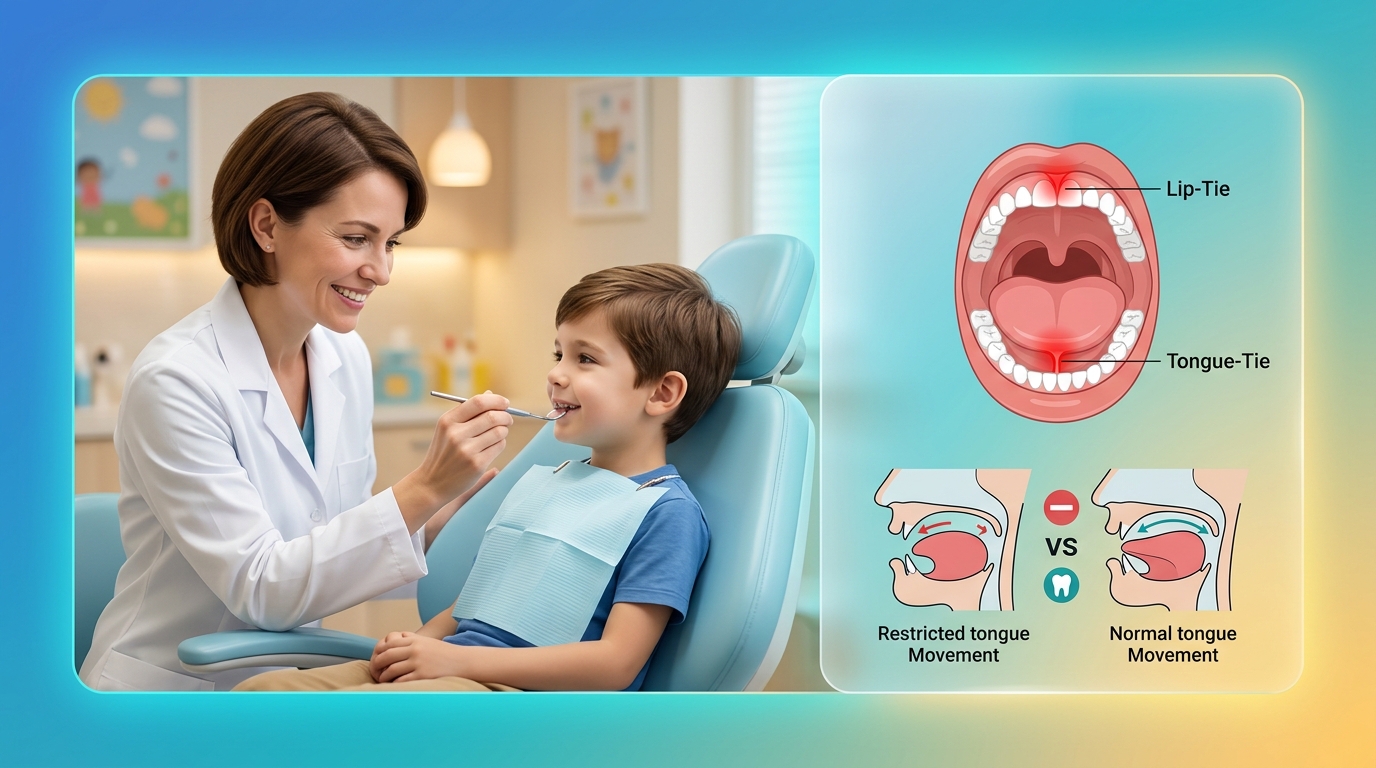
A frenectomy is a short procedure that releases a tight band of tissue, called a frenum, that limits movement of the tongue, lip, or cheek. It can help with feeding, speech, or oral hygiene in some children, but not every tongue-tie or lip-tie causes a problem that needs surgery. A functional evaluation is the step that tells you whether release, monitoring, or another approach fits your child.
Key Takeaways
- A frenectomy releases a tight frenum, the small tissue band under the tongue, behind the upper lip, or inside the cheek.
- Not every tongue-tie or lip-tie causes a functional problem, and not every one needs surgery. Function, not appearance, guides the decision.
- Laser and traditional (scissors or scalpel) techniques both release the tissue. They differ mainly in bleeding, stitches, and comfort, not in proven long-term results.
- Aftercare, including stretches, feeding support, or myofunctional therapy, plays a real role in how well a release works.
- Cost and insurance coverage depend on the technique, the provider, and whether a functional problem is documented.
If your pediatrician, lactation consultant, or a family member has mentioned "tongue-tie" or "lip-tie," you probably have questions before you have answers. You want to know what the terms mean, whether treatment actually helps, and what a procedure would involve for your child. This guide walks through the anatomy, the signs to watch for, how providers decide whether a frenectomy is appropriate, and what recovery looks like, so you can have an informed conversation at your child's evaluation.
What Is a Frenectomy?
A frenectomy is a minor procedure that releases or removes a frenum, a small fold of tissue inside the mouth, when it restricts normal movement. It is one of the more common minor oral surgery procedures performed on infants and young children.
Understanding Oral Frena (Lingual, Labial, Buccal)
Everyone has several frena in their mouth. The lingual frenum connects the underside of the tongue to the floor of the mouth. The labial frena connect the upper and lower lips to the gum tissue. The buccal frena connect the inner cheeks to the gum. These are normal structures present in every child. They only become a concern when one is unusually tight, thick, or positioned in a way that limits movement.
Tongue-Tie (Ankyloglossia) and Lip-Tie Explained
Ankyloglossia, commonly called tongue-tie, is the medical term for a lingual frenum that attaches close to the tip of the tongue and may restrict how far the tongue lifts or extends. A lip-tie describes a labial frenum, usually the upper one, that limits how the lip flanges or moves. Studies estimate that somewhere between roughly 2% and 11% of newborns are diagnosed with a tongue-tie, though the number varies widely depending on the diagnostic criteria a provider uses.
Both the American Academy of Pediatrics (AAP) and the American Academy of Pediatric Dentistry (AAPD) emphasize that a visible frenum does not automatically mean it is restrictive. Many infants with a noticeable tie feed, speak, and eat without any difficulty at all.
Frenectomy vs. Frenotomy vs. Frenuloplasty
These three terms get used loosely in everyday conversation, but they describe different levels of surgical involvement.
- Frenotomy: A simple incision or clip that releases the frenum. This is the most common approach for infants and is typically quick, with minimal tissue removed.
- Frenectomy (or frenulectomy): A more complete removal of the frenum tissue. This term is often used for procedures on older children or when more tissue needs to be addressed.
- Frenuloplasty: A more involved surgical revision that may include repositioning tissue and placing stitches. This is more common in older children, teens, and adults, or in cases where a simple release is not enough.
Types of Frenectomy
The right procedure depends on which frenum is involved and what problem it is causing.
Lingual Frenectomy (Tongue-Tie Release)
A lingual frenectomy releases the tissue under the tongue. It is the most frequently performed type, usually considered when a tongue-tie is linked to feeding difficulty in an infant, or to speech or oral hygiene concerns in an older child.
Labial Frenectomy (Lip-Tie Release)
A labial frenectomy releases the upper (or occasionally lower) lip frenum. Major medical groups, including the Academy of Breastfeeding Medicine and the American Academy of Otolaryngology-Head and Neck Surgery, currently recommend a more selective approach to lip-tie release than to tongue-tie release, since the evidence connecting labial frena to breastfeeding difficulty is more limited. In older children, a labial frenectomy is sometimes considered when the tissue contributes to a persistent gap between the front teeth or to gum recession.
Buccal Frenectomy (Cheek Tie Release)
A buccal, or cheek, tie is less studied than tongue-tie or lip-tie, and current pediatric guidance does not broadly support treating it for breastfeeding purposes alone. When a buccal frenectomy is considered, it is typically reserved for select cases where the tissue is clearly limiting cheek or lip function.
Signs and Symptoms of Tongue-Tie and Lip-Tie
Symptoms look different depending on your child's age, because the demands placed on the tongue and lips change over time.
In Infants: Latch and Breastfeeding Problems
Possible signs in a nursing infant include a shallow or difficult latch, clicking sounds while feeding, milk leaking from the corners of the mouth, very long or very short feeding sessions, and slow weight gain. Nursing parents may notice nipple pain or damage that does not improve with positioning changes.
It is worth knowing that most breastfeeding difficulties are not caused by tongue-tie. A 2024 clinical report from the American Academy of Pediatrics found that pain and latch problems more often stem from other causes, and it encourages a full feeding evaluation, ideally with a lactation consultant, before assuming a tie is the source.
In Children: Feeding, Speech, and Oral Habits
As children move to solid foods, a restricted tongue can sometimes make it harder to clear food from around the teeth, lick an ice cream cone, or manage certain textures. Some parents notice trouble with sounds that require the tongue tip to lift, such as t, d, n, and l. The link between tongue-tie and speech is less firmly established in the research than the link between tongue-tie and infant feeding, so a speech-language pathologist's assessment is the most reliable way to know whether tongue mobility is actually contributing to a speech pattern.
In Adults: Mobility, Dental, and Hygiene Concerns
Adults with an unaddressed tongue-tie or lip-tie sometimes report difficulty cleaning behind the lower front teeth, gum recession near a tight lip frenum, or self-consciousness about tongue movement. Some seek evaluation in connection with orthodontic treatment, denture fit, or speech goals.
How Are Tongue-Tie and Lip-Tie Diagnosed?
Diagnosis is a hands-on, functional process rather than something read from a photo or a quick glance.
Oral Examination and Functional Assessment
A provider examines the frenum's appearance and thickness, then checks function: how far the tongue lifts toward the roof of the mouth, how far it extends past the lower lip, and how the lips move. For infants, this often includes watching an actual feeding, sometimes alongside a lactation consultant.
Anatomical Appearance vs. Functional Restriction
This is one of the most important distinctions in the whole evaluation. A frenum can look tight and still allow completely normal function, while a less obvious frenum can sometimes restrict movement in a way that matters. Appearance alone is not a diagnosis. What matters is whether the tissue is actually limiting the tongue or lip in a way that affects feeding, speech, or hygiene.
Assessment Tools and Classification Systems
Providers sometimes use classification systems, such as one that measures the tongue's "free length," to describe how much of the tongue moves independently of the frenum. These tools can help document findings, but according to the AAP's 2024 clinical report, none of the current scoring systems for ankyloglossia have been formally validated. They are best used as one part of a broader functional evaluation, not as a stand-alone test that decides treatment on its own.
When to See a Specialist
Consider a focused evaluation if feeding difficulties continue despite working with a lactation consultant, if a pediatrician or speech-language pathologist raises a tongue mobility concern, or if an older child has ongoing trouble with eating, oral hygiene, or a specific sound in speech. A pediatric dentist can assess the tissue and coordinate with your child's pediatrician, an ENT, a lactation consultant, or a speech-language pathologist as needed.
When Is a Frenectomy Needed and When Is It Not?
This is usually the question parents care about most, and it deserves an honest answer: needing a frenectomy depends on function, not on the fact that a tie is present.
Functional Problems That May Justify Release
A frenectomy may be considered when there is a documented functional problem, such as feeding difficulty in an infant that has not improved with lactation support, a speech sound affected by limited tongue mobility as identified by a speech-language pathologist, or a lip-tie contributing to a persistent gap between the front teeth or to gum irritation in an older child. The AAPD's position is direct on this point: release can improve feeding for some infants, but not all infants with a tongue-tie need surgery.
When Observation and Monitoring Are Appropriate
Monitoring, rather than surgery, is often reasonable when the tie is mild and not causing a functional problem, when a newborn's feeding difficulties have not yet been addressed through lactation support, or when a child eats, speaks, and maintains oral hygiene without any noticeable trouble. In some children, the tissue loosens somewhat with normal growth and use over time.
Non-Surgical Alternatives (Lactation, Speech, Myofunctional Support)
For infant feeding concerns, working with a board-certified lactation consultant on positioning and latch resolves many difficulties without any procedure at all, which is why the AAP recommends trying this route first. For speech concerns, a speech-language pathologist can determine whether therapy alone addresses the sound in question. Myofunctional therapy, which trains tongue and lip muscle patterns, is sometimes recommended before or alongside a release for older children, though research on its stand-alone benefit is still developing.
What Happens During a Frenectomy?
For most healthy infants and children, a frenectomy is a brief, in-office procedure rather than a major surgery.
Preparing for the Procedure
Preparation starts with the evaluation visit described earlier, where the provider confirms the tie is restrictive and discusses the plan with you. For newborns, your provider may also confirm your baby has received the standard vitamin K injection given after birth, which supports normal clotting before any minor procedure.
Where It's Performed and How Long It Takes
Most frenectomies for healthy infants and children happen right in the dental or medical office and take only a few minutes. Hospital settings and general anesthesia are generally reserved for more complex cases or children with other medical needs, not for a routine, uncomplicated release.
Anesthesia and Pain Control
Most infant procedures use a topical numbing gel, sometimes with a small amount of local anesthetic. Older children may need a local anesthetic injection similar to what is used for a filling. Your child's dentist will explain the specific plan based on age and the extent of the release. For children who need extra comfort support, options such as nitrous oxide or oral sedation may be available and can be discussed at the evaluation visit. No procedure can be promised as completely pain-free, but discomfort for a routine frenectomy is generally brief.
Step-by-Step: What the Procedure Involves
In general terms, the provider positions and gently stabilizes your child (often swaddling and holding for an infant), numbs the area, and releases the frenum with a laser or with scissors or a scalpel. The provider then checks the new range of motion, controls any bleeding, and reviews aftercare instructions with you before you leave.
Laser Frenectomy vs. Traditional Frenectomy
Both approaches release the same tissue. The differences are mostly practical rather than proven differences in long-term outcome.
Bleeding and Stitches
A laser cuts and seals small blood vessels at the same time, which often means less bleeding and no stitches. A traditional release with scissors or a scalpel may involve more bleeding, and stitches are sometimes needed, particularly for a more involved frenuloplasty.
Pain and Comfort
Some published comparisons suggest laser procedures are associated with less reported discomfort, but the overall body of evidence comparing pain between techniques is still limited. Neither approach is proven to be universally more comfortable for every child.
Healing and Recovery Time
Both techniques generally heal within a similar overall window. Some research points to modestly less post-procedure swelling with laser techniques, but the skill and experience of the provider matters at least as much as the tool used.
Choosing the Appropriate Technique
The right technique depends on the equipment and training your provider has, your child's age, how severe and how thick the tie is, and your family's preferences. Neither laser nor traditional technique is established in the research as safer or more effective across the board. It is reasonable to ask your provider which approach they recommend for your child and why.
Laser vs. Traditional Frenectomy: What Commonly Differs
Frenectomy Recovery and Aftercare
What happens after the procedure has a real influence on the result, which is why aftercare deserves careful attention.
The First 24 to 48 Hours
Mild fussiness or discomfort is common in the first day or two. Babies can usually be fed as normal, and this often helps soothe them. Older children may prefer soft foods for a day or two, and a cold compress can ease any swelling if the dentist recommends it.
Feeding and Lactation Support After Release
Releasing the tissue does not automatically fix a latch on its own. Continued support from a lactation consultant in the days after the procedure is often recommended so feeding technique can be reassessed and adjusted as your baby heals.
Post-Procedure Stretches and Exercises
Many providers recommend specific stretches during healing to keep the tissue from reattaching as it closes. Your provider will show you exactly how and how often to do these for your child, and following that specific plan matters more than any general instructions found online.
Myofunctional and Speech Therapy After Release
For older children with speech sound concerns or oral habits, a referral to a myofunctional therapist or speech-language pathologist after the release can support the muscle patterns and coordination the tongue needs to use its new range of motion well.
Healing Timeline and Returning to Normal Activities
The surface tissue generally heals within about one to two weeks, though this varies by child and by how much tissue was addressed. Most children return to normal feeding, eating, and daily activities the same day or the next day. A follow-up visit is typically recommended to check healing and range of motion.
Frenectomy Risks and Possible Complications
A frenectomy is considered a minor procedure with a generally low complication rate, but it is still a surgical procedure and carries some risk.
Pain, Swelling, Bleeding, and Infection
Mild pain, some swelling, and light bleeding are the most common short-term effects. Infection is uncommon following a straightforward release, and following your provider's cleaning and aftercare instructions helps lower that risk further.
Scarring and Reattachment
The released tissue can scar or reattach as it heals, especially if recommended stretches are skipped. Reattachment sometimes means the original restriction returns and a second procedure is needed.
Injury to Nearby Oral Structures
Structures such as salivary duct openings, nearby soft tissue, or teeth sit close to the surgical site. Injury to these structures is uncommon in the hands of an experienced provider, and a thorough pre-procedure evaluation is part of how that risk is managed.
When to Contact Your Provider
Call your provider if you notice bleeding that does not slow down with gentle pressure, increasing redness, swelling, warmth, or pus at the site, a fever, your child refusing to feed or drink well beyond the first day or two, or any signs of dehydration such as noticeably fewer wet diapers in an infant. These symptoms warrant a prompt call rather than a wait-and-see approach.
Potential Benefits and Expected Outcomes
It helps to know what the evidence actually supports, and where it is still limited, so expectations stay realistic.
Breastfeeding and Feeding Improvements
A 2017 Cochrane review of frenotomy for newborns found that release was associated with reduced nipple pain for breastfeeding parents in the short term. Evidence for longer-term benefits, such as how long breastfeeding continues overall, is less consistent.
Improved Tongue and Lip Mobility
A measurable increase in how far the tongue lifts or extends, or how the lip flanges, is typically seen right after a successful release, since the physical restriction has been addressed.
Speech and Oral Hygiene Outcomes
Some children show improved articulation after a release combined with speech therapy, though this connection has less robust research behind it than the feeding connection. Better tongue mobility can also make it easier for a child to move food debris and saliva around the mouth, which may support oral hygiene.
What the Evidence Does and Doesn't Show
The strongest evidence supports short-term breastfeeding comfort for some infants. Evidence is weaker or still developing for long-term breastfeeding duration, speech outcomes, sleep, and other benefits sometimes claimed online. The American Academy of Pediatrics has specifically raised concern about rising rates of diagnosis and treatment outpacing the strength of the supporting evidence, which is part of why a careful functional evaluation matters more than treating the tie itself.
Frenectomy by Age: Infants, Children, and Adults
Age changes both the reason a frenectomy is considered and what the procedure itself looks like.
Infant Frenectomy: What Parents Should Know
In infants, a frenectomy is usually a simple, brief release addressing a documented feeding problem. It typically pairs best with continued lactation support before and after, since the tie is rarely the only factor at play in a breastfeeding difficulty.
Child Frenectomy: What to Expect
In an older child, the procedure may involve a bit more tissue and, in some cases, a frenuloplasty rather than a simple frenotomy. Local anesthesia is usually sufficient. The reasons considered at this age often shift toward speech, oral hygiene, or a specific dental concern such as a persistent gap between the front teeth, and therapy referral is frequently part of the overall plan.
Adult Frenectomy: What to Expect
Adults are generally evaluated and treated by a general dentist, periodontist, or oral surgeon rather than a pediatric dental practice. The procedure often involves a frenuloplasty with local anesthesia and, occasionally, stitches. If you are an adult wondering about your own tongue-tie or lip-tie, your general dentist is the right starting point for an evaluation.
Is There an Ideal Age for Frenectomy?
There is no single ideal age established for every child. The AAPD notes that addressing a clearly restrictive tie early, in a symptomatic newborn under about two weeks old, may help avoid a more involved procedure later. Beyond that early window, timing depends far more on the functional problem your child is having than on age alone. This is a decision to make with your child's provider, not on a fixed timeline.
Frenectomy Cost and Insurance Coverage
Cost is a real part of this decision, and it is fair to ask about it directly at the evaluation visit.
Factors That Affect Frenectomy Cost
Several things influence the total cost: which technique is used, which frenum (or how many) need to be addressed, whether the procedure is performed in-office or requires a hospital setting with general anesthesia, your child's age and the complexity of the case, and whether follow-up visits or therapy referrals are included.
Laser vs. Traditional Frenectomy Costs
Nationally, a straightforward in-office frenectomy commonly falls somewhere in the range of roughly $250 to $800, with laser procedures often landing at the higher end of that range because of the equipment involved, and traditional scalpel or scissor releases sometimes costing less. Hospital-based procedures under general anesthesia, which are reserved for more complex cases, can run substantially higher. These figures are general market ranges rather than a quote, and your child's specific cost will depend on the evaluation.
Insurance Coverage and Payment Options
Since 2022, the American Dental Association has used separate procedure codes for a lip or cheek frenectomy, a tongue frenectomy, and a tongue frenuloplasty, which can affect how a claim is processed. Some dental plans cover a portion of the cost, and medical insurance sometimes covers an infant procedure when feeding difficulty is documented by a pediatrician or lactation consultant. Coverage varies widely by plan, so it is worth asking your insurer directly. The office team can also answer questions about accepted insurance and payment options for your child's specific case.
Choosing a Frenectomy Provider in Lafayette, LA
Families in Lafayette, Youngsville, Broussard, and the surrounding Acadiana area have several types of providers to consider for a frenectomy evaluation.
What a Thorough Tongue-Tie Evaluation Should Include
A thorough evaluation involves more than a quick look. It should include a functional exam of tongue and lip movement, a feeding observation or speech assessment when relevant, a clear conversation about whether release, monitoring, or a non-surgical approach fits best, and an honest discussion of what to expect if you move forward.
Pediatric, Dental, ENT, and Multidisciplinary Options
Pediatric dentists, ENT physicians, oral surgeons, general dentists, and sometimes pediatricians all perform frenectomies. Because feeding, speech, and dental function can overlap, a team-based approach that includes your child's pediatrician, a lactation consultant, or a speech-language pathologist when appropriate tends to support the best outcomes.
Questions to Ask Your Provider
A short list of questions can make the evaluation visit more productive:
• Is my child's tie affecting function, or mainly how it looks?
• Which technique do you recommend for my child, and why?
• What does aftercare involve, and how often will we need to do stretches?
• What happens if the tissue reattaches?
• What is included in the cost, and does insurance apply?
• Should we also involve a lactation consultant or speech-language pathologist?
The team at Dr. Leslie Jacobs Pediatric Dentistry, located at 113 Rue Fontaine in Lafayette, is led by a board-certified pediatric dentist and provides evaluation and frenectomy care for infants, children, and teens in Lafayette, Youngsville, Broussard, and the surrounding Acadiana communities. Every recommendation starts with a functional evaluation of your child's tongue, lip, and cheek movement, not with an assumption that surgery is the answer.
Frequently Asked Questions
Is a frenectomy painful for a baby?
Most infant frenectomies use a topical numbing gel, and the procedure itself is brief. Babies often cry during the moment of the procedure, which is a normal reaction to being held still and handled, not necessarily a sign of significant pain. Most infants calm quickly, especially when fed right afterward.
How long does a frenectomy take to heal?
The surface tissue generally heals within about one to two weeks, though this varies by child. Most children return to normal feeding and daily activities the same day or the next.
Can babies breastfeed immediately after release?
Many babies can nurse right after the procedure, and feeding often helps soothe them. Releasing the tie does not automatically perfect the latch on its own, so continued support from a lactation consultant in the days after is often part of the plan.
Can a tongue-tie or lip-tie reattach?
Yes. The tissue can scar or reattach as it heals, particularly if recommended stretches are not done consistently. This is why your provider's specific aftercare instructions matter as much as the procedure itself.
Is laser frenectomy better than traditional?
Laser and traditional techniques both release the tissue effectively. Laser procedures often involve less bleeding and no stitches, but current evidence does not clearly establish either technique as superior for long-term outcomes. The right choice depends on your provider's training and your child's specific situation.
Does every tongue-tie need surgery?
No. Many infants and children have a tongue-tie or lip-tie that causes no functional problem at all. The American Academy of Pediatric Dentistry is direct on this point: not every infant with ankyloglossia needs a surgical release. A functional evaluation is what determines whether treatment, monitoring, or a non-surgical approach fits your child.
Can adults still benefit from a frenectomy?
Some adults pursue a frenectomy for oral hygiene, gum health, orthodontic treatment, denture fit, or speech goals. Adult evaluation and treatment are typically handled by a general dentist, periodontist, or oral surgeon rather than a pediatric dental practice.
Conclusion
Tongue-tie and lip-tie are common, and hearing the terms does not automatically mean your child needs surgery. What matters most is whether the tissue is actually restricting feeding, speech, or oral hygiene, and that question is best answered through a hands-on functional evaluation rather than a photo or a quick look. When a frenectomy is appropriate, it is generally a brief, low-risk procedure, and how well it works often depends as much on aftercare, stretches, and any needed lactation or speech support, as it does on the release itself.
If you have questions about your child's tongue-tie or lip-tie, the team at Dr. Leslie Jacobs Pediatric Dentistry in Lafayette can schedule a consultation to evaluate your child's specific situation and talk through whether a frenectomy, monitoring, or another approach makes the most sense.

.jpg)
.jpg)


