.png)
Your 18-month-old just took a tumble and injured their front tooth. The dentist says everything looks stable for now but mentions something about monitoring for effects on permanent teeth. You're probably thinking: "Why does it matter? Won't this baby tooth fall out in a few years anyway?"
This is one of the most common questions parents ask after their child experiences dental trauma. The truth is, baby teeth play a much bigger role in your child's future dental health than most people realize. Understanding the connection between infant dental injuries and permanent teeth can help you protect your child's smile for years to come.
Why Baby Teeth Matter More Than You Think
Many parents believe baby teeth are just temporary placeholders that don't have lasting importance. This misconception can lead to missed opportunities for monitoring and early intervention after dental injuries.
The reality is that permanent teeth begin forming long before they ever appear in your child's mouth. In fact, the permanent front teeth start developing beneath the gums when your baby is just 3 to 12 months old. This is exactly the age when babies are learning to crawl, pull themselves up, and take those first wobbly steps. It's also when they're most vulnerable to falls and dental injuries.
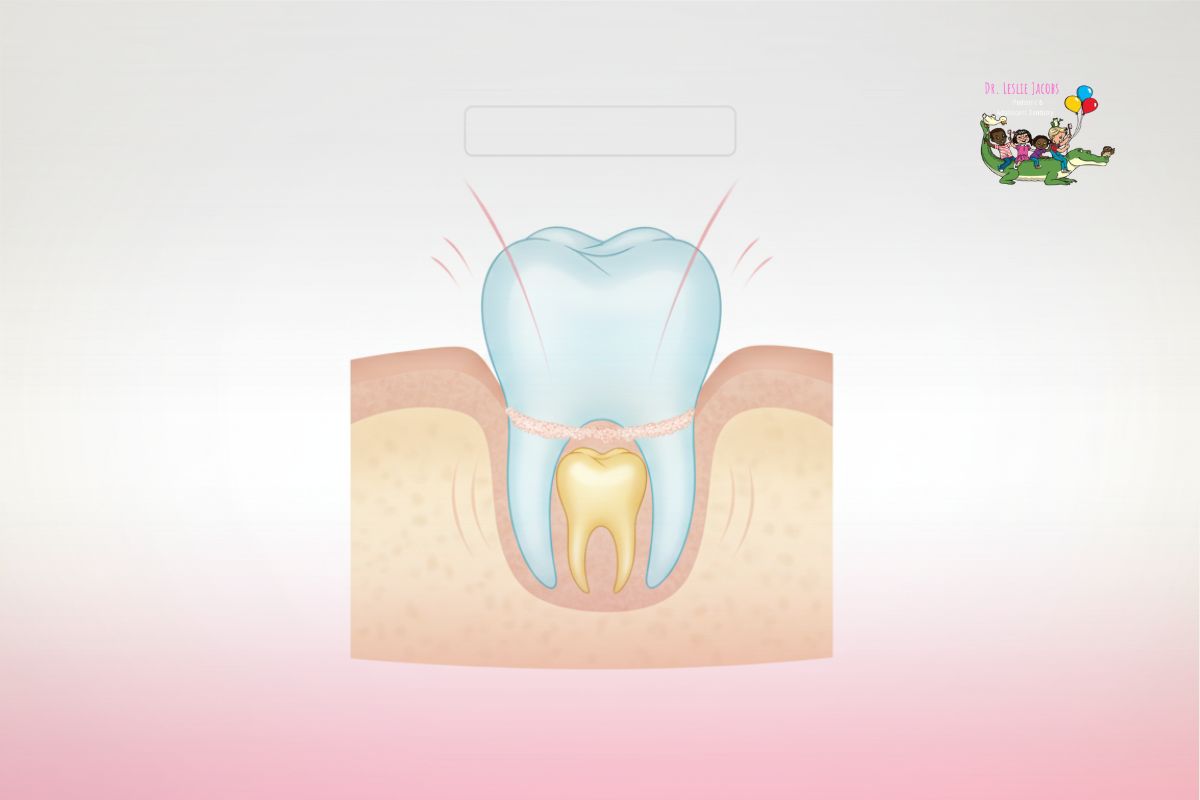
Here's what makes this connection so important: only a thin layer of bone separates baby teeth from the developing permanent tooth buds underneath. When trauma occurs to a baby tooth, the force can travel through to the permanent tooth that's forming below. This means an injury today can affect a tooth that won't even appear until your child is 6 or 7 years old.
The permanent tooth buds sit in a protected space in the jawbone, but they're not completely safe from harm. Blood from an injured baby tooth can seep down and stain the developing enamel. Infection from a damaged baby tooth can spread to the permanent tooth bud. In severe cases, the physical displacement of a baby tooth can directly damage or knock the permanent tooth bud out of position.
Types of Permanent Tooth Damage from Baby Tooth Injuries
.png)
The effects of infant dental trauma on permanent teeth can show up in several different ways. Some are purely cosmetic, while others can affect the function and health of the tooth throughout your child's life.
Enamel Defects and Discoloration
One of the most common issues is enamel hypoplasia, which means the enamel doesn't form properly. When the permanent tooth finally erupts at age 6 or 7, you might notice white, yellow, or brown spots on the surface. The enamel might look pitted or rough instead of smooth and shiny.
This happens because trauma disrupts the cells responsible for building strong enamel. Blood from the injured baby tooth can stain the developing enamel underneath. If infection sets in, it interferes with the mineralization process that creates hard, healthy enamel.
Studies show that 20 to 30 percent of severe baby tooth injuries result in some type of enamel defect on the permanent tooth. The severity can range from small spots that are barely noticeable to extensive damage covering the entire tooth surface.
Children with enamel defects face several challenges:
- Increased risk of cavities because weak enamel can't protect the tooth as well
- Sensitivity to hot and cold foods and drinks
- Self-consciousness about the appearance of their teeth
- Need for dental treatments like bonding, veneers, or crowns as they get older
Tooth Shape Problems
Sometimes the permanent tooth erupts in an abnormal shape. The crown (the visible part) might be smaller than normal, irregularly shaped, or have unexpected bumps or curves. The roots can be bent or hooked, a condition dentists call dilaceration.
This typically occurs when physical impact displaces the developing tooth bud, interrupting the normal formation pattern. Intrusion injuries, where the baby tooth gets pushed up into the gum, carry the highest risk for this type of damage.
Shape deformities can lead to:
- Orthodontic complications when trying to align the teeth
- Difficulty fitting the tooth properly with other teeth
- Need for extraction and replacement if the deformity is severe
- Challenges with normal biting and chewing
Eruption Disturbances
Your child's permanent teeth follow a fairly predictable schedule for eruption. The bottom front teeth usually come in around age 6, followed by the top front teeth. When a baby tooth injury affects the permanent tooth bud, this timing can get thrown off completely.
The permanent tooth might erupt a year or two early, or it might be delayed by several years. In some cases, the tooth becomes impacted and won't erupt at all without surgical help. Scar tissue from the injury can block the eruption path. The permanent tooth bud might have shifted position during the original trauma, causing it to try erupting in the wrong location or at an odd angle.
Parents usually first notice eruption problems when comparing both sides of the mouth. If the permanent tooth on one side comes in but the injured side stays empty for many months, that's a red flag.
Root Development Issues
The roots of permanent teeth continue forming even after the crown erupts. Trauma to baby teeth can damage the cells responsible for root growth, leading to roots that are short, thin, curved, or simply stop developing too early.
Root problems are particularly concerning because they affect the long-term stability of the tooth. Short roots provide less support, making the tooth more likely to become loose or lost later in life. Severely curved roots create challenges for orthodontic treatment and can make the tooth difficult to maintain over time.
The tricky part about root issues is that they're not always visible. Your child's tooth might look perfectly normal on the outside, but X-rays reveal compromised roots underneath. According to research from the American Academy of Pediatric Dentistry, root development problems occur in approximately 15 to 25 percent of cases involving severe baby tooth displacement.
Which Injuries Carry the Highest Risk?
.png)
Not all baby tooth injuries have the same likelihood of affecting permanent teeth. Understanding the risk levels can help you know when to be extra vigilant with monitoring.
Highest Risk Injuries:
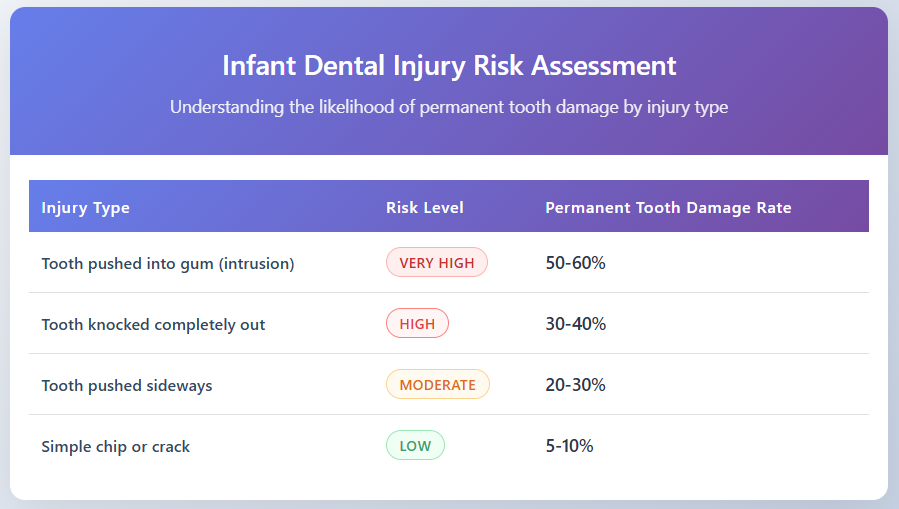
Intrusion injuries, where the tooth gets pushed up into the gum tissue, carry a 50 to 60 percent risk of causing permanent tooth damage. This is because the baby tooth is literally driven toward the developing permanent tooth bud. Complete avulsion, when the tooth is knocked entirely out of the mouth, has a 30 to 40 percent risk. Severe displacement injuries where the tooth is pushed significantly sideways fall in the 35 to 45 percent range.
Moderate Risk Injuries:
Lateral luxation, where the tooth is pushed to the side but not completely displaced, carries a 20 to 30 percent risk. Fractures that expose the nerve or involve significant portions of the tooth have a 15 to 25 percent chance of affecting the permanent tooth.
Lower Risk Injuries:
Simple chips that don't involve the nerve and minor fractures have only a 5 to 10 percent risk. Mild loosening without any displacement typically has less than a 5 percent chance of causing permanent tooth problems.
Age also plays a role in risk levels. Injuries occurring between 12 and 24 months tend to cause more damage because permanent teeth are actively forming during this window. By age 4 or 5, most of the permanent tooth formation is complete, so injuries at this stage are less likely to cause developmental problems.
The Long Wait: When Damage Shows Up
One of the most challenging aspects of infant dental injuries is the waiting period. Unlike adult dental trauma where you can see the full extent of damage fairly quickly, the effects on permanent teeth take years to reveal themselves.
In the days and weeks immediately after an injury, you won't be able to see any damage to the permanent tooth. X-rays might show some position changes, but the developing tooth bud is still too small to evaluate fully.
During the first six months to two years after injury, your dentist will continue monitoring with periodic X-rays. This is when developmental abnormalities might start becoming visible on imaging, though still nothing you can see in your child's mouth.
The real revelation comes four to six years after the original injury, when the permanent tooth finally starts erupting. This is when damage becomes visible and the true extent of the injury is revealed. For front teeth, this happens around age 6 to 8.
This creates an unusual situation where a significant gap exists between the injury and visible consequences. Parents often forget about a fall that happened when their child was a toddler. By the time the permanent tooth comes in years later, the connection isn't always obvious.
This is exactly why dentists schedule long-term follow-ups after infant dental trauma, even when the baby tooth appears to have healed perfectly. The injured baby tooth might look and function normally, but the permanent tooth underneath could still be affected.
What Parents Should Watch For
Ages 2–5 (after injury):
Monitor the injured baby tooth for color changes, especially gray or darkening, which can signal nerve damage or infection. Watch for gum swelling, abscesses, or a tooth falling out much earlier than expected. Keep regular dental visits so X-rays can track the developing permanent tooth.
Ages 6–8 (permanent tooth eruption):
Compare eruption timing on both sides. If the injured side is delayed by more than six months, see your dentist. Look for discoloration, unusual shape, rough texture, wrong position, pain, or swelling as the tooth emerges. Periodic photos can help track changes.
Treatment Options for Damaged Permanent Teeth

Modern dentistry offers effective solutions for most permanent tooth problems caused by infant dental injuries. Treatment depends on the type of damage and your child’s age.
Enamel defects:
Fluoride treatments help strengthen weak enamel. Dental bonding can cover discolored or pitted areas. More severe cases may require veneers or crowns to restore strength and appearance.
Tooth shape problems:
Minor irregularities may be smoothed or reshaped. Orthodontic treatment can improve alignment and function. Severely misshapen teeth may need crowns or, in rare cases, extraction with future replacement.
Eruption issues:
Orthodontic guidance can help teeth erupt in the correct position. Impacted teeth may need surgical exposure. Space maintainers preserve room for delayed teeth. If eruption isn’t possible, extraction and later implant placement may be needed.
Root problems:
Teeth with shortened or damaged roots require careful monitoring. Some may have limits on orthodontic movement and, in adulthood, may need replacement.
Early monitoring and treatment lead to better outcomes and help avoid more complex care later.
The Importance of Long-Term Follow-Up
.png)
After an infant dental injury, establishing a monitoring schedule with your pediatric dentist is one of the most important steps you can take. Here's what a typical follow-up timeline looks like:
- One week after injury for initial healing check
- One month later to recheck stability and healing progress
- Six months post-injury for X-ray evaluation of the permanent tooth bud
- Annual check-ups until the permanent tooth erupts
- Close monitoring at ages 6-8 during the eruption period
During these appointments, your dentist tracks the permanent tooth's development on X-rays, watches for position and orientation changes, evaluates root formation progress, and ensures the eruption path looks clear.
This long-term commitment to monitoring serves several crucial purposes. Early detection of problems allows for interceptive treatment that works better than waiting until issues become severe. It prevents complications that could require more extensive treatment. It also prepares your family mentally and financially for potential treatment needs.
At Make Your Kids Smile in Lafayette, we understand how stressful infant dental injuries can be for parents. Our pediatric dentistry team specializes in trauma cases and provides comprehensive long-term monitoring to protect your child's developing teeth.
Frequently Asked Questions
Will every injured baby tooth affect the permanent tooth?
No. Only 15 to 50 percent of baby tooth injuries cause permanent tooth damage, depending on injury severity. Minor injuries like small chips rarely cause problems. Severe trauma like intrusion or avulsion carries much higher risk.
Can we prevent permanent tooth damage after a baby tooth injury?
You can't undo damage that occurred at the moment of impact, but prompt treatment and good oral hygiene reduce additional risks. Preventing infection is crucial since secondary infection causes more damage than the original injury in some cases.
How long do we need to monitor after the injury?
Until the permanent tooth fully erupts and your dentist confirms it looks healthy. For front teeth, this means monitoring until age 7 to 9, which can be five or six years after the original injury.
If the baby tooth healed fine, is the permanent tooth safe?
Not necessarily. The baby tooth can appear completely normal while the permanent tooth underneath is damaged. This is why X-rays and long-term follow-up remain essential even when everything looks good on the surface.
What if my child's permanent tooth is damaged? Can it be fixed?
Most permanent tooth problems from infant injuries are treatable with modern dentistry. Options range from simple bonding for minor defects to crowns, orthodontics, or eventual implants for severe cases. Early detection usually leads to better outcomes.
Should I tell future dentists about an injury that happened years ago?
Absolutely. Even if your child has been seeing the same dentist, it's important to mention early childhood dental injuries whenever you fill out new patient forms or see specialists. This information helps providers watch for potential late-appearing effects.
Protecting Your Child's Future Smile
.png)
While learning that infant dental injuries can affect permanent teeth might feel overwhelming, remember that knowledge empowers you to take action. Most children with proper monitoring and treatment go on to have healthy, beautiful smiles.
The key takeaways for parents are straightforward. Baby teeth do matter because they protect the developing permanent teeth underneath. Damage takes years to show since permanent teeth won't erupt until age 6 to 8. Not all injuries cause problems, but severe injuries carry 30 to 60 percent risk. Long-term monitoring is essential, even if the baby tooth looks completely fine. Most problems are treatable with modern dentistry techniques.
If your infant has experienced dental trauma, take these action steps. Schedule regular follow-ups according to your dentist's recommendations. Take photos every few months to track changes over time. Keep all X-rays and injury records in a safe place. Inform any new dentists about early childhood injuries. Watch for eruption problems when your child reaches age 6 to 8.
Your pediatric dentist is your partner in protecting your child's long-term dental health. Don't hesitate to ask questions, voice concerns, or request additional monitoring if something doesn't look right. Early intervention almost always leads to better outcomes than waiting.
The connection between infant dental injuries and permanent teeth is real, but it doesn't have to be scary. With proper care, monitoring, and treatment when needed, your child can move forward with confidence and a healthy smile that lasts a lifetime.

.jpg)
.jpg)


