.png)
.png)
You can prevent cavities in kids by brushing twice daily with age-appropriate fluoride toothpaste, limiting sugary snacks and drinks, drinking fluoridated water, and seeing a pediatric dentist for professional fluoride treatments and sealants. Caught early enough, enamel damage can actually reverse itself before a cavity ever forms.
Key Takeaways
- White or chalky spots on your child's teeth are the earliest sign of decay — and at this stage, the damage can still be reversed without a filling.
- The amount of fluoride toothpaste matters by age: children under 3 need a rice-grain smear; ages 3–6 need a pea-sized amount.
- How often your child eats sugar matters more than how much — frequent snacking keeps acid levels high for hours.
- Silver Diamine Fluoride (SDF) is an FDA-approved treatment that stops active decay in seconds and requires no drilling, making it ideal for young children.
- Dental sealants protect molars for up to 9 years, according to the Centers for Disease Control and Prevention (CDC), cutting cavity risk in half.
Every parent has that moment. The dentist points to a spot on your child's tooth and says, "We need to watch this." You leave the office wondering: did I miss something? Could I have stopped this?
Most of the time, yes. Early decay does not show up overnight. It builds quietly over weeks and months. The good news is that when you know what to look for and what to do at home, you can stop it before it ever turns into a real cavity.
In this guide, you will learn exactly how to prevent cavities in kids using daily home care habits, the right foods, and professional treatments available right here in Lafayette. You will also learn when early decay can still be reversed and when it is time to call a pediatric dentist.
Can You Actually Prevent Cavities in Kids?
Yes, you can. Cavities are not inevitable. They happen when acid produced by plaque bacteria breaks down tooth enamel faster than the body can repair it. But your child's mouth has a built-in defense system. Understanding how it works gives you real power to protect your child's teeth.
What Is Demineralization vs. Remineralization?
Demineralization is the process where acid strips minerals like calcium and phosphate from tooth enamel. Every time your child eats or drinks something sugary or starchy, bacteria produce acid for about 20 minutes afterward. Repeated acid attacks weaken the enamel over time.
Remineralization is the natural repair process. Saliva carries calcium and phosphate back into the enamel surface between meals. Fluoride makes this repair process faster and more durable. When remineralization keeps pace with demineralization, cavities do not form.
The balance between these two processes determines your child's cavity risk. Your daily habits, your child's diet, and professional dental treatments all shift that balance in your favor.
When Does Prevention Work Best?
Prevention works best before a cavity fully forms. Early-stage decay, called a white spot lesion, sits right at the enamel surface. At this point, no filling is needed. The enamel can still repair itself with the right support.
Once decay breaks through the enamel and reaches the inner layer of the tooth (called dentin), remineralization cannot keep up. A filling becomes necessary. This is why catching decay early and acting fast makes such a difference in your child's experience at the dentist.
What Are the Early Signs That Decay Is Starting?
Decay does not announce itself. By the time a child complains of a toothache, the cavity has usually been growing for months. Learning to spot the early warning signs is one of the most important things a parent can do.
White or Chalky Spots on Teeth — What Do They Mean?
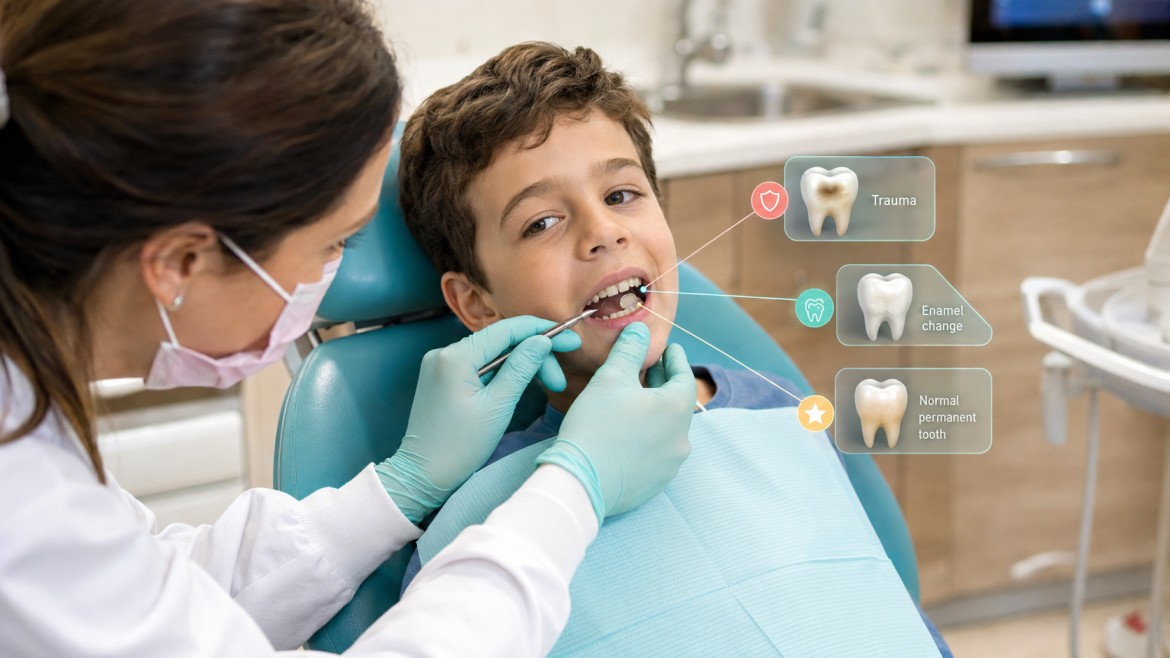
White or chalky spots on your child's teeth are the first visible sign of demineralization. They often appear near the gumline or between teeth. The enamel looks dull and opaque instead of shiny.
These spots are not stains. They are areas where minerals have been lost from the enamel. At this stage, the damage is still reversible with consistent fluoride use and dietary changes.
Does Sensitivity to Hot, Cold, or Sweet Signal a Problem?
Yes. When your child flinches from a cold drink or a sweet snack, the enamel may have thinned enough for temperature changes to reach the nerve. This level of sensitivity usually means decay has progressed past the earliest stage.
It does not always mean a filling is needed right away, but it does mean you should schedule a dental visit promptly. Waiting tends to make the situation more complex and more expensive.
What Does Brown, Yellow, or Black Discoloration Mean?
Brown, yellow, or black spots on baby teeth often signal active decay. Some surface staining is harmless and comes from food or iron supplements. However, a brown or black lesion that feels soft or rough to the tongue is a different matter entirely.
Do not try to judge this at home. A pediatric dentist can tell the difference in seconds with a visual exam and, if needed, an X-ray.
How Does Early Decay Progress Into a Full Cavity?
Early decay follows a predictable path: white spot to brown spot to soft enamel to a hole in the tooth. The speed of that progression depends on how often acid attacks happen, how much fluoride the child gets, and whether the mouth has a chance to remineralize between meals.
Children who snack constantly and rarely brush give bacteria a near-perfect environment to thrive. Children who brush twice daily, drink fluoridated water, and see their dentist regularly slow that progression significantly.
Can Early Tooth Decay Be Reversed?
This is the question parents ask most often after a dentist visit. The honest answer is: it depends on how far the decay has progressed.
When Can Remineralization Repair Enamel?
Remineralization can repair enamel when decay is limited to the outer enamel surface. At the white spot stage, the enamel structure is still intact underneath. With daily fluoride use, reduced sugar exposure, and professional fluoride treatments, the body can fill in those mineral gaps and harden the surface again.
Research published by the National Institute of Dental and Craniofacial Research confirms that fluoride actively encourages this remineralization process, making it faster and more effective than the body's natural repair alone.
How Do You Know If Decay Is Still Reversible?
Signs that decay may still be reversible include:
- White or chalky spots that have not yet turned brown
- No visible hole or pit in the tooth surface
- Mild or no sensitivity
- Early detection at a routine dental checkup (before symptoms appear)
Your pediatric dentist will assess this at every checkup. This is another strong reason why six-month visits matter, even when your child seems fine.
When Does a Filling Become Necessary?
A filling becomes necessary when decay has broken through the enamel and entered the dentin. At that point, the softened tooth structure cannot remineralize. It must be removed and replaced with a filling material to prevent the decay from reaching the nerve.
The longer you wait at this stage, the deeper the decay goes. A small filling today prevents a root canal or extraction later.
How to Prevent Cavities in Kids at Home
Home care is the foundation of cavity prevention. Professional treatments help, but they cannot replace what happens in your bathroom twice a day.
How Do You Establish a Twice-Daily Brushing Routine?
Brushing twice a day, once in the morning and once before bed, is the single most important habit for preventing cavities in kids. The bedtime brush matters most. Saliva flow drops during sleep, which means bacteria have a longer window to produce acid without the natural rinse effect of saliva.
Make brushing non-negotiable at the same time every day. Use a timer, a song, or a brushing app to make two minutes feel manageable for young children. Consistency builds the habit faster than any reward system.
How Do You Choose the Right Fluoride Toothpaste by Age?
Not all toothpaste is created equal for children. Here is a simple breakdown by age:
- Under 3 years: Use fluoride toothpaste with at least 1,000 ppm fluoride. A grain-of-rice amount only.
- Ages 3–6: A pea-sized amount of fluoride toothpaste (1,000–1,450 ppm).
- Ages 6 and up: Adult-strength fluoride toothpaste is appropriate. Continue with a pea-sized amount until they consistently spit rather than swallow.
Check the label before you buy. "Training toothpaste" and many children's toothpastes marketed for toddlers often contain no fluoride, which means they offer almost no cavity protection.
How Much Toothpaste Should Children Use?
Amount matters as much as frequency. Too little toothpaste means not enough fluoride contact. Too much, especially in children under 6 who tend to swallow, can lead to mild dental fluorosis, white streaking on permanent teeth from excess fluoride ingestion.
Stick to the rice grain or pea-sized guidance above. Supervise your child's brushing until they consistently spit and rinse on their own, usually around age 6 to 7.
What Is the Right Brushing Technique for Kids?
Young children do not have the dexterity to brush effectively on their own until around age 7 or 8. Until then, you should brush their teeth for them, or at minimum, finish up after they try on their own.
Use a soft-bristled toothbrush angled at 45 degrees toward the gumline. Brush in small circular motions, covering all surfaces: outer, inner, and the chewing surface of each tooth. Two minutes total is the goal. Spend 30 seconds on each quadrant of the mouth.
When and How Should Children Start Flossing?
Start flossing as soon as two teeth touch each other. For most children, this happens around ages 2 to 3. A toothbrush cannot clean between teeth where surfaces are in contact. That gap is where a significant number of childhood cavities start.
Floss picks designed for children make this easier for parents. Wrap floss in a C-shape around each tooth and slide gently under the gumline, rather than snapping the floss between teeth, which can cause gum soreness.
What Fluoride Sources Help Prevent Cavities in Kids?
Fluoride works through multiple channels. The more sources your child gets safely, the stronger the protection:
- Fluoride toothpaste — the most accessible daily source
- Fluoridated tap water — drinking water in most U.S. cities contains added fluoride at the level recommended by the American Dental Association (ADA)
- Fluoride varnish — applied by a dentist at checkups
- Fluoride supplements — prescribed by a dentist if your local water is not fluoridated
Check your local water fluoride level at My Water's Fluoride (CDC), a free tool that takes 30 seconds to use.
What Are Age-Specific Oral Care Tips That Actually Work?
Ages 0–1: Wipe gums with a clean damp cloth after feeding. Start brushing when the first tooth appears.
Ages 1–3: Use a soft-bristled infant toothbrush twice daily. Limit sippy cup use to water between meals.
Ages 3–6: Supervise brushing completely. Begin flossing when teeth touch. First dental visit should already be established by age 1 (or first tooth), per the American Academy of Pediatric Dentistry.
Ages 6–12: Children may brush independently but still need parental checks. Permanent molars erupt around age 6 — this is a key time to ask your dentist about sealants.
What Is the Connection Between Diet and Tooth Decay?
What your child eats and drinks directly shapes how much acid their teeth face every day. Diet is often the most underestimated factor in childhood cavities.
Why Does Frequent Sugar Exposure Cause More Damage?
Think of it this way: every time your child eats something sugary, bacteria produce acid for about 20 minutes. If your child eats three sugar-heavy meals a day, their teeth face 60 minutes of acid exposure daily. But if they snack on sugary foods six times a day, that exposure climbs to two full hours.
It is not the total amount of sugar that matters most. It is how often sugar hits the teeth. A piece of candy after lunch is less damaging than sipping juice slowly through the afternoon.
Which Foods and Drinks Increase Cavity Risk?
The biggest offenders include:
- Sugary drinks: juice, sports drinks, flavored milk, soda
- Sticky sweets: gummies, dried fruit, fruit leather, caramel
- Starchy snacks: crackers, chips, and white bread (these break down into sugar quickly)
- Frequent grazing: any food eaten continuously between meals keeps acid levels elevated
Sippy cups filled with juice and carried around all day are one of the most common causes of severe early childhood tooth decay, sometimes called baby bottle tooth decay.
Which Foods Support Strong Enamel?
Not all foods are the enemy. Some actually help protect teeth:
- Cheese and plain yogurt stimulate saliva and contain calcium that supports enamel
- Crunchy vegetables like carrots and celery increase saliva flow and gently clean tooth surfaces
- Nuts and seeds provide calcium and phosphate without added sugar
- Plain milk contains calcium and phosphates; it is far better between meals than juice
Ending a meal with a small piece of cheese is a simple habit that helps neutralize acid and support remineralization.
Why Does Water Help Protect Your Child's Teeth?
Drinking water, especially fluoridated tap water, is one of the simplest and most effective ways to protect teeth. Water rinses food particles and sugar off tooth surfaces between meals. Fluoridated water actively supports remineralization throughout the day.
Replacing juice, sports drinks, or flavored water with plain water between meals makes a measurable difference in cavity risk over time.
What Professional Treatments Prevent and Reverse Decay?
Home care alone is not always enough, particularly for children at higher risk. Pediatric dentists have several professional tools that dramatically reduce cavity risk or stop early decay in its tracks.
How Does Fluoride Varnish Work?
Fluoride varnish is a concentrated fluoride treatment painted directly onto tooth surfaces at your child's dental checkup. It hardens on contact with saliva and releases fluoride into the enamel over several hours.
The American Academy of Pediatric Dentistry recommends fluoride varnish applications every three to six months for children at risk of cavities. Research shows it reduces cavities in primary teeth by up to 37%, according to a Cochrane systematic review. It takes less than five minutes and is well-tolerated even by very young children.
What Is Silver Diamine Fluoride (SDF)?
Silver Diamine Fluoride (SDF): a liquid treatment applied to decayed tooth surfaces that stops active decay without drilling. It is FDA-approved for dental use and has been used in countries like Japan for over 50 years.
How Does SDF Stop Decay?
SDF works through two mechanisms. The silver kills the bacteria causing decay. The fluoride strengthens the remaining enamel and promotes remineralization. Together, they arrest the decay process, meaning they stop it from getting worse.
A single application takes less than a minute per tooth. No anesthesia, no drilling, no tears.
What Are the Benefits of SDF for Children?
SDF is particularly valuable for:
- Young children who cannot tolerate traditional drilling
- Children with multiple cavities needing priority treatment
- Managing decay on baby teeth that will fall out naturally
- High-risk children as a preventive measure on cavity-prone teeth
Because it is fast, painless, and highly effective, SDF has become one of the most important tools in modern pediatric dentistry.
Does SDF Leave Black Staining on Teeth?
Yes. SDF turns the decayed portion of a tooth permanently black. This is a known and expected result of the treatment. It can be alarming if you are not prepared for it, but it is not harmful. The black staining confirms that the decay has been arrested.
For front teeth where appearance matters, your dentist may offer tooth-colored fillings to cover the treated area. For back teeth, the staining is generally not visible and is considered an acceptable trade-off for avoiding more invasive treatment.
How Do Dental Sealants Protect Teeth?
Dental sealants are thin plastic coatings applied to the chewing surfaces of back molars to seal out food and bacteria. The grooves on molar surfaces are deep and narrow, making them nearly impossible to clean with a toothbrush alone.
Sealants fill those grooves and create a smooth surface that brushing can actually clean. According to the CDC, sealants prevent 80% of cavities in back teeth in the two years after application and continue protecting for up to nine years.
How Are Sealants Applied?
The process is simple and completely painless:
- The tooth surface is cleaned and lightly etched to help the sealant bond
- The liquid sealant is painted onto the grooves
- A special curing light hardens it in seconds
- The dentist checks your child's bite and trims any excess
No needles, no drilling. The whole process takes about a minute per tooth.
What Is the Best Age for Dental Sealants?
The best time for sealants is as soon as the permanent molars erupt. The first set of permanent molars typically comes in around age 6. The second set arrives around age 12. Sealing them immediately after eruption, before any decay starts, gives the longest protection.
Some dentists also place sealants on baby molars in high-risk children. Talk to your pediatric dentist about whether your child is a good candidate.
When Is Prevention No Longer Enough?
There comes a point where remineralization, fluoride, and sealants cannot undo the damage. Knowing the signs helps you act before the situation escalates further.
What Signs Show Decay Has Progressed Beyond Reversal?
- A visible hole, pit, or dark brown lesion on the tooth surface
- Pain when chewing or biting
- Persistent sensitivity that does not resolve between meals
- Swelling near the tooth or gumline
- A tooth that your child avoids using on one side
Any of these signs means the tooth needs professional treatment. Do not wait for the next scheduled checkup.
What Does Treatment Look Like at This Stage?
Treatment at this stage typically involves removing the decayed tissue and placing a filling. In young children, tooth-colored composite fillings or stainless steel crowns may be recommended depending on how much tooth structure remains. If decay has reached the nerve, a pulpotomy (a child's version of a root canal) may be needed.
None of these treatments are optional once decay reaches the dentin. The tooth will not heal on its own.
Why Does Early Action Save Time and Cost?
A filling placed early costs a fraction of the time, discomfort, and expense of a crown, pulpotomy, or extraction later. Children who receive prompt treatment for early decay also tend to have less dental anxiety long-term, because their dental experiences stay manageable rather than urgent.
This is why at Make Your Kids Smile, we always encourage parents not to postpone when something looks off. A five-minute checkup call often saves months of worry and a much larger treatment plan later.
Cavity Prevention and Early Treatment in Lafayette, LA
Parents in Lafayette have access to excellent pediatric dental care. Knowing when to use it and what to ask for makes all the difference.
When Should You Schedule a Pediatric Dental Appointment?
Schedule an appointment:
- At the appearance of your child's first tooth, or by age 1 (whichever comes first)
- Every six months for routine checkups and cleaning
- Immediately if you notice white spots, brown spots, sensitivity, or any pain
- Before starting school, to establish a dental home and assess cavity risk
Early, routine visits build familiarity and reduce fear. Children who visit the dentist early and regularly tend to need far less restorative care over time.
What Are Fluoride Treatments and Sealants Like in Lafayette?
At Make Your Kids Smile, fluoride varnish applications and dental sealants are both quick, comfortable, and completed at the same visit in most cases. Parents sit with their child throughout the appointment. Treatment times are short, typically under 30 minutes for a preventive visit.
If your child needs restorative dentistry for a cavity that has already formed, our team explains every step before we begin. No surprises. No rushing.
What Should You Look for in a Pediatric Dentist?
Look for a dentist who:
- Holds board certification in pediatric dentistry
- Offers preventive treatments like sealants and fluoride varnish as routine services
- Uses age-appropriate language with children and keeps appointments calm
- Welcomes parent questions and explains findings clearly
- Accepts your insurance and makes scheduling easy
Comfort and trust matter. Your child's experience at age 3 shapes how they feel about dental visits at age 13 and beyond.
Conclusion
Preventing cavities in kids comes down to three things: consistent daily habits, the right fluoride, and professional support before problems grow. When you brush twice daily, limit how often your child has sugar, drink fluoridated water, and keep up with dental checkups, you give your child's teeth the strongest possible defense. And when decay does start, catching it at the white spot stage means you can often reverse it without any drilling at all.
At Make Your Kids Smile, we work with Lafayette families every day to build healthy habits, apply preventive treatments, and catch early decay before it becomes a bigger problem. Our team understands that a child's dental experience shapes their relationship with oral health for the rest of their life, which is why we make every visit as easy and positive as possible.
If you are ready to take the next step, we are here to help. Book a fluoride treatment or sealant appointment for your child today, and let us build a prevention plan that fits your family. And if you want to understand more about how cavities actually form in the first place, our guide to what causes cavities in children explains the full picture from the start.
Frequently Asked Questions
At what age should I start worrying about cavities in my child's teeth?
Start taking cavity prevention seriously at the appearance of your child's first tooth, usually around 6 months. Baby teeth are more vulnerable to decay than permanent teeth because their enamel is thinner. The American Academy of Pediatric Dentistry recommends a first dental visit by age 1.
Can baby teeth get cavities if they are just going to fall out anyway?
Yes, and it matters more than most parents realize. Cavities in baby teeth cause pain, infection, and early tooth loss. Losing a baby tooth too early can cause the surrounding teeth to shift, crowding the space needed for permanent teeth to erupt correctly.
How do I brush my toddler's teeth when they refuse?
Make it a routine, not a request. Use a soft toothbrush with a small head, a rice-grain amount of fluoride toothpaste, and a consistent time each morning and night. Distraction with a song or video helps. Let them hold a second toothbrush so they feel some control. If refusal is extreme, bring it up at your next dental visit.
Is fluoride safe for young children?
Yes. Fluoride in appropriate doses is safe and highly effective at preventing cavities. The risk of dental fluorosis (white streaking from too much fluoride) is real but preventable by using the correct amount of toothpaste by age. The CDC, ADA, and World Health Organization all support fluoride use in children for cavity prevention.
How long do dental sealants last?
According to the CDC, dental sealants can protect teeth for up to nine years with proper care. They should be checked at every dental visit. Sealants that chip or wear down can be easily reapplied. Most children get them around age 6 and again at age 12 when the second set of permanent molars comes in.
What is the difference between a cavity and early tooth decay?
Early tooth decay, called a white spot lesion, is enamel damage that has not yet formed a hole in the tooth. At this stage, it can still be reversed with fluoride and dietary changes. A cavity is a hole in the tooth that has broken through the enamel. It requires professional treatment and cannot heal on its own.
.jpg)