.png)
Interceptive orthodontic appliances are early treatment devices that guide jaw growth and tooth position in children between ages 6 and 12. They correct crossbites, narrow jaws, crowding, and thumb habits while the facial bones are still growing. Treating early often shortens later braces treatment, and in some cases it prevents extractions or surgery entirely.
Key Takeaways
- The American Association of Orthodontists recommends a first orthodontic check by age 7, not because braces start then, but because that is when a narrow jaw or a developing crossbite first becomes visible and correctable.
- A palatal expander can widen a child's upper jaw in three to six months, while the same correction attempted after age 14 usually requires surgical assistance.
- Losing a baby molar early can permanently cost your child arch space, so a space maintainer costing a few hundred dollars often prevents thousands in later treatment.
- Most children who complete early treatment still need braces afterward, which means interceptive care shortens and simplifies the second phase rather than replacing it.
- Dental plans usually cover early orthodontics under a separate lifetime maximum, so using that benefit now reduces what remains available for teen braces.
Your child's dentist just mentioned early orthodontic treatment, and now you are wondering whether any of this is really necessary at age 7. That reaction is completely normal, because most parents picture braces on teenagers rather than appliances inside a mouth still full of baby teeth. You may also be worried about paying for orthodontics twice.
Here is what changes the picture. Between ages 6 and 12, your child's jaw bones remain soft and actively growing, which gives an orthodontist a genuine chance to widen, hold, or redirect them. Once the growth spurt ends, that same problem usually needs a far bigger fix.
This guide walks you through every appliance type, what each one corrects, how long it stays in, and roughly what it costs. You will also learn the warning signs you can spot at home, how to care for an appliance day to day, and whether braces will still follow. By the end, you will know exactly which questions to ask at your child's first evaluation.
What Are Interceptive Orthodontic Appliances?
Interceptive orthodontic appliances are custom devices that correct bite and jaw problems while a child still has a mix of baby and permanent teeth.
The word "interceptive" says it plainly, because you are intercepting a problem before it fully develops. Instead of waiting for every permanent tooth to arrive, the orthodontist steps in during the years when growth can still be steered.
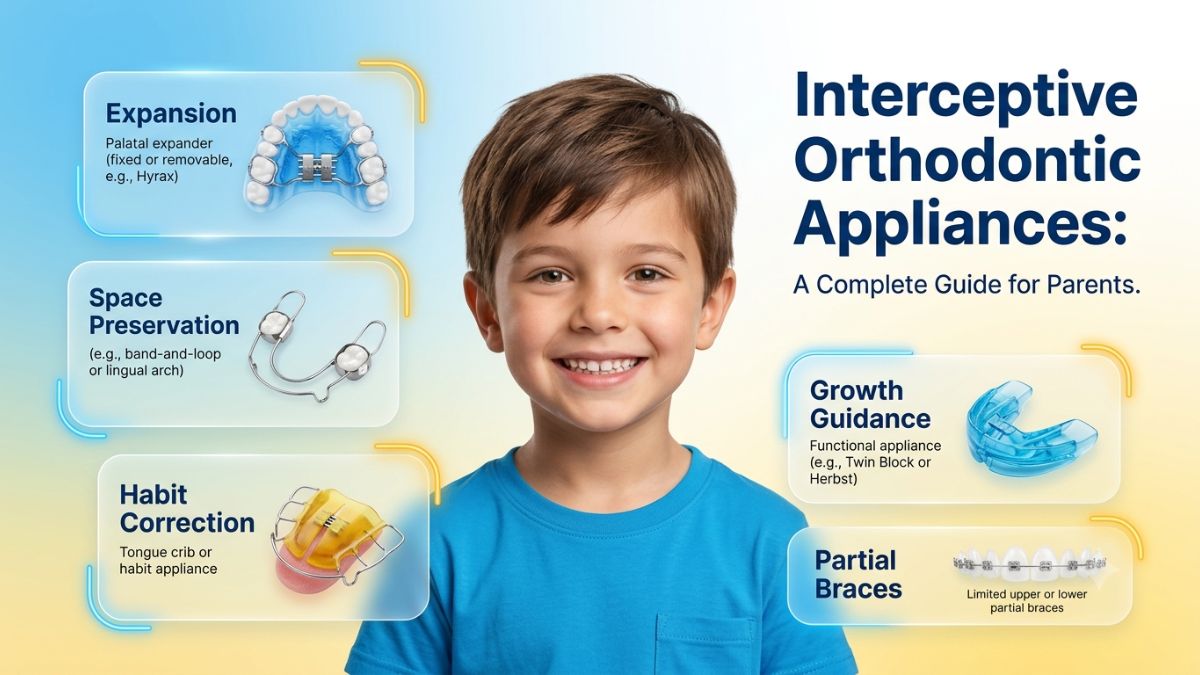
These appliances fall into four working groups: expanders, space holders, habit breakers, and growth modifiers. Some are cemented in place and stay there, while others come out for meals and cleaning.
How These Appliances Guide Growth Instead of Just Straightening Teeth
Braces move teeth through bone, whereas interceptive appliances change the bone itself, and that difference drives everything else in this article.
Your child's upper jaw has a seam running down the middle called the midpalatal suture, which stays open until roughly age 14 or 15. An expander applies gentle pressure across that seam, and new bone gradually fills the space that opens.
Think of it like staking a young tree. You are not bending a mature trunk into a new shape; you are simply guiding direction while the growth is still happening on its own.
This distinction matters for your budget too, because skeletal changes made during growth are usually permanent, while the same changes attempted in adulthood often require jaw surgery.
Interceptive Appliances vs. Traditional Braces: The Key Difference
Braces do one job extremely well, which is aligning individual teeth, but they cannot widen a jaw or reposition a lower jaw that sits too far back.
Interceptive appliances build the foundation, and braces then arrange the teeth on top of that foundation, which is why orthodontists describe the sequence as Phase 1 and Phase 2.
Once you understand that split, it becomes obvious why timing carries so much weight in early treatment.
Why the Timing of Appliance Treatment Matters
Timing decides whether a problem needs a straightforward appliance or an eventual surgical correction, and the difference between those two paths can be just a few years.
The Mixed Dentition Window (Ages 6–12)
Mixed dentition simply means your child has baby teeth and permanent teeth in the mouth at the same time, a stage that usually begins near age 6 and ends around age 12.
Three useful things happen together during these years. Permanent first molars erupt and anchor both arches, the jaw bones grow rapidly, and the palatal suture remains open enough to respond to gentle pressure.
Orthodontists call this the treatment window for good reason, because it closes quietly and most parents never notice it closing.
What Appliances Can Correct Now That Braces Cannot Correct Later?
Some corrections carry a genuine deadline, and these four come up most often in our Lafayette practice:
- Narrow upper jaw. An expander widens it within months before age 12, while correction after roughly age 15 usually requires surgically assisted expansion.
- Underbite from a small upper jaw. Reverse-pull headgear pulls the upper jaw forward, and it works best between ages 6 and 10 while the facial sutures still respond.
- Lost arch space. Once molars drift forward into an empty gap, that space rarely returns without extracting a permanent tooth later.
- Open bite from thumb sucking. Stopping the habit before the permanent front teeth settle often allows the bite to close on its own.
Each of these depends on active growth rather than on tooth position, which is exactly why braces alone cannot solve them.
Why Orthodontists Recommend an Evaluation by Age 7
The American Association of Orthodontists recommends that every child receive an orthodontic evaluation by age 7, and the American Academy of Pediatric Dentistry offers similar early screening guidance.
Why age 7 specifically? By then the first permanent molars and the front incisors have usually erupted, and those teeth reveal the bite pattern that the rest of the mouth will follow.
Most children evaluated at 7 need nothing at all and are simply placed on monitoring. That single visit, however, catches the smaller group of children who benefit enormously from acting during this window.
So what should you actually be watching for between dental checkups?
Signs Your Child May Need an Interceptive Appliance
You do not need any clinical training to spot most early red flags, since the majority show up during ordinary moments at home.
Bite and Alignment Warning Signs
Watch for these while your child brushes, smiles, or bites down normally:
- Crowded or overlapping permanent teeth
- Upper teeth biting inside the lower teeth, known as a crossbite
- Upper front teeth covering more than half the lower teeth, known as a deep overbite
- Lower jaw sitting ahead of the upper jaw, known as an underbite
- Front teeth that do not touch when the back teeth close, known as an open bite
- Baby teeth lost much earlier than expected
- Permanent teeth that fail to erupt on schedule
A crossbite deserves particular attention, because children frequently shift the lower jaw sideways to bite comfortably, and that shift can become a lasting habit.
Habit and Airway Warning Signs
Some of the most telling signs have nothing to do with how the teeth actually look:
- Thumb or finger sucking past age four
- Tongue pushing forward against the front teeth when swallowing
- Chronic mouth breathing
- Snoring or restless sleep
- Difficulty pronouncing "s" and "th" sounds
Mouth breathing matters more than most parents realize, since constant open-mouth posture changes where the tongue rests, and tongue position helps shape the developing upper arch.
One family came to us concerned about crowding, but the real driver turned out to be nightly mouth breathing linked to enlarged tonsils. Coordinating with their pediatrician changed the entire treatment plan before a single appliance was placed.
What Parents Notice at Home vs. What an Orthodontist Sees on an X-Ray
You see the surface, while a panoramic X-ray shows everything happening beneath it.
Below the gumline, an orthodontist checks whether the permanent teeth exist at all, since some children are missing teeth entirely, and others have canines angled toward neighboring roots in a pattern called impaction.
An X-ray also reveals root development and eruption sequence, which means a tooth that looks worryingly late may be perfectly on track, or it may be genuinely blocked.
That hidden layer explains why observation at home starts the conversation but can never finish it.
Types of Interceptive Orthodontic Appliances
The right interceptive orthodontic appliance depends entirely on which specific problem needs solving, so the same child rarely needs more than one or two.
Expansion Appliances
Expansion appliances widen a narrow dental arch to create room for permanent teeth and to correct crossbites.
Rapid Palatal Expander (RPE)
Rapid palatal expander: a fixed appliance cemented to the upper molars that widens the upper jaw by gradually opening the midpalatal suture.
You turn a small key once or twice daily at home, and each turn moves the two halves a fraction of a millimeter, which means active expansion usually finishes within three to six months.
A gap often appears between the upper front teeth during this period, and parents almost always worry when they first see it. That gap normally closes on its own within a few weeks.
The appliance then stays in place for several more months so newly formed bone can harden and hold the width.
Removable (Schwarz) Expander
A Schwarz expander looks like a retainer with a screw set into the middle, and your child removes it to eat and brush.
It expands more slowly and produces mostly dental movement rather than true skeletal change, so it suits mild arch narrowing rather than a genuine skeletal crossbite.
Success depends entirely on wear time. An appliance sitting in a drawer is not a treatment plan.
Space-Holding Appliances
Space maintainers preserve room for permanent teeth after a baby tooth is lost earlier than nature intended.
Band-and-Loop Space Maintainer
This appliance holds the gap where a single baby molar was lost early, using a metal band around a neighboring tooth and a wire loop that reaches across the space.
It does not move anything, since its only job is blocking drift.
The cost is modest compared with what happens without it, because when a molar drifts forward, the permanent tooth waiting underneath can become impacted and require surgical exposure.
Lower Lingual Holding Arch (LLHA)
An LLHA connects both lower first molars with a wire that runs behind the lower front teeth, preserving space across the entire lower arch rather than in one spot.
Orthodontists often place it when several baby molars are expected to fall out around the same time.
Transpalatal Arch (TPA)
A TPA links the upper molars with a wire crossing the roof of the mouth, controlling molar position and adding stability during other treatment.
Children usually adapt within a few days, although speech feels strange at first.
Habit-Breaking Appliances
Tongue Crib and Thumb Habit Appliances
A tongue crib is a small wire fence placed behind the upper front teeth, and it blocks the thumb or the tongue from pressing forward against them.
The appliance is not a punishment, and framing it that way reliably backfires with children. Explain it instead as a reminder helper.
Most habits stop within two to three months, though the appliance stays a while longer to prevent the habit from returning.
The American Academy of Pediatric Dentistry notes that most children stop sucking habits naturally between ages 2 and 4, which is why persistence past age 4 brings appliances into the conversation.
Growth-Modifying (Functional) Appliances
Bionator, Twin Block, and Herbst Appliances
These appliances hold the lower jaw in a forward position during growth, and over time the jaw and joint adapt to that new posture.
A Twin Block uses two removable plates that guide the bite forward, while a Herbst appliance does similar work but stays fixed in the mouth throughout treatment.
Orthodontists time these around the peak growth spurt, often between ages 9 and 13. Starting too early wastes available growth, and starting too late misses it altogether.
Reverse-Pull Headgear (Facemask)
A facemask pulls an underdeveloped upper jaw forward, resting against the forehead and chin while connecting to an expander inside the mouth.
Children wear it at home and while sleeping, typically 12 to 14 hours daily, so nobody wears it to school.
Research suggests results are strongest before age 10, while the facial sutures remain responsive to that forward pull.
Cervical Headgear
Cervical headgear restrains excessive upper jaw growth in children with a large overjet, using a strap that runs behind the neck and connects to bands on the upper molars.
Like the facemask, it works only during evening and sleeping hours.
Partial (Phase 1) Braces
Sometimes a few brackets on already-erupted front teeth solve the problem entirely, correcting a front crossbite or aligning incisors that are trapped in the wrong position.
They usually stay on for 6 to 12 months, and full braces follow years later once the remaining permanent teeth arrive.
Interceptive Appliance Comparison Chart
Notice how often that chart divides appliances into fixed and removable, because that single choice affects your results more than almost any other factor.
Fixed vs. Removable Appliances: Which Works Better?
Neither category wins outright, so the more useful question is which one actually fits your child and your household.
Where Fixed Appliances Have the Advantage
Fixed appliances work around the clock, which means your child cannot forget them, lose them, or leave them behind on a lunch tray.
For skeletal problems, that consistency matters enormously, since an expander needs steady and uninterrupted pressure to open a suture properly.
The trade-off is cleaning, because food traps around the bands and brushing takes noticeably more time and attention.
Where Removable Appliances Have the Advantage
Removable appliances come out for meals, brushing, and sports, so hygiene stays simpler and most children find them more comfortable overall.
They also cost less to repair, since a misplaced retainer-style expander is an inconvenience rather than an emergency.
Their success, however, rests on one variable that nobody in the office can control.
How Your Child's Compliance Changes the Recommendation
Compliance simply means wearing the appliance as instructed, every day, for as long as the plan requires.
Before recommending headgear or a Twin Block, we talk honestly with parents about whether their child will realistically wear it 12 hours a day for a year. Some children absolutely will, and others will not.
A fixed appliance that works imperfectly still beats a removable appliance sitting in a backpack, which is not a judgment of your child but simply planning around reality.
How the Right Appliance Is Selected for Your Child
Appliance selection follows diagnostic evidence rather than preference, and the records come first every time.
Diagnostic Records That Drive the Decision
A complete evaluation usually includes four records. A panoramic X-ray shows developing teeth and roots, while a lateral cephalometric X-ray measures the jaw relationship in profile.
Photographs document the face and bite from several angles, and digital scans or impressions create a working model of both arches.
Together, these records answer one central question: is this problem sitting in the teeth, or is it sitting in the bones?
Skeletal Problems vs. Dental Problems: Why the Distinction Matters
A dental crossbite means a single tooth has tipped the wrong way, whereas a skeletal crossbite means the entire upper jaw is too narrow.
In the mirror, they look almost identical, yet their treatments differ completely.
Tipping a tooth back into position takes weeks with a simple appliance, while widening a jaw requires an expander and an open growth window. Choosing the wrong one wastes both time and money.
When Watchful Monitoring Is the Better Choice Than Treating Now
Not every finding needs an appliance today, since mild crowding at age 7 frequently resolves on its own as the jaw grows and larger permanent teeth replace baby molars.
In those cases, we schedule observation visits every 6 to 12 months, track growth, and charge nothing extra for the monitoring itself.
Rushing into treatment can turn one necessary phase into two, and a good orthodontist will tell you plainly when waiting is the smarter option. If you are unsure which category your child falls into, the team at Dr. Leslie Jacobs Pediatric Dentistry can walk you through the records at your first visit.
What to Expect From Fitting Through Removal
Knowing the sequence in advance removes most of the anxiety, both for you and for your child.
The Fitting Appointment
The first appointment usually takes 30 to 60 minutes, and for fixed appliances, small separators may go between the molars about a week earlier to create room for the bands.
Fitting itself is not painful, since your child mainly feels pressure and hears some clicking.
Before you leave, you will practice any at-home turns yourself while we watch. Never guess at this step.
The First Two Weeks: Soreness, Speech Changes, and Eating
Expect three to five days of tenderness, which over-the-counter children's pain relief usually handles without difficulty.
Speech changes surprise families more than soreness does, because words containing "s" and "sh" sound different when the tongue has less room to move. Reading aloud for fifteen minutes a day speeds up that adaptation dramatically.
Soft foods help during the first week, so think pasta, eggs, yogurt, soup, and bananas rather than anything requiring a hard bite.
Extra saliva is also completely normal early on, and it settles within days.
Adjustment and Progress Visits
Most children return every 4 to 8 weeks, and these visits are short, often lasting only 15 to 20 minutes.
We check cement integrity, tissue health, and actual movement measured against the original plan, then take progress photos your child can genuinely see change in.
How Long Interceptive Appliance Treatment Usually Takes
Most Phase 1 treatment runs between 6 and 18 months, with expanders finishing their active work faster but remaining in place to stabilize the result.
After removal, a resting period usually follows, during which your child wears a retainer and simply grows for two or three years before Phase 2 begins.
Factors That Can Extend Treatment Time
Several things reliably stretch the timeline:
- Missed appointments or long gaps between visits
- Broken bands, loose cement, or lost removable appliances
- Inconsistent wear with headgear or functional appliances
- Continued thumb sucking or tongue thrusting during correction
- Unexpected eruption patterns or delayed permanent teeth
Most of these are preventable, and consistent daily care at home eliminates the majority of them.
Caring for Your Child's Appliance at Home
Good home care protects both the appliance itself and the enamel sitting underneath it.
Daily Cleaning Routine for Fixed and Removable Appliances
For fixed appliances, brush after every meal whenever possible, angling the brush toward the gumline and working carefully around each band.
A water flosser reaches areas a toothbrush simply cannot, and many families find it considerably faster than threading floss under wires each night.
For removable appliances, rinse immediately after every removal and brush the appliance gently with a soft brush and cool water, since hot water warps acrylic permanently.
Soaking in a denture-style cleanser once or twice weekly controls odor and mineral buildup.
The National Institute of Dental and Craniofacial Research continues to emphasize daily fluoride toothpaste use for children in orthodontic treatment, because appliances noticeably increase plaque retention.
Foods and Habits to Avoid
Certain foods break appliances with predictable regularity:
- Hard candy, ice, and nuts
- Sticky caramel, taffy, and chewing gum
- Popcorn, especially unpopped kernels
- Whole raw carrots and apples, unless cut into pieces first
- Chewing on pencils, straws, or fingernails
Cutting food into smaller pieces solves most of this without banning your child's favorites outright.
What to Do If the Appliance Loosens, Breaks, or Causes Pain
Call the office the same day for a loose band or a broken wire, because a loose expander can shift sideways and injure the soft tissue around it.
For a poking wire, cover the end with orthodontic wax as a temporary fix until you can be seen. Never cut wires at home.
If a removable appliance goes missing, stop and call rather than waiting, since a few weeks without it can undo months of movement.
Pain that lasts beyond a week is not typical and always deserves an examination.
Results, Limitations, and Whether Braces Will Still Be Needed
Honest expectations matter more in this section than optimism does, so here is the realistic picture.
What Interceptive Appliances Realistically Achieve
Early treatment reliably delivers several outcomes, starting with crossbite correction and the elimination of the jaw shift that usually accompanies it.
It creates arch width that reduces crowding severity later, preserves space that lowers the chance of impacted canines, and reduces injury risk for front teeth that stick out noticeably.
One benefit gets overlooked in clinical discussions. Children who stop feeling self-conscious about their front teeth at age 8 tend to carry that confidence forward for years.
Limitations and Risks Parents Should Understand
Interceptive treatment cannot guarantee your child avoids braces, and it cannot predict every eruption pattern several years in advance.
The risks are generally minor but genuinely real, including temporary discomfort, gum irritation, white decalcification spots caused by poor hygiene, and relapse when retention is skipped.
Two-phase treatment also costs more in total than a single phase would, and that trade-off buys a better foundation rather than a discount.
Research on early Class II treatment suggests the clearest measurable benefit is reduced trauma risk to protruding front teeth, rather than a shorter total treatment time, so ask your orthodontist to explain the specific benefit in your child's case.
Will My Child Still Need Braces Later?
Usually yes, since most children who complete Phase 1 still need braces or aligners during their teenage years.
Phase 1 corrects the foundation, and Phase 2 arranges the finished permanent teeth on top of it.
The real difference shows up in complexity, because Phase 2 is often shorter and permanent tooth extractions become considerably less likely.
Retainers and Holding the Result After Appliance Removal
Retention begins the day the appliance comes off, because both teeth and bone naturally want to drift back toward their old positions.
Your child may wear a retainer nightly, or a holding appliance may simply stay in place until Phase 2 begins.
Skipping retention is the single most common reason early results disappear. Would you rebuild a fence and then leave the gate open?
Cost and Insurance for Interceptive Appliances
Cost varies widely by appliance type and by region, so treat any figure you find online as a starting point rather than a quote.
What Drives the Price of an Appliance
Four factors set the price. Appliance complexity comes first, since a simple space maintainer costs far less than a functional appliance with laboratory work behind it.
Diagnostic records come second, followed by the number of adjustment visits across treatment, and finally whether the case needs one appliance or several in sequence.
Simple space maintainers typically fall in the low hundreds, while expanders and functional appliances usually run into the low thousands depending on the practice and the plan.
Always ask for a written treatment estimate before starting, and make sure it lists records, the appliance, every visit, and retention.
How Dental Insurance Typically Handles Early Orthodontic Treatment
Most dental plans include a separate lifetime orthodontic maximum, and that benefit does not reset each year the way general dental coverage does.
Here is the part families most often miss. Using part of that maximum for Phase 1 directly reduces what remains available for teen braces later.
Many plans also apply an age limit, and some exclude orthodontic coverage entirely before a certain age, although space maintainers sometimes fall under general dental benefits instead.
Our team verifies your specific plan before treatment begins, so you see real numbers rather than estimates.
Payment and Financing Options
Most practices offer monthly payment plans spread across the treatment period, usually with a modest down payment at the start.
HSA and FSA dollars generally apply to orthodontic care, and third-party financing options exist for families who prefer them.
Ask whether your practice offers a discount for paying in full, since small savings add up meaningfully across a two-phase plan.
Frequently Asked Questions About Interceptive Appliances
At what age should my child get an interceptive orthodontic appliance?
Most interceptive appliances are placed between ages 6 and 12, during mixed dentition. The American Association of Orthodontists recommends an evaluation by age 7. Expanders and facemasks work best before ages 10 to 12, while functional appliances usually wait until the growth spurt near ages 9 to 13.
Does a palatal expander hurt my child?
No, expanders create pressure rather than sharp pain. Most children feel tightness for a few minutes after each turn, along with mild soreness during the first three to five days. Children's over-the-counter pain relief usually handles it comfortably. If discomfort lasts beyond a week, call your orthodontist for an examination.
Will interceptive treatment mean my child avoids braces completely?
Usually not, since most children who complete interceptive treatment still need braces or aligners afterward. Early treatment corrects jaw width, arch space, and bite foundation problems, while braces align the permanent teeth. The real benefit is a shorter second phase with a lower chance of permanent tooth extraction.
How long does my child wear an interceptive orthodontic appliance?
Wear time depends entirely on the appliance. Space maintainers stay until the permanent tooth erupts, which can take years. Expanders finish active widening in three to six months, then hold for another three to six. Functional appliances and headgear typically require 9 to 18 months of consistent daily wear.
What happens if we wait instead of treating now?
Some problems stay stable and can safely be monitored, while others steadily worsen. A narrow jaw left untreated past the mid-teens usually requires surgical expansion, and lost arch space often leads to extracting a permanent tooth. Your orthodontist can tell you which category your child's specific issue falls into.
Does dental insurance cover early orthodontic treatment?
Many plans do, through a separate lifetime orthodontic maximum. Coverage varies widely, however, and some plans set minimum age requirements before benefits apply. Space maintainers sometimes qualify under general dental benefits instead of orthodontic ones. Ask your provider to verify your exact plan and remaining benefit before committing.
Interceptive Orthodontic Appliances for Lafayette Families
Deciding whether to treat your child now is genuinely difficult, and you have just covered a great deal of ground. You now know the warning signs, from crossbites and early tooth loss through thumb habits and mouth breathing, along with which appliance addresses which problem and roughly how long each takes.
The single most useful takeaway is timing, because interceptive orthodontic appliances work specifically while your child's jaw bones are still growing and responsive to gentle pressure. That window does not stay open forever, and an evaluation costs you nothing more than an hour of your afternoon. At Dr. Leslie Jacobs Pediatric Dentistry, we see plenty of children who need nothing but monitoring, and we tell those parents exactly that.
We would always rather check early and reassure you than treat late and watch your options narrow. Schedule a complimentary early orthodontic evaluation at our Lafayette office, and we will review the records with you in plain language you can act on. You can also read more about our interceptive orthodontic appliance services, or simply call us to ask whether the sign you noticed at home warrants a visit right now.
.jpg)