.png)
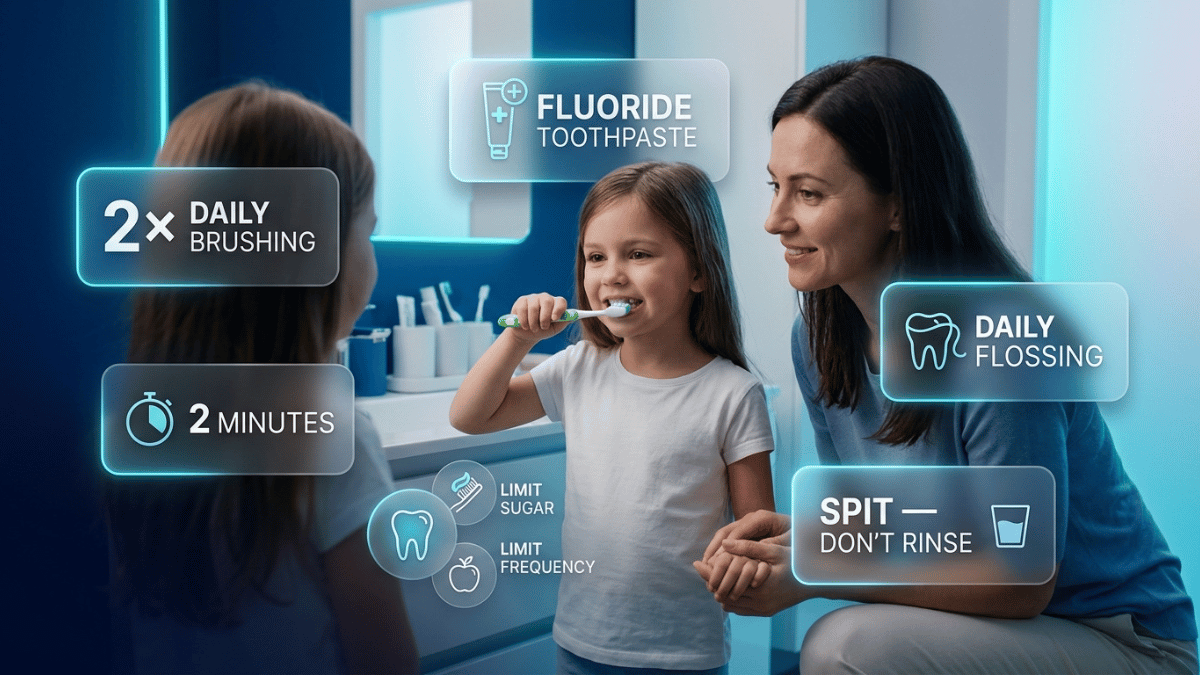
Oral hygiene instructions for children mean brushing twice daily with fluoride toothpaste, cleaning between the teeth once a day, and limiting how often sugar hits the teeth. Parents should brush for children under 6 and supervise until about age 9. Most children need a dental checkup every six months.
KEY TAKEAWAYS
- Use a rice-grain smear of fluoride toothpaste from the first tooth to age 3, then a pea-size amount after that.
- Have your child spit without rinsing, because water washes away the fluoride that is still working.
- Start cleaning between the teeth the day two teeth touch, which usually happens well before age 3.
- Sugar frequency does more damage than sugar quantity, so one dessert beats a drink sipped all afternoon.
- Most children need help brushing until roughly age 6 and supervision until they can tie their own shoelaces.
You brush your child's teeth every night, and you still worry it is not enough. That worry is fair, because plenty of careful parents sit in our chair hearing about a cavity they never saw coming. Brushing twice a day matters, though technique, timing, and what happens between meals matter just as much. The good news is that the fixes are small, and most of them cost nothing.
Children's mouths change constantly, so a routine that worked at 18 months stops fitting at 6, and again at 11. Toothpaste amounts change, responsibility shifts from you to them, and new risks appear with each stage. Having coached thousands of families through this, I can tell you that parents rarely fail on effort. They usually just get outdated instructions.
This guide covers what to do at every age, how to brush correctly, and what to try when your toddler fights you. You will also see when to start flossing, and how fluoride and sealants fit in. You will also find the warning signs worth a call, the snack swaps that actually help, and clear answers on mouthwash, water flossers, and electric brushes.
Why Your Child's Daily Routine Matters More Than You Think
Daily habits do more for your child's teeth than anything we do in the office. Prevention happens at your bathroom sink, and our job is mostly to catch what slips through.
How Plaque Forms and Why Daily Removal Is the Whole Point
Plaque: a soft, sticky film of bacteria that forms on teeth within hours of cleaning them. Those bacteria feed on sugars and starches from food, then release acid that pulls minerals out of enamel.
Enamel repairs itself between acid attacks, which is why timing matters so much. When plaque sits undisturbed, acid production never pauses long enough for that repair to happen, and a weak spot turns into a cavity. Brushing breaks the cycle mechanically, since no rinse or mouthwash removes plaque the way bristles do. Left alone for a few days, plaque hardens into tartar, which only a dental cleaning removes.
"They're Just Baby Teeth": Why That Thinking Causes Problems Later
Baby teeth fall out, so the logic feels reasonable until you see what a neglected one does on its way out. A decayed primary tooth hurts, disrupts sleep, and can abscess, and the infection sits directly above the permanent tooth forming underneath.
Losing one early also opens a gap that neighboring teeth drift into, which crowds the permanent tooth waiting to erupt. According to the CDC, roughly 1 in 5 children aged 5 to 11 has at least one untreated decayed tooth, and untreated decay is one of the most common chronic conditions of childhood. Baby teeth guide jaw growth, chewing, and speech, so they deserve the same care as adult teeth.
How Oral Health Connects to Your Child's Overall Health, Speech, and Sleep
A sore tooth changes how a child eats, and children with dental pain often avoid crunchy foods and shift toward soft, processed options. Sleep suffers too, since throbbing teeth wake kids at night and tired children struggle at school the next day.
Front teeth also shape certain sounds, so early loss can affect speech clarity while the gap stays open. Research links poor oral health in children to more missed school days, which surprises parents more than any other fact I share. Getting the routine right early prevents most of it, and that starts with matching the routine to your child's age.
Oral Hygiene Age by Age
Almost every question parents ask has a different answer depending on the child's age. This table is the quick version, and the sections that follow explain the reasoning behind each stage.
When Can My Child Brush Without My Help?
Most children lack the hand control for a thorough job until around age 6, and plenty need help past that. The classic benchmark still holds up: if your child cannot tie their own shoelaces or write neatly in cursive, their wrist control is not ready for the back molars.
A practical middle path works better than a hard cutoff. Let your child brush first, so they build the habit and feel ownership, then take a turn yourself and call it the checking pass. Handing over full responsibility usually fits somewhere between ages 7 and 9, though supervision should continue well into the tween years.
How to Tell Whether Your Child Is Actually Doing a Good Job
Run your fingernail or a clean fingertip along the gumline of the lower back teeth after they brush. If it feels fuzzy or slippery rather than squeaky, plaque is still there, and that spot is the one children miss most often.
Plaque disclosing tablets make it visual, staining leftover plaque bright pink so your child sees exactly what the brush skipped. Used once a week, they turn nagging into a game, and most kids fix their own technique within a month. Bleeding gums during brushing are another clue, since healthy gums do not bleed. Knowing where plaque hides is only useful if the technique itself is right.
How to Brush Your Child's Teeth Properly
Technique beats effort here, because two rushed minutes with the wrong motion leave more plaque than one careful minute with the right one.
Choosing the Right Toothbrush and Toothpaste for Their Age
Pick a soft-bristled brush with a head small enough to reach behind the last molar. Replace the flashy character handles if they stop your child from angling the brush properly. Soft bristles are not a compromise, since medium and hard bristles damage gums without cleaning better.
Use fluoride toothpaste from the very first tooth, with a rice-grain smear until age 3 and a pea-size amount after that. Both the American Academy of Pediatric Dentistry and the American Dental Association support fluoride toothpaste at these amounts for children under 3. That guidance changed from the older advice many parents still remember. Electric brushes work well for kids who like them, though a manual brush used correctly cleans just as thoroughly.
The Step-by-Step Brushing Technique
Follow the same sequence every night, since a fixed order is what stops surfaces from being skipped:
- Position your child so you can see clearly. Try knee-to-knee with a partner for babies and toddlers, or stand behind an older child with their head tilted back against you.
- Angle the bristles at 45 degrees toward the gumline, so they reach slightly under the gum edge where plaque starts.
- Use small gentle circles instead of a back-and-forth scrub, which skims the surface and irritates gums.
- Work through the outer surfaces, then the inner surfaces, then the chewing surfaces, in the same order every single time.
- Spend extra seconds on the back molars and the inside of the lower front teeth, where plaque collects fastest.
- Brush for two full minutes, timed rather than estimated, because most people stop near 45 seconds.
- Have your child spit but not rinse, which leaves the fluoride where it needs to be.
Brushing at night matters more than the morning round, since saliva flow drops during sleep and whatever sits on the teeth stays active for hours.
Why Spitting Without Rinsing Matters
Fluoride keeps working after brushing by staying on the tooth surface and rebuilding weakened enamel. Rinsing with water washes that layer away within seconds, which cancels part of the benefit you just spent two minutes creating.
Teach your child to spit the foam out and stop there: no cup, no swishing. Young children who cannot spit yet are fine with a rice-grain smear, because the amount is small enough to swallow safely. This one change costs nothing, and it is the tip parents most often tell me they had never heard.
When to Replace the Toothbrush
Swap the brush every three months, or sooner once the bristles splay outward, since bent bristles cannot reach along the gumline. Children who chew their brushes may need a new one monthly.
Replace it after any illness involving fever, strep, or a stomach bug. Store brushes upright and uncovered so they dry fully, and keep them from touching a sibling's brush. Good technique still fails, however, if getting the brush into the mouth turns into a nightly battle.
When Brushing Becomes a Fight
Resistance is normal developmental behavior rather than a sign you are doing something wrong, and almost every family hits this stage.
Why Toddlers Resist and What Actually Helps
Toddlers push back because brushing is something done to them at exactly the age when they want control over everything. Add an odd texture, a strong mint flavor, and being pinned down, and the reaction makes perfect sense.
Offer controlled choices rather than a yes or no question, since asking whether they want to brush invites the answer you do not want. Let them pick the brush color or which song plays, then brush regardless. Brushing your own teeth beside them works better than any lecture, because toddlers copy far more than they obey.
Positioning Techniques That Make Brushing Easier
Visibility is the whole battle, and most parents brush from the front where they cannot see the back teeth. For babies and toddlers, sit knee-to-knee with another adult, with the child's head resting in your lap facing up while your partner holds their hands gently.
Alone, lay your child across your lap on the bathroom floor, or stand behind them and tilt their head back against your body. That is exactly how we position children in the office. Both angles let you see every surface and stabilize the head, and children usually settle faster once they are not fighting for balance.
Timers, Charts, Songs, and Other Approaches Worth Trying
Two minutes feels endless to a four-year-old, so make the time visible rather than abstract. A sand timer, a two-minute song, or a brushing app that animates progress all work, and the novelty matters more than the specific tool.
Sticker charts help for a few weeks, then lose power, which is why rotating approaches beats perfecting one. Try letting your child brush your teeth first, or counting teeth out loud together as you go. One family I worked with solved months of screaming by letting their three-year-old brush a stuffed animal's teeth immediately before her own.
Brushing Support for Children With Sensory Sensitivities or Special Healthcare Needs
Children with sensory differences may react to the vibration, taste, foam, or the feeling of being held, and pushing through rarely works. Start by removing one variable at a time: try an unflavored or mild flavor toothpaste, a smaller or softer brush head, or a silicone finger brush.
Predictability calms most children, so keep the same time, same place, same order, and use a visual schedule showing each step. Brushing outside the bathroom is fine if the lighting or echo bothers them. Tell us about these challenges at the visit, because we adjust our approach the same way and can share what has worked for similar families.
Cleaning Between Your Child's Teeth
A toothbrush reaches about three of the five surfaces on each tooth, which leaves the contact points between teeth untouched. Those hidden surfaces are where most childhood cavities begin.
When to Start Flossing and How to Know It's Time
Start the day two teeth touch, since that is the moment a brush stops reaching between them. For most children, the back molars close up somewhere between ages 2 and 3, though it varies.
Widely spaced baby teeth need no flossing, which is why some toddlers can wait while others cannot. Check by sliding floss between the back molars, and if it needs a gentle snap to pass, they are touching. Once daily is the target, and bedtime works best.
How to Floss a Child's Teeth Step by Step
Use the same positioning as brushing, with your child's head tilted back so you can see. Wind about 18 inches of floss around your middle fingers, guide it between two teeth with a gentle sawing motion, then curve it into a C shape against one tooth.
Slide it just under the gumline, move it up and down a few times, then repeat against the neighboring tooth before moving on. Never snap the floss straight down, because that cuts the gum tissue and teaches your child that flossing hurts. A fresh section of floss for each gap keeps you from moving bacteria around.
Floss Picks, Water Flossers, and Interdental Brushes for Kids
The best tool is the one your family will actually use every night. Here is how the common options compare:
Flossing done imperfectly beats flossing skipped, so pick the easiest option and stay consistent.
When Your Child Can Take Over Flossing Themselves
Flossing needs finer motor skills than brushing, so most children cannot manage it alone until around ages 8 to 10. Let them practice on the front teeth early while you handle the molars, which is where technique matters most.
Keep checking through the tween years, since flossing is the first habit to disappear once supervision stops. Even a perfect home routine, though, benefits from a few extra layers of protection.
Fluoride, Sealants, and Extra Protection
Home care removes plaque, while fluoride and sealants strengthen the teeth themselves. Together, they cover the gaps that brushing alone leaves behind.
How Fluoride Works and How Much Is Right at Each Age
Fluoride works by replacing minerals that acid strips from enamel, making the tooth surface harder and more acid-resistant. It also slows the bacteria that produce that acid, which is why it helps even after a weak spot appears.
Toothpaste amounts do the heavy lifting: a rice-grain smear from the first tooth to age 3, then pea-size through the teen years. Many children also get fluoride from tap water, and the CDC counts community water fluoridation among the major public health achievements of the last century. If your family drinks well water or filtered water only, tell us, because a supplement may be appropriate.
Professional Fluoride Treatments and How They Protect Growing Teeth
The fluoride varnish we apply at checkups is far more concentrated than toothpaste, and it sets on contact so it keeps working for hours. Application takes under a minute, tastes fine to most kids, and involves no trays or gagging.
We usually apply it twice a year, or more often for children with a history of cavities, white spot lesions, braces, or dry mouth from medication. Newly erupted permanent teeth benefit most, since their enamel is still maturing during the first couple of years in the mouth. You can see how varnish fits into our oral hygiene instructions for children page.
Dental Sealants for Cavity-Prone Molars
A dental sealant is a thin protective coating painted into the grooves of a back tooth to keep food and bacteria out. Those grooves are often narrower than a single toothbrush bristle, which means no amount of careful brushing reaches the bottom of them.
The CDC reports that sealants can prevent roughly 80% of cavities in the back teeth during the first two years after placement, with meaningful protection continuing for years afterward. We place them on the first permanent molars around age 6 and the second molars around age 12, and the procedure needs no numbing or drilling. Sealants chip occasionally, so we check them at every visit and repair as needed.
Is Mouthwash Safe for Children?
Mouthwash is an extra, never a replacement for brushing, and it only makes sense once a child reliably spits everything out. That skill usually arrives around age 6, though some children need longer.
Choose an alcohol-free fluoride rinse made for children, and skip whitening or strong antiseptic formulas entirely. Have them rinse at a different time from brushing, since rinsing right after washes away the stronger fluoride from toothpaste. For kids with braces or a high cavity rate, a nightly fluoride rinse genuinely helps.
What to Do If Your Child Swallows Toothpaste
Swallowing the small amounts we recommend is not dangerous, which is exactly why the rice-grain and pea-size guidelines exist. Swallowing a smear daily causes no harm.
If your child eats toothpaste straight from the tube, give them milk or a calcium-rich food and contact Poison Control at 1-800-222-1222 for guidance. Store toothpaste out of reach, and avoid dessert-flavored pastes if your child treats them as a snack. Swallowing habits aside, what your child eats and drinks all day shapes their cavity risk more than most parents expect.
Food, Drinks, and Habits That Affect Your Child's Teeth
Diet advice for teeth is not really about avoiding sugar entirely, which no family sustains. It is about when and how often sugar reaches the teeth.
Why Frequency Matters More Than Quantity With Sugar
Every time sugar hits the teeth, bacteria produce acid for roughly 20 to 30 minutes before saliva neutralizes it. A whole cookie eaten in five minutes creates one acid attack, while the same cookie nibbled over two hours creates a nearly constant one.
That single idea reframes most snacking decisions. Keep sweets with meals, when saliva flow is already high, rather than as standalone treats between them. Would you rather your child have one dessert or graze on crackers all afternoon? For teeth, the dessert wins easily.
Bottles, Sippy Cups, and Night-Time Feeding
A bottle of milk, formula, or juice at bedtime pools around the front teeth for hours while saliva flow drops. That pattern causes the rapid decay we call early childhood caries. Water is the only safe bedtime bottle.
Move toward an open cup or straw cup by around age one, since prolonged sippy cup use spreads sugar across the teeth all day. Night nursing is a more nuanced conversation, though wiping the teeth afterward and keeping regular checkups matters once teeth are present. Tell us about your feeding routine rather than worrying about it alone.
Juice, Sports Drinks, and Acidic Snacks
Acid softens enamel directly, separate from anything sugar does, so citrus drinks, sodas, and sports drinks hit teeth twice. The American Academy of Pediatrics recommends no juice before age one, and no more than 4 ounces daily for toddlers aged 1 to 3.
Sports drinks rarely make sense for children who are not endurance athletes, and energy drinks are worse on every measure. Sticky items deserve attention too, including gummy vitamins, fruit snacks, and dried fruit, which cling to the grooves of molars long after the meal ends.
Snack Swaps That Are Easier on Teeth
Small substitutions add up faster than strict rules:
- Cheese or plain yogurt instead of fruit snacks, since dairy helps neutralize acid.
- Crunchy apple slices, carrots, or cucumber instead of dried fruit, because water content rinses as they chew.
- Water instead of juice between meals, keeping juice for mealtimes if you serve it.
- Nuts, seeds, or hummus instead of crackers and pretzels, which turn to sugar quickly in the mouth.
- Sugar-free gum with xylitol for kids over 6, which raises saliva flow after eating.
What to Do Right After Meals
Skip brushing for about 30 minutes after anything acidic, because enamel is temporarily softened and brushing at that moment scrubs away the surface. Have your child drink water or rinse instead, then brush once saliva has done its work.
A quick water swish after snacks costs seconds and clears a surprising amount of debris. Sugar-free gum helps older children the same way. Habits shift again, however, once orthodontic hardware enters the picture.
Oral Hygiene With Braces and Dental Appliances
Appliances create dozens of new places for plaque to hide, and the two years of braces are when many children develop their first cavities.
What Changes When Your Child Has an Appliance
Brackets, wires, expanders, and space maintainers all trap food along their edges, so brushing time roughly doubles. The most common consequence we see is white spot lesions, which are permanent chalky marks left on the enamel around where brackets sat.
Those marks appear within months when brushing slips, and they do not disappear when the braces come off. Brushing after every meal becomes the standard rather than twice daily, and a fluoride rinse at bedtime is worth adding for most kids in braces.
Tools That Make Cleaning Around Brackets, Wires, and Expanders Easier
A few inexpensive tools do most of the work:
- An interdental brush to sweep under the wire and around each bracket.
- Floss threaders or orthodontic floss with a stiff end that passes behind the wire.
- A water flosser to flush debris from an expander or bonded retainer.
- An orthodontic toothbrush with a V-shaped bristle pattern that straddles the brackets.
- A travel brush in the backpack, since lunch is the meal most often skipped.
Angle the brush above the brackets and then below them, rather than straight on, so the bristles reach the gumline itself. Consistent care during treatment protects the result your family is paying for. Even so, some changes need attention before the next visit.
Warning Signs Parents Should Watch For
Most dental problems in children show visible signs long before they hurt, which gives you a window to act while treatment is still simple.
Bleeding or Swollen Gums
Healthy gums are firm and pale pink, and they do not bleed during normal brushing. Bleeding usually means plaque is sitting along the gumline, which is reversible with better cleaning within a week or two.
Keep brushing the area gently rather than avoiding it, since avoidance makes the inflammation worse. Bleeding that continues past two weeks of good care deserves a look, particularly if the gums are puffy, red, or tender.
White Spots, Brown Spots, or Visible Holes
Chalky white spots along the gumline are early decay, and at that stage fluoride can often reverse them before a filling is needed. Brown or dark spots suggest the process has advanced, while a visible hole means the enamel surface has broken.
Check the upper front teeth near the gumline every couple of weeks, since that area shows the earliest signs in young children. Catching a white spot is genuinely good news, because it is the one stage where we can turn things around without drilling.
Persistent Bad Breath
Morning breath is normal, though breath that stays bad all day usually points to plaque buildup, a coated tongue, mouth breathing, or trapped food between teeth. Occasionally it signals decay or an infection.
Add tongue brushing and daily flossing for two weeks before assuming something is wrong. If the smell persists despite good hygiene, we should take a look.
Tooth Sensitivity or Complaints About Chewing
Children rarely say a tooth hurts, so listen for the indirect version: chewing only on one side, avoiding cold drinks, or turning down foods they used to like. Sensitivity to sweets is a particularly common early signal of decay.
A child who suddenly refuses ice cream is telling you something. Take it seriously rather than assuming it is a phase.
Visible Plaque or Tartar Buildup
A soft white or yellowish film along the gumline means plaque is staying put between cleanings. Once it hardens into tartar, which feels rough and does not brush off, only a professional cleaning removes it.
Tartar most often appears on the inside of the lower front teeth, where saliva glands sit, and behind the upper molars. Both spots are exactly where children rush their brushing.
When to Call Us Instead of Waiting for the Next Checkup
Some situations should not wait for a scheduled visit:
- Facial swelling or a pimple on the gum, which can signal an abscess needing same-day care.
- Toothache that wakes your child at night or does not respond to a children's pain reliever.
- A knocked-out or fractured permanent tooth, where the first hour matters most.
- A visible hole in any tooth, since decay progresses faster in children than in adults.
- Gums that bleed heavily or look swollen despite two weeks of careful brushing.
- A loose permanent tooth at any age, which is never normal.
Consistent daily care prevents nearly all of these, and the payoff shows up in what your child never has to go through.
What a Good Daily Routine Prevents
Prevention is invisible when it works, so it helps to name exactly what a solid routine keeps away.
Cavities and Early Childhood Caries
Early childhood caries is rapid tooth decay affecting children under 6, usually beginning on the upper front teeth. It often starts with a white line near the gumline and can progress to brown decay within months, since baby tooth enamel is thinner than adult enamel.
Frequent sugar exposure and bedtime bottles drive most cases, though bacteria passed from caregivers through shared spoons contribute too. Treatment in very young children sometimes requires sedation, which is a heavy experience for a preschooler and an expense for the family.
Gingivitis in Children:
Gingivitis is gum inflammation caused by plaque along the gumline, and it shows up as redness, puffiness, and bleeding. Children get it more often than parents assume, particularly during the tween years when supervision drops.
The encouraging part is that gingivitis reverses completely with thorough brushing and daily flossing, usually within a couple of weeks. Left alone for years, it can progress toward more serious gum disease, which is far harder to undo.
Enamel Erosion:
Erosion differs from decay, since acid dissolves the enamel surface directly without bacteria involved. Sodas, sports drinks, citrus, and frequent vomiting from reflux all contribute.
Eroded teeth look glassy or yellowed as the underlying dentin shows through, and the edges of front teeth may appear translucent. Enamel does not grow back, which makes prevention the only real treatment.
Why Prevention Costs Far Less Than Treatment:
A checkup with cleaning, exam, and fluoride varnish costs a fraction of what a filling, crown, or extraction does, and most dental plans cover preventive visits at or near 100%. Sealants are cheaper than the fillings they prevent.
The cost that families feel most, though, is not financial. A child who never needs a filling never learns to fear the dental office, and that comfort carries into adulthood. Regular visits are what make that outcome likely.
How Often Should Your Child See the Dentist?
Twice a year suits most children, and the schedule starts far earlier than many parents expect.
The First Visit and Why Age One Is the Recommendation
The American Academy of Pediatric Dentistry recommends a first dental visit by the first birthday, or within six months of the first tooth appearing. Parents often find that surprisingly early for a mouth with four teeth in it.
That visit is mostly about you, since we check for early decay, review brushing and feeding, discuss fluoride, and answer the questions no one had time for at the pediatrician. Starting early also builds familiarity, so the office feels ordinary rather than frightening. Children whose first visit happens after a problem appears tend to carry that association for years.
Six-Month Checkups and What Happens at Them
A routine visit includes a cleaning, an exam of the teeth and gums, fluoride varnish, and a look at how the bite and jaw are developing. We take X-rays only when needed, based on your child's age and cavity history.
Six months is not arbitrary, since it is roughly how long decay takes to progress from a reversible spot to a filling in a child. We also use the time to coach whichever habit is slipping, whether that is flossing, night brushing, or sports drinks.
When Your Child Needs to Be Seen Sooner
Some children benefit from visits every three or four months, including those with a history of cavities, white spot lesions, braces, dry mouth from medication, or special healthcare needs. We will tell you directly if your child fits that group.
Come in sooner for any injury, persistent pain, swelling, or a tooth that looks or feels different. Habits built between visits, though, are what determine how those checkups go.
Building Good Habits Beyond the Bathroom
Children keep habits that feel like theirs, not habits enforced on them, and that shift usually happens outside the bathroom.
Our School Programs and Community Oral Health Education:
We visit local schools, daycares, and community events around Lafayette to talk with children about brushing, snacks, and what a dental visit actually involves. Kids listen differently in a classroom with friends than they do from a parent at 8 p.m.
These visits also reach families who have not yet found a dental home, which matters because untreated decay remains concentrated among children with the least access to care. If your child's school or group would like a session, reach out and we will arrange one.
Making Oral Hygiene Something Your Child Wants to Do:
Ownership beats enforcement over the long run. Let your child choose their brush and toothpaste flavor, handle the timer, or track their own routine on a chart they designed themselves.
Explain the reasoning in age-appropriate terms, because children who understand that sugar bugs make acid cooperate more than children told simply to brush. Praise effort rather than perfection, and avoid using the dentist as a threat, since that single habit shapes how your child feels about every future visit. Families who get this part right rarely struggle with the rest.
Frequently Asked Questions About Kids' Oral Hygiene
My Child Refuses to Let Me Brush: What Do I Do?
Change the position before changing anything else, since most resistance comes from discomfort and lost control. Lay your child across your lap or stand behind them with their head tilted back. Offer choices about the brush or song, brush your own teeth alongside them, and keep the routine identical every night.
Do Baby Teeth With Cavities Really Need to Be Filled If They Fall Out Anyway?
Yes, because decay spreads, causes pain, and can abscess above the permanent tooth developing underneath. Molars are not lost until ages 10 to 12, so an untreated cavity has years to worsen. Early loss also lets neighboring teeth drift and crowd the permanent tooth.
Is Fluoride Toothpaste Safe for a Toddler?
Yes, at the right amount. Both the American Academy of Pediatric Dentistry and the American Dental Association recommend a rice-grain smear of fluoride toothpaste from the first tooth to age 3, then pea-size after that. Those amounts are safe to swallow, which is why the size guidance matters more than the fluoride itself.
My Child's Gums Bleed When I Floss: Is That Normal?
Bleeding at the start is common when flossing is new, since inflamed gums bleed easily. Keep flossing gently every day, and the bleeding usually stops within one to two weeks as inflammation settles. Bleeding that continues past two weeks, or gums that look swollen, deserves an exam.
Are Electric Toothbrushes Better for Kids?
Research suggests electric brushes remove slightly more plaque, though the difference is small compared with technique and consistency. They help most for children with limited dexterity, sensory needs, or braces. Built-in timers are the real advantage. A manual brush used correctly for two minutes cleans perfectly well.
At What Age Should My Child Start Using Mouthwash?
Around age 6, and only once your child reliably spits everything out instead of swallowing. Choose an alcohol-free fluoride rinse made for children, and use it at a separate time from brushing. Mouthwash adds protection but never replaces brushing and cleaning between the teeth.
How Do I Handle Brushing When We're Travelling or Out Late?
Keep a spare brush and travel toothpaste in your bag, and brush wherever you are rather than skipping. When brushing is impossible, have your child rinse with water and chew sugar-free gum if they are over 6. Never skip the night brushing, since saliva protection drops during sleep.
Should My Child Use a Water Flosser?
Water flossers work well for children with braces, expanders, or bonded retainers, and for kids who refuse string floss entirely. They flush debris effectively, though they do not scrape plaque from tooth surfaces the way floss does. Use one alongside floss when possible, not instead of it.
Children's Preventive Dental Care in Lafayette, LA
Families across Lafayette and the surrounding parishes come to our pediatric dental practice in Lafayette for cleanings, fluoride varnish, sealants, and honest coaching on the routine at home. Every visit includes time to ask the small questions, because those are usually the ones that change how the next six months go.
.jpg)
.jpg)