.png)
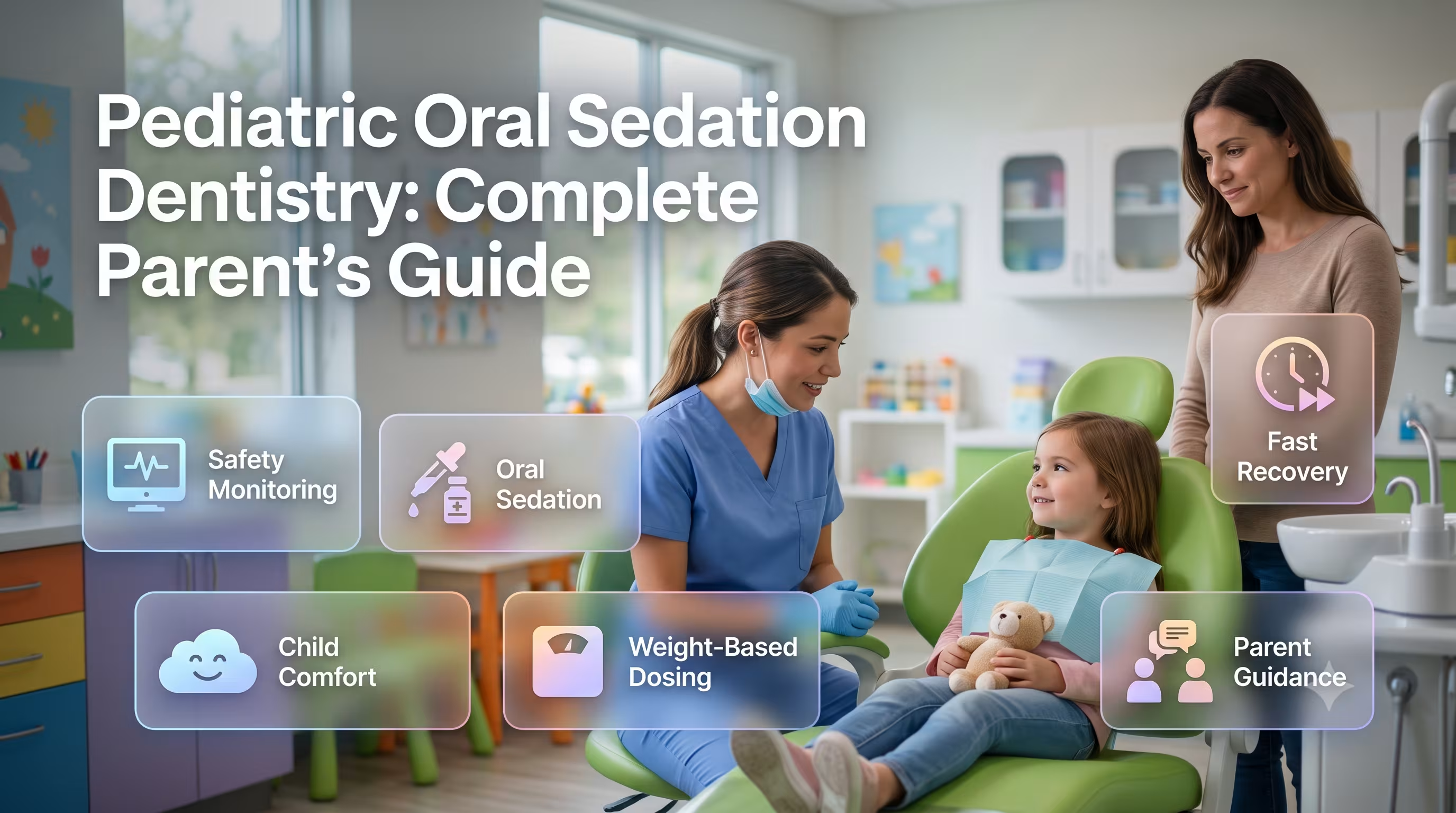
Pediatric oral sedation dentistry uses a liquid or pill medication, usually midazolam, to help anxious or very young children stay calm and cooperative during dental treatment. The child stays awake but relaxed. Dentists follow strict AAPD and AAP monitoring guidelines to keep the process safe from start to recovery.
Key Takeaways
- Oral sedation keeps your child awake, relaxed, and responsive, unlike general anesthesia, which puts a child fully to sleep.
- Midazolam is the most common medication used, and pediatric dentists calculate every dose by your child's exact weight.
- AAPD and AAP guidelines require pulse oximetry and dedicated monitoring staff during any moderate sedation appointment.
- Most children recover within 4 to 6 hours, though some grogginess can last into the next morning.
- Cost typically runs $200 to $600 per visit, depending on the procedure length and your child's weight.
Your child needs dental work, and just the thought of the visit sends them into tears. You are not alone. Many parents search for pediatric oral sedation dentistry after a first appointment ended in a meltdown, or because their child needs several fillings done at once.
Our team at Make Your Kids Smile has walked hundreds of Lafayette families through this exact decision. We know the questions that keep you up at night. Is it safe? What does the medication actually do? What happens if something goes wrong?
This guide answers all of it. You will learn how sedation works, which medications dentists use, what the appointment looks like, and how to prepare your child at home. By the end, you will know whether oral sedation fits your child's needs.
What Is Pediatric Oral Sedation Dentistry?
Pediatric oral sedation dentistry is the use of a swallowed medication to calm a child before and during a dental procedure. Unlike general anesthesia, your child stays conscious. They can breathe on their own, respond to their name, and follow simple directions.
How Oral Sedation Works in Children
The dentist gives your child a liquid or pill roughly 20 to 30 minutes before treatment starts. The medication depresses the central nervous system just enough to reduce fear. Children often become drowsy, relaxed, and less aware of sounds or sensations in the room.
This differs from feeling pain-free. The local anesthetic still numbs the treatment area. Sedation simply lowers anxiety, so your child tolerates the numbing shot and the procedure itself.
Levels of Sedation (Minimal, Moderate) in Pediatric Dentistry
Minimal sedation means your child is relaxed but fully awake and coordinated. Moderate sedation, sometimes called conscious sedation, means your child may slur speech or drift toward sleep, but still responds to touch or voice.
Pediatric dentists choose the level based on your child's age, anxiety, and the treatment planned. Moderate sedation always requires closer monitoring than minimal sedation.
Oral Sedation vs. General Anesthesia for Kids (Quick Overview)
Oral sedation keeps your child breathing independently and responsive to stimulation. General anesthesia removes consciousness entirely and typically requires a hospital or surgical center with an anesthesiologist present.
Most routine pediatric cases only need oral sedation. General anesthesia is reserved for extensive work, very young children, or kids with medical conditions that make sedation risky.
Medications Used for Pediatric Oral Sedation
Pediatric dentists rely on a small group of well-studied medications. Each one has a specific role, and many practices combine two drugs for a stronger, more predictable effect.
Midazolam (Most Common)
Midazolam is a benzodiazepine and the most widely used oral sedative in pediatric dentistry today. It works quickly, wears off within a few hours, and has a strong safety record when dosed correctly (Source: AAPD/AAP Sedation Guidelines).
Many parents notice their child seems giggly or forgets parts of the visit afterward. That memory gap is a normal, expected effect and often helps reduce fear at future appointments.
Chloral Hydrate (Historical/Occasional Use)
Chloral hydrate was once a standard choice for very young children. Newer medications have largely replaced it because of a slower onset and less predictable recovery time.
Some practices still use it in specific cases, often paired with another sedative. Your dentist will explain the reasoning if this medication comes up during your consultation.
Other Sedatives Used in Combination
Hydroxyzine, nitrous oxide, and low-dose combinations are sometimes layered with midazolam. This approach can smooth out the sedation and reduce the total dose of any single drug.
Your child's dentist selects the combination based on age, weight, medical history, and the length of the planned procedure.
Weight-Based Dosing and Safety
Every pediatric sedative is dosed by your child's exact body weight, not by age or a standard adult formula. This is one of the most important safety steps in the entire process.
We never share specific dosing numbers publicly, since the right amount depends on your child's individual health history. Your dentist calculates this privately during the pre-sedation evaluation.
Is Oral Sedation Right for Your Child?
Not every anxious child needs sedation, and not every calm child can skip it. The decision depends on behavior, medical history, and how much treatment is needed.
Signs Your Child May Need Sedation
- Your child cries, gags, or physically fights during routine cleanings
- Multiple cavities require treatment in a single visit
- Previous dental visits ended before treatment finished
- Your child has a strong gag reflex that blocks basic exams
- Sensory sensitivities make sitting still nearly impossible
Dental Anxiety and Behavior Management in Young Children
Pediatric dentists try behavior guidance first. Tell-show-do, distraction, and positive reinforcement work well for many kids. Sedation becomes an option when these techniques cannot get the treatment done safely.
Children With Special Healthcare Needs
Children with autism, ADHD, or sensory processing differences often struggle with the sounds, lights, and touch involved in dental care. Sedation can make treatment possible without added trauma.
Your dentist will ask detailed questions about triggers and communication style so the visit feels as predictable as possible.
Very Young Children or Uncooperative Patients
Toddlers and preschoolers often lack the developmental ability to sit through a procedure, regardless of anxiety level. Sedation lets the dentist complete necessary work safely and efficiently.
When Oral Sedation Is Not Recommended (Contraindications)
Sedation is generally avoided in children with certain airway conditions, uncontrolled seizure disorders, or severe sleep apnea. Some medication allergies also rule out specific sedatives.
A thorough medical history review during your consultation catches these red flags before any medication is ever considered.
Benefits of Oral Sedation for Pediatric Patients
Reduced Fear and Anxiety
The most immediate benefit is a calmer child. Sedation lowers the stress response, so your child experiences less crying, less resistance, and a more comfortable visit overall.
Parents often tell us the change is noticeable within minutes of the medication taking effect. A child who was rigid with fear in the waiting room settles into the chair without a fight.
Easier Completion of Necessary Treatment
A relaxed child holds still longer. This lets the dentist work with more precision and finish treatment that might otherwise require stopping and restarting several times.
Minimizing Traumatic Dental Memories
Midazolam's memory-blunting effect often means your child recalls little of the actual procedure. This can prevent the fear cycle where one bad visit makes every future visit harder.
Fewer Appointments for Extensive Work
Instead of scheduling four short visits for four separate fillings, sedation can let your dentist treat multiple teeth in one sitting. This means fewer missed school days and fewer trips for you.
Risks, Side Effects, and Safety Considerations
No sedation is completely risk-free, and honest pediatric dentists tell you that upfront. Understanding the possible side effects helps you make an informed decision, not a fearful one.
Common Side Effects in Children
Drowsiness, mild nausea, unsteady walking, and a wobbly feeling are the most frequent effects. These typically fade within a few hours as the medication clears your child's system.
Some children also seem unusually silly or emotional right after treatment. This mood shift is temporary and resolves on its own without any special care.
Paradoxical Reactions (Increased Agitation)
A small percentage of children react to sedatives with the opposite effect: increased agitation, crying, or restlessness instead of calm. Trained staff recognize this quickly and adjust their approach.
Rare but Serious Complications
Airway obstruction, slowed breathing, and allergic reactions are rare but serious possibilities. This is exactly why monitoring equipment and trained staff stay in the room throughout treatment.
AAPD Guidelines and Monitoring Standards
The American Academy of Pediatric Dentistry and American Academy of Pediatrics jointly publish detailed sedation guidelines covering evaluation, monitoring, and recovery (Source: AAPD/AAP Guidelines for Monitoring and Management of Pediatric Patients). Every credentialed pediatric sedation dentist follows this framework.
Role of Pulse Oximetry and Vital Sign Monitoring
A pulse oximeter tracks your child's oxygen level and heart rate continuously during moderate sedation. A dedicated staff member watches these numbers the entire time, separate from the dentist performing treatment.
Preparing Your Child for Oral Sedation
Pre-Sedation Medical History and Evaluation
Before scheduling, your dentist reviews your child's full medical history, current medications, allergies, and any prior sedation experiences. This step catches contraindications early and shapes the medication plan.
Eating and Drinking Restrictions Before the Appointment
Your child will need to fast for a set number of hours before the appointment, similar to fasting rules before surgery. Your dentist gives you the exact timing based on your child's age and the sedation depth planned.
Following this instruction closely reduces the risk of vomiting or airway complications during sedation.
What to Tell Your Child Beforehand
Keep the explanation simple and calm. Tell your child the medicine will make them feel sleepy and relaxed, and that you will be nearby the whole time.
Avoid scary words like "shot" or "drill." Young children respond better to gentle, honest language than to surprises.
Parental Consent Requirements
You will sign a detailed consent form explaining the medication, expected effects, and possible risks before treatment begins. Ask questions at this step. A good pediatric sedation dentist welcomes them.
What to Expect During the Appointment
Check-In and Administering the Medication
After check-in, staff confirm your child's weight and review the fasting timeline. The dentist or hygienist then gives the medication and starts a timer, since the onset typically takes 20 to 30 minutes.
Protective Stabilization (Papoose Board) — When It's Used
Protective stabilization, sometimes called a papoose board, is a soft wrap that gently limits movement during treatment. It is used only when needed for safety, and only with parental consent.
This tool protects your child from sudden movements that could cause injury while sharp instruments are near the mouth.
During Treatment: What Parents Can Expect
Most offices ask parents to wait in the reception area once sedation begins, though policies vary. A staff member updates you periodically, and vital signs are checked throughout the entire procedure.
Immediate Recovery in the Office
After treatment ends, your child moves to a quiet recovery area. Staff continues monitoring breathing and alertness until your child meets discharge criteria, meaning they can sit up and respond appropriately.
Recovery After Pediatric Oral Sedation
How Long Does Recovery Take in Children
Most children feel back to normal within 4 to 6 hours. Some grogginess or mood changes can linger into the evening, and occasionally into the next morning.
Parent Supervision at Home (First 24 Hours)
Your child needs direct adult supervision for the rest of the day after sedation. Keep them away from stairs, pools, bikes, and anything requiring balance or quick reflexes.
Eating, Activity, and Sleep After Sedation
Start with clear liquids, then move to soft, easy foods once your child is fully alert. Plan for a quiet day with rest, since extra sleep is common and completely normal.
Warning Signs That Require Immediate Medical Attention
- Difficulty breathing or unusual, noisy breathing
- Bluish tint around the lips or fingernails
- Vomiting that will not stop
- Inability to wake your child fully
- Severe swelling anywhere near the mouth or face
Call your dentist's emergency line or seek immediate medical care if you notice any of these signs.
Pediatric Oral Sedation vs. Other Sedation Options
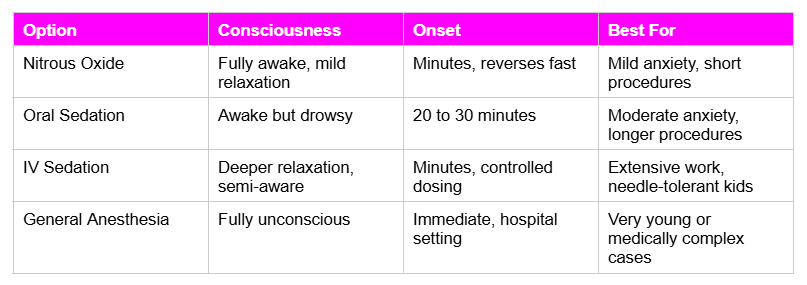
Parents often compare sedation methods before deciding. Here is how the main options stack up against each other.
Oral Sedation vs. Nitrous Oxide for Children
Nitrous oxide, also called laughing gas, wears off within minutes of removing the mask. Oral sedation runs deeper and lasts longer, making it better suited for kids who need more than mild calming.
Oral Sedation vs. IV Sedation
IV sedation allows the dentist to adjust the dose in real time through a vein. Oral sedation cannot be adjusted once swallowed, so dentists rely more heavily on precise weight-based dosing beforehand.
Oral Sedation vs. General Anesthesia
General anesthesia removes consciousness completely and requires specialized equipment, often outside the dental office. Oral sedation keeps your child breathing on their own in a standard dental chair.
Which Option Fits Your Child's Needs?
The right choice depends on your child's anxiety level, medical history, and the amount of treatment needed. Your pediatric dentist will walk through these factors with you during a consultation.
Dental Procedures Commonly Performed With Pediatric Sedation
Cavity Fillings (Multiple/Extensive)
Children with several cavities often need longer chair time than a young patient can tolerate awake. Sedation allows the dentist to complete multiple fillings in one visit safely.
Pulpotomies and Pulpectomies (Baby Root Canals)
These procedures treat decay that has reached the nerve of a primary tooth. They take longer and require more precision than a routine filling, which often makes sedation helpful.
Tooth Extractions
Removing a severely decayed or injured tooth can be stressful for a young child. Sedation keeps the child calm through the pressure and sounds involved in an extraction.
Crowns on Primary Teeth
Placing a stainless steel or zirconia crown on a baby tooth involves several steps and more time in the chair than most children can manage without support.
Full-Mouth Rehabilitation in Young Children
Some children, especially those with early childhood caries, need treatment across most or all of their teeth. This scale of work is one of the most common reasons dentists recommend sedation or general anesthesia.
Cost of Pediatric Oral Sedation Dentistry
Pricing varies by practice and region, but most families should expect an additional charge on top of the treatment itself. Understanding what drives the cost helps you plan ahead.
Factors That Affect the Cost
The main cost drivers include your child's weight, the length of the procedure, the monitoring equipment used, and whether a second trained staff member is required for observation.
Insurance Coverage for Pediatric Sedation
Some dental insurance plans cover sedation when a documented medical or behavioral need exists. Coverage varies widely, so calling your insurer before the appointment is worth the extra step.
Ask your plan specifically about sedation codes tied to your child's procedure. Our front desk team can also help you understand your benefits before treatment begins.
Payment and Financing Options
Many pediatric dental offices, including ours, offer payment plans or financing partners for families facing an unexpected sedation cost. Ask our team about current options during your consultation.
Choosing a Pediatric Sedation Dentist
Pediatric Sedation Training and Credentials
Look for a dentist with specific pediatric sedation training beyond general dental school, along with current certification in pediatric emergency response and airway management.
Emergency Preparedness and Equipment
A well-prepared office keeps reversal medications, oxygen, and resuscitation equipment on hand at every sedation appointment, even though emergencies are rare.
Experience With Sedating Young Children
Ask how many pediatric sedation cases the dentist handles each month. Frequent, hands-on experience with young patients builds the judgment needed to catch problems early.
Questions to Ask Before Scheduling
- What medication do you recommend for my child, and why?
- Who monitors vital signs during the procedure?
- What is your emergency protocol if a complication happens?
- How do you calculate dosing for my child's weight?
- What should I expect during recovery at home?
Finding a Pediatric Sedation Dentist Near You
Our team at Make Your Kids Smile provides pediatric oral sedation dentistry for families across Lafayette. We would be glad to answer your questions during a consultation visit.
Conclusion
Pediatric oral sedation dentistry gives anxious or very young children a calmer, more manageable path through necessary dental work. It sits between no sedation and general anesthesia, keeping your child conscious while easing fear enough for the dentist to work safely and thoroughly.
Every step, from the pre-sedation evaluation to weight-based dosing to pulse oximetry monitoring, follows AAPD and AAP safety standards designed specifically for children. Side effects are usually mild, and serious complications remain rare when a trained pediatric team handles the process.
At Make Your Kids Smile, we have guided countless nervous families through this exact decision, and we treat every child like our own. If your son or daughter dreads the dentist's chair, we invite you to schedule a consultation so we can talk through the right option together.
Frequently Asked Questions
Is oral sedation safe for young children?
Yes, when a trained pediatric dentist follows AAPD and AAP monitoring guidelines. Dosing is calculated by weight, and vital signs are watched throughout the entire appointment.
How long does oral sedation last in kids?
Most children feel normal again within 4 to 6 hours. Mild grogginess can sometimes linger into the evening or the next morning.
Will my child remember the dental visit?
Midazolam often causes partial memory loss of the procedure. Many children recall little or nothing about the actual treatment afterward.
Can I stay with my child during sedation?
Policies vary by office. Many practices ask parents to wait nearby while staff monitors the child directly during treatment.
What is the difference between oral sedation and general anesthesia?
Oral sedation keeps your child breathing independently and responsive to touch. General anesthesia removes consciousness completely and requires specialized equipment.
How much does pediatric oral sedation cost?
Typical costs range from $200 to $600 per visit, depending on your child's weight, procedure length, and required monitoring.
.jpg)
.jpg)


