.png)
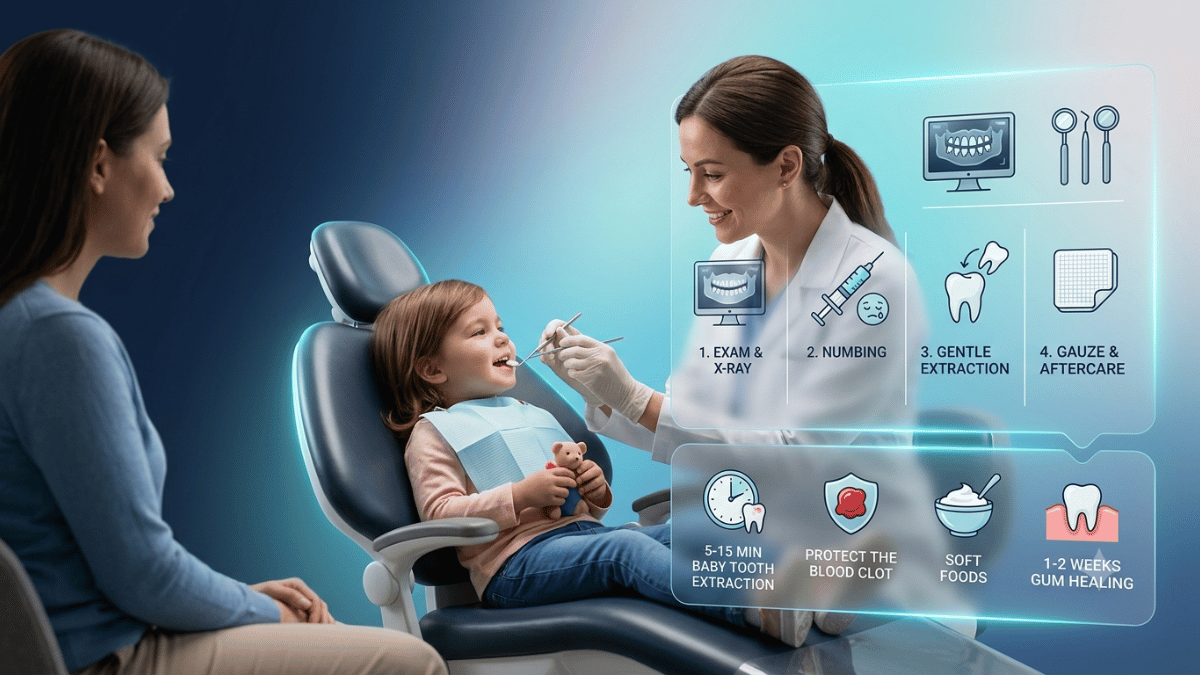
Extractions of primary and permanent teeth remove a tooth that decay, infection, injury, or crowding has made impossible to save. In children, the procedure usually takes 5 to 20 minutes under local anesthesia, and most kids feel normal again within two days. Baby tooth removals sometimes need a space maintainer afterward to protect the permanent tooth underneath.
KEY TAKEAWAYS
- Most baby tooth removals take 5 to 15 minutes of chair time, while the full visit usually runs 30 to 45 minutes.
- Numbing gel goes on before the injection, so most children feel pressure and a cold pinch rather than sharp pain.
- Protecting the blood clot matters more than anything else on day one, which means no straws, no spitting, and no vigorous rinsing.
- A missing second primary molar is the space most likely to close, so ask whether a space maintainer belongs in your child's plan.
- Permanent first molar removals are usually timed around ages 8 to 10, when the second molar can still drift forward on its own.
Hearing that your child needs a tooth pulled can feel worse than the toothache that started it. You picture the chair, the noise, and a scared kid who trusts you completely. Most parents walk in bracing for a fight and walk out surprised, because a planned extraction in a calm office looks almost nothing like the version they imagined. The tooth comes out, your child gets a sticker, and the hard part turns out to be the next 24 hours at home.
Pediatric extractions follow a different rulebook than adult ones, since a child's jaw is still growing and every baby tooth is holding a place for something else. That is why timing, root shape, and what happens to the empty space matter as much as the removal itself. Having done thousands of these, I can tell you the anxiety usually comes from not knowing the sequence.
This guide walks through the whole thing in order: why a tooth gets recommended for removal, and what the exam and X-rays show. You will see how we keep your child comfortable, and what the procedure feels like. You will also see exactly what to do at home afterward. You will also find timing tables, warning signs worth a same-day call, and answers on cost, insurance, and space maintainers.
When a Child's Tooth Needs to Come Out
Removal is almost never the first idea on the table. When a tooth reaches the point where filling, crowning, or pulp therapy will not hold, taking it out protects everything around it. That includes the permanent tooth waiting underneath.
What a Tooth Extraction Actually Involves
Tooth extraction: the complete removal of a tooth from its socket, roots and all. The tooth sits in bone, held by a thin ligament. The work is less about pulling and more about widening that ligament space until the tooth releases on its own.
We numb the area first, then use a small instrument called an elevator to rock the tooth gently until the fibers let go. Forceps lift it out. Your child feels firm pressure and hears some sound, but the nerve is already asleep, so the sharp sensation people dread never arrives. The whole active part often finishes before a short cartoon episode would.
How Baby Tooth and Permanent Tooth Extractions Differ in Children
Baby teeth have thin, splayed roots that are usually dissolving already, which makes most primary extractions quick and uncomplicated. Permanent teeth sit deeper, hold denser bone around them, and carry roots that may still be forming, so the approach changes.
The bigger difference is what comes next. A baby tooth has a built-in replacement, while a permanent tooth does not, so removing one always involves a plan for the gap. Because of that, permanent extractions in children are usually scheduled with an orthodontist's input rather than decided in a single visit.
Why We Try to Save the Tooth First
Natural teeth guide jaw growth, hold space, and help children chew and speak clearly, so keeping one is almost always better than replacing it. Fillings, stainless steel crowns, pulpotomies, and pulpectomies each buy real time when the tooth structure can still support them.
Saving a tooth stops making sense once infection reaches the bone, or when so little tooth remains that a crown has nothing to grip. A restoration that fails within months helps no one. Understanding those tipping points makes the specific reasons below much easier to follow.
Reasons a Child May Need an Extraction
Five situations account for nearly every pediatric extraction we schedule. Knowing which one applies to your child tells you a lot about how the appointment will go and what follow-up care to expect.
Decay, Infection, and Abscess
Deep decay remains the leading reason children lose teeth early. According to the CDC, roughly 1 in 5 children aged 5 to 11 has at least one untreated decayed tooth. Because the enamel layer is thinner, tooth decay in baby teeth spreads faster than it does in adult teeth.
Once bacteria reach the pulp, a small pimple on the gum, called a parulis, may appear, which signals an abscess draining underneath. At that stage, the infection sits close to the developing permanent tooth, so removing the source protects the tooth your child has not grown yet.
Injury and Fractured Teeth
Playground falls, bike spills, and elbows during sports send more children to our office than any other emergency. Front baby teeth take most of the damage. When a tooth fractures below the gumline, or loosens so far that the ligament cannot recover, removal is safer than watching it fail slowly.
I once saw a four-year-old whose front tooth looked fine after a scooter fall, though it turned gray over the following month. The X-ray showed the nerve had died, so we removed it and her permanent tooth arrived on schedule two years later, perfectly normal.
Baby Teeth That Won't Fall Out on Their Own
Sometimes the permanent tooth erupts behind, or in front of a baby tooth that refuses to loosen, a pattern parents often call shark teeth. If the baby tooth has no wiggle after several weeks, or the new tooth is drifting off course, a quick extraction clears the path it needs.
Crowding, Serial Extraction, and Orthodontic Reasons
When the jaw is too small for the teeth arriving, an orthodontist may plan a serial extraction sequence. Selected baby teeth come out in a set order, so the permanent ones erupt straighter. Later, premolars are sometimes removed to create the room braces need.
These extractions are elective and planned months ahead, which makes them the calmest visits we do. Nothing hurts beforehand, so children arrive without fear attached to the tooth.
Severely Weakened Permanent Molars (Enamel Defects and Deep Decay)
Some permanent first molars come in with soft, chalky, discolored enamel, a condition called molar incisor hypomineralization. Research suggests it affects roughly 13% of children worldwide, and affected molars crumble under normal chewing and struggle to hold fillings.
When one of these molars is beyond repair, timed removal can be the better long-term choice, because the second molar may drift forward and take its place naturally. Timing drives that outcome, which is why we involve an orthodontist before scheduling anything.
Treatments We Consider Before Recommending Extraction
Before we suggest removal, we work through the conservative options in this order:
- Fluoride or silver diamine fluoride to arrest early decay that has not reached the pulp.
- A filling when enough healthy tooth structure remains to hold it.
- A stainless steel crown for a molar with extensive decay but a healthy nerve.
- A pulpotomy when the infection sits in the top of the pulp only, keeping the roots intact.
- A pulpectomy when the whole nerve is involved but the tooth can still be saved and crowned.
- Antibiotics plus a follow-up when active swelling needs to settle before any treatment.
Extraction enters the conversation only when the list above runs out, or when a failing restoration would put your child through repeat visits for no lasting gain.
Primary vs. Permanent Extraction Reasons Compared
The two situations look similar in the chair, though the reasoning behind them differs in ways worth seeing side by side.
Once the reason is clear, preparation becomes the part you can actually control.
Getting Ready for the Appointment
What happens in the days before the visit shapes how your child behaves in the chair far more than anything we do on the day itself.
The Exam and What X-Rays Reveal
A visual exam shows the damage above the gum, though the useful information hides below it. X-rays reveal root length and curvature, how close the roots sit to the developing permanent tooth, whether infection has reached the bone, and how much root has already dissolved.
That last detail matters, because a baby tooth with two thirds of its root gone lifts out easily. One with full roots wrapped around a permanent tooth needs a slower approach. We also check whether the permanent tooth is close enough to erupt soon, since that decides the space question later.
Health History and Medications to Tell Us About
Please tell us about heart conditions, bleeding disorders, immune conditions, diabetes, asthma, seizure history, and any recent illness. Also list every medication and supplement, including over-the-counter ones, because blood thinners, some seizure medications, and even fish oil can affect clotting.
Allergies matter twice over, since they influence both the anesthetic we choose and the pain reliever we recommend afterward. If your child has needed premedication before dental work in the past, mention it when you book rather than on the day.
How to Talk to Your Child Beforehand (and Words to Avoid)
Children read your tone before they process your words, so a matter-of-fact explanation the day before works better than a long build-up. Keep it short, honest, and free of anything that plants an image of pain.
Skip these words entirely:
- Shot, needle, or pinch, since children picture the worst version of each.
- Pull, yank, or drill, which suggest force rather than the gentle wiggling that actually happens.
- Hurt, pain, or brave, because promising it will not hurt teaches them to expect that it might.
- It's no big deal, which dismisses a worry rather than answering it.
Try this instead: the dentist will put your tooth to sleep, wiggle it out, and then it will feel better. If your child asks a direct question, answer it plainly and stop there, because volunteering extra detail usually creates new fears.
What to Do the Morning of the Appointment
For an appointment with local anesthesia or nitrous oxide, feed your child a normal light meal, since an empty stomach makes kids shaky and irritable. Brush teeth as usual, bring a comfort item, and dress them in short sleeves in case we need to check vitals.
Oral sedation follows different rules, and we will give you exact fasting instructions when we schedule it. Plan on one parent handling the visit and the rest of the day staying quiet at home. Comfort, though, is where most parent questions land next.
Keeping Your Child Comfortable
Comfort is not one setting we apply to every child. We match the support to your child's age, temperament, and the complexity of the tooth coming out.
Local Anesthesia and How Numbing Feels to a Child
Local anesthesia numbs the nerve serving one tooth and the tissue around it, so the area feels asleep while your child stays fully awake. We start with a flavored topical gel on the gum, wait for it to work, then deliver the anesthetic slowly, because speed is what makes injections uncomfortable.
Most children describe cold, pressure, and a fat lip feeling. That heavy, puffy sensation lasts one to three hours depending on which area we numbed, and it bothers kids more than the procedure did. Warning them ahead of time that their lip will feel funny prevents a lot of afternoon panic.
When Nitrous Oxide or Oral Sedation Is Recommended
Nitrous oxide, the sweet air children breathe through a small nose mask, takes the edge off anxiety while leaving them awake and responsive. It wears off within minutes of removing the mask, so your child can usually return to school the same day.
Oral sedation suits younger children, those with several teeth to remove, or kids whose anxiety makes treatment unsafe to attempt otherwise. The American Academy of Pediatric Dentistry publishes monitoring guidelines for both, and we follow them closely, which is why sedation visits include extra recovery time. You can review the full range of comfort options on our extractions of primary and permanent teeth page.
How We Decide What Level of Comfort Support Your Child Needs
We weigh four things: your child's age and ability to cooperate, how many teeth are involved, whether infection is present, and how previous dental visits went. A calm eight-year-old having one loose baby molar removed rarely needs more than local anesthesia and a distraction.
A frightened four-year-old needing two extractions is a different conversation, and we would rather plan sedation upfront than push through a visit that leaves lasting fear. Complexity, however, sometimes points beyond our office entirely.
Simple Extractions and When a Referral Is Needed
Extractions fall into two categories, and knowing which one your child needs explains both the appointment length and who performs it.
What Makes an Extraction Simple
A simple extraction involves a tooth fully visible above the gumline with roots we can access directly. No incision, no bone removal, and usually no stitches. The vast majority of baby tooth removals and orthodontic premolar extractions fall here, and we handle them in our office.
What Makes an Extraction Surgical
A surgical extraction becomes necessary when the tooth has broken at the gumline, sits impacted under bone, or has roots that curve so sharply they will not release intact. These cases need a small gum flap, careful bone contouring, and stitches afterward.
Why Root Shape and Bone Density Change the Approach in Children
Children's bone is more elastic than adult bone, which usually works in our favor because sockets expand rather than fracture. Root shape complicates things instead, particularly with second primary molars whose roots often wrap around the permanent premolar developing between them.
When an X-ray shows that pattern, we plan for a sectioned removal, splitting the tooth so each root comes out on its own path without disturbing the tooth below. Recognizing that situation before we start is exactly why we take the X-ray.
How We Coordinate Care With an Oral Surgeon
If a case belongs in a surgical setting, we say so directly and send the X-rays, the treatment plan, and our notes ahead of your consultation, so nothing gets repeated. We stay involved afterward for follow-up and space management, which keeps your child's overall plan in one place.
What Happens During the Procedure
Here is the actual sequence, start to finish, so nothing in the room comes as a surprise.
Numbing the Area
Topical gel goes on first and sits for a minute or two while we talk your child through what happens next. We then deliver the anesthetic slowly, and most children report the taste bothers them more than the sensation does.
We wait until the area is genuinely numb before touching the tooth, testing it first so your child confirms the tooth feels asleep. That pause is not wasted time, since starting early is what turns a routine visit into a difficult memory.
Loosening and Lifting the Tooth Out
An elevator instrument rocks the tooth back and forth, gradually stretching the ligament fibers holding it in place. Once the tooth moves freely, forceps lift it straight out along the path of least resistance.
Your child feels steady pressure and hears a creaking sound through the jawbone, which is normal and not a sign of anything breaking. We usually keep a hand resting on the jaw for support, and children often describe it afterward as pushing rather than pain.
Stitches and When They're Used
Simple extractions rarely need stitches, since a firm gauze bite closes the site well enough for a clot to form. We place them after surgical removals, when a gum flap needs to be repositioned, or when a child on certain medications needs extra clotting help.
The sutures we use dissolve on their own within about a week, so no return trip is needed just to remove them.
How Long Each Type of Extraction Takes
Chair time and total visit length are different numbers, and the second one is what you should plan your day around.
Which tooth is coming out changes more than the clock, though, as the next section shows.
What to Expect Tooth by Tooth
Parents usually want to know about one specific tooth, so this table covers the six we remove most often in children, including what tends to surprise families afterward.
Whichever tooth comes out, the first day at home follows the same rules.
The First 24 Hours After an Extraction
This is the window where parents make the biggest difference, and almost every complication we see traces back to something that happened here.
Gauze, Bleeding, and Protecting the Blood Clot
Have your child bite firmly on the gauze for 30 to 45 minutes without peeking, because lifting it early restarts the bleeding you are trying to stop. Light oozing that tints saliva pink can continue for a few hours, which is normal.
The blood clot that forms in the socket is the healing itself, so protecting it is the whole job on day one. That means no straws, no spitting, no rinsing, and no poking at the site with a tongue or finger. If bleeding restarts, a moistened black tea bag bitten for 20 minutes often works better than fresh gauze, since the tannins encourage clotting.
Preventing Lip and Cheek Biting While Your Child Is Numb
Numb tissue feels swollen and interesting, and young children chew it without realizing, which can leave a painful ulcer that hurts far longer than the extraction did. Keep your child in sight for the first two hours and remind them frequently rather than once.
Soft, cool foods that need no chewing help, and so does a simple game of checking their lip in a mirror every so often. Once sensation returns fully, the risk disappears.
Managing Soreness and Swelling
Give the first dose of children's ibuprofen or acetaminophen before the numbness wears off, dosed by weight according to the label or our written instructions. Comfort should stay ahead of the pain. Alternating the two is sometimes recommended, though only if we tell you to.
A cold pack on the cheek for 15 minutes on and 15 minutes off reduces swelling during the first day. Never give aspirin to a child, since it carries a risk of Reye's syndrome and also thins the blood.
What Your Child Can Eat and Drink
Cool and soft wins for the first day: yogurt, applesauce, smoothies eaten with a spoon, mashed potatoes, scrambled eggs, and lukewarm soup. Hydration matters more than calories, so do not worry if appetite dips.
Avoid anything crunchy, sharp, spicy, or very hot, along with popcorn, chips, and nuts, which lodge in the socket. Skip carbonated drinks and straws entirely for 24 hours, because suction is what dislodges clots.
Activity, Rest, and Going Back to School
A quiet afternoon at home is enough after a simple extraction with local anesthesia, and many children return to school the next morning. After sedation, plan on the full day at home with an adult watching.
Hold off on running, sports, and swimming for 24 to 48 hours, since a raised heart rate can restart bleeding. A stray elbow is the last thing a healing socket needs. After that first day, the focus shifts to healing.
Healing and Aftercare Beyond Day One
Recovery after a pediatric extraction is usually faster than parents expect, though the tissue and bone follow their own separate timelines.
How Long the Site Takes to Heal
The gum tissue closes over the socket within one to two weeks, while the bone underneath continues filling in for several months without your child noticing. Most soreness fades by day three, and children are eating normally well before the site looks fully closed.
A whitish or yellowish film over the socket during the first week is granulation tissue, which is healthy healing rather than infection. Food debris settling in the socket is common too, and gentle rinsing after day one clears it.
Brushing and Flossing Around the Extraction Site
Resume brushing the rest of the mouth normally that same evening, avoiding only the socket itself. Starting 24 hours after the extraction, have your child rinse gently with warm salt water, about half a teaspoon in a cup of water, after meals and before bed.
Gentle is the operative word, since forceful swishing works exactly like a straw. Return to brushing the area lightly after about three days, and flossing the neighboring teeth once it is comfortable.
When to Come Back for a Follow-Up
Simple single extractions often need no separate follow-up, and we check the site at the next routine visit. We do schedule a recheck within one to two weeks after surgical removals, extractions involving infection, or any case where a space maintainer is planned.
What to Expect as the Permanent Tooth Comes In
When a baby tooth is removed close to its natural exfoliation date, the permanent tooth often appears within months. Early removals are different, because the gum tissue over the socket toughens and the permanent tooth may take longer to break through than its partner on the other side.
A difference of six months between matching teeth is usually nothing to worry about. Wondering whether something has gone wrong is natural, and that is exactly what the warning signs below are for.
Warning Signs Parents Should Watch For
Complications after children's extractions are uncommon, though a few situations deserve a phone call rather than a wait-and-see approach.
Infection at the Extraction Site
Watch for a fever above 100.4°F starting a day or more after the procedure, along with increasing swelling, a bad taste or smell, or pus at the site. Pain that improves for two days and then returns is another classic pattern worth reporting.
Bleeding That Doesn't Slow Down
Oozing for several hours is expected, while steady bright red bleeding that soaks through fresh gauze after an hour of firm pressure is not. Call us before trying more home remedies, especially if your child has any bleeding condition.
Dry Socket and Why It's Uncommon in Children
Dry socket happens when the blood clot is lost before the site heals, exposing the bone underneath. It is rare in children, since younger tissue heals quickly and kids do not smoke, which is a leading adult risk factor.
The telltale sign is severe pain starting around day three, often radiating toward the ear, and it does not respond well to over-the-counter medicine. If that describes what you are seeing, call us, because the fix is quick and brings relief the same day.
Pain or Swelling That Gets Worse Instead of Better
Discomfort should trend downward each day after the first. Swelling that increases after 48 hours, spreads toward the eye or neck, or comes with difficulty swallowing needs same-day attention rather than a morning appointment.
When to Call Us Right Away
Contact the office immediately if your child has any of the following:
- Fever above 100.4°F that begins a day or more after the extraction.
- Swelling that spreads toward the eye, jawline, or neck.
- Trouble swallowing, breathing, or opening the mouth more than slightly.
- Bleeding that will not slow after an hour of firm, continuous gauze pressure.
- Severe pain around day three that medicine barely touches.
- A rash, hives, or vomiting following any prescribed medication.
Once healing is on track, attention turns to the space the tooth left behind.
What Happens to the Space Afterward
An empty space is not neutral territory, because teeth move toward any opening they find, and in children that movement happens faster than most parents expect.
Why an Empty Baby Tooth Space Can Cause Problems Later
Baby teeth act as placeholders, keeping the path clear for the permanent tooth developing below. When one is removed years before its natural exit, neighboring teeth tip and drift into the gap. That drifting can block the permanent tooth or push it sideways.
The result shows up later as crowding, an impacted tooth, or orthodontic treatment that costs far more than prevention would have. Have you ever wondered why one child needs braces, and a sibling with similar teeth does not? Early tooth loss without space management is often part of that story.
When a Space Maintainer Is Recommended and When It Isn't
A space maintainer is a small custom appliance that holds the gap open until the permanent tooth arrives. We recommend one when a molar comes out well before the permanent tooth is ready, particularly a second primary molar, which sits next to the space most prone to closing.
We skip it when the permanent tooth is close to erupting, or when the missing tooth is a front baby tooth held in place by the canines. Planned orthodontic treatment also changes the answer. Ask us directly which category your child falls into, since the answer changes the follow-up schedule entirely.
How Permanent Tooth Spaces Are Handled Differently
A permanent tooth has no replacement waiting, so the space is either closed deliberately with braces or aligners, or held open for a future restoration once jaw growth finishes. Premolar extractions for crowding are planned around closure from the start.
First molar cases depend heavily on timing, which is why an orthodontic evaluation comes before the extraction rather than after it. Cost, understandably, is the next question most families ask.
Cost and Insurance for Children's Extractions
Costs vary widely by case, and any office quoting a single number before seeing an X-ray is guessing.
What Affects the Cost of an Extraction
Several factors drive the final figure:
- Simple versus surgical removal, as surgical cases involve more time and materials.
- How many teeth are being removed in one visit, since multiples usually cost less per tooth.
- Comfort options chosen, because nitrous oxide and oral sedation are billed separately.
- X-rays and the exam, which are typically separate line items from the extraction itself.
- A space maintainer, if one is needed, along with the appointments to fit and check it.
We give families a written estimate before treatment, so the number you see is the number you plan around.
How Dental Insurance Typically Covers Extractions for Children
Most dental plans classify extractions as basic or oral surgery services rather than preventive care, which usually means coverage after a deductible rather than at 100%. Coverage levels differ by plan, so we verify your specific benefits before treatment and tell you what remains.
Louisiana Medicaid and LaCHIP cover medically necessary extractions for eligible children, and space maintainers are often covered when documentation supports the need. Bring your card, and our team handles the paperwork on your behalf.
Frequently Asked Questions About Children's Tooth Extractions
Does a tooth extraction hurt a child?
The extraction itself should not hurt, because local anesthesia numbs the nerve completely before we begin. Children feel pressure and hear sound, not sharp pain. Mild soreness follows once numbness fades, and it usually responds well to children's ibuprofen for a day or two.
How long does it take for a child's gum to heal after a tooth extraction?
Gum tissue closes over the socket within one to two weeks, while the bone underneath fills in over several months. Most children stop feeling soreness by day three and eat normally within a week. Saltwater rinses starting 24 hours after the procedure support faster, cleaner healing.
What can my child eat after a tooth extraction?
Stick to cool, soft foods for the first day: yogurt, applesauce, mashed potatoes, scrambled eggs, and smoothies eaten with a spoon. Avoid straws, carbonated drinks, and anything crunchy, spicy, or hot. Most children return to a normal diet within two to three days.
Does my child need a space maintainer after a baby tooth is pulled?
It depends on which tooth came out and how soon the permanent one is due. Second primary molars almost always need one, since that space closes fastest. Front baby teeth usually do not, because the canines hold the arch. We decide using the X-ray.
Can a permanent tooth be extracted from a child?
Yes, most often a premolar for orthodontic crowding or a first molar damaged by severe decay or an enamel defect. Permanent extractions are planned with an orthodontist, since timing determines whether nearby teeth drift in naturally or the space needs closing with braces.
How do I prepare my anxious child for a tooth extraction?
Explain it simply the day before using calm words like sleepy tooth and wiggle, and avoid needle, pull, or hurt entirely. Bring a comfort item, schedule a morning appointment, and stay relaxed yourself. Tell us about the anxiety when booking so we can plan nitrous oxide.
Pediatric Tooth Extractions in Lafayette, LA
Families across Lafayette and the surrounding parishes bring us everything from a knocked-loose front tooth after a Saturday soccer game to a planned series of orthodontic extractions. Our pediatric dental care in Lafayette is built around children rather than adapted for them.
.jpg)
.jpg)